Contents:
NP | Quantifiers | Logical Structure of NP |
Contents:
NP | Quantifiers | Logical Structure of NP |Keywords - L322.2 S99
Intermediate Syntax
Week 2
Contents:
NP | Quantifiers | Logical Structure of NP |
 Week 2: The Logical Structure of the Noun Phrase--Part
1.
Week 2: The Logical Structure of the Noun Phrase--Part
1.
- Object
- Thing
- Container
- Ruler
- Part-Whole
- Description of
- Features
- Inherent
- Category
- N, V, A, P, Q, D, C, and so forth
- Count/Mass
- [±Ct]
- Gender
- [±Gender-Specific] ([±GS])
- [±Fem]
- Number [±Pl] in certain nouns:
- If [-Ct]
- number is inherent
- police, cattle: ([+Pl]);
- news: ([-Pl]));
- [-Ct] (mass) = [-Pl].
- If [+Ct]
- Acquired
- Number [±Pl]
- Case [±Nom]
- Case [±Nom]
- Acquired in all nouns
- Lexical entries
- [+Ct]
DOG
Lexical Item
dog
orthographic form
+
Count
POLICE
Lexical Item
police
orthographic form
-
Count
WATER
Lexical Item
water
orthographic form
-
Count
- Expanded Lexical Entry: phonological form, category, [±Plural], [±GS] (Gender-Specific), [±Nom]
BOOK N
category
book
orthographic form
/bËk/
phonological form
+
Count
Plural
-
GS
Case
POLICE
lexical item
N
category
police
orthographic form
/p-lîs/
phonological form
-
Count
+
Plural
-
GS
Case
WATER
Lexical Item
N
category
water
orthographic form
/wátr/
phonological form
-
Count
-
Plural
-
GS
Case
[THING], [CONTAINER], [RULER], [RELATION], [PART OF], [DESCRIPTION OF]
(1)
BOOK N
category
book
orthographic form
/bËk/
phonological form
+
Count
-
GS
Plural
Case
The new slot is category, and here it is N. Therefore, in the above tree structure, N is selected and assigned to [THING].
- Normally a phrase is named after the head of the phrase:
- VP -> V NP
- NP -> N PP
- AP ->A AP
- PP -> P NP
- Therefore:
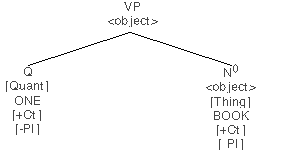
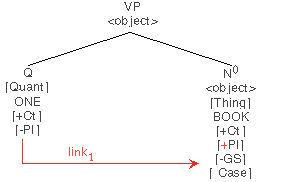
(2)
- Normally, such a phrase is called NP.(2)
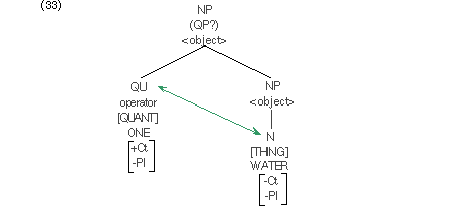
- Q is seen as a modifier
- Q is an operator
- As such it is an operator
- book is its argument -- its complement.
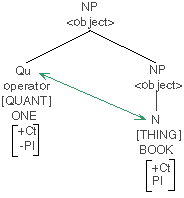
- Why is it called an NP'?
- Because the phrase (*QP) occurs within the project of an object: <object> in (2).
- <object> is always a noun, N.
- The projection is of N, not of Q
- Hence NP:
(3)
Lexical Entry--one more slot:
Arguments assigned and the theta roles assigned to them:
CUP lexical item N category cup orthographic form /k-p/ phonological form + Count Plural - GS Case <theme> arguments and associate theta roles <object> logico-semantic feature (major) [Container] Semantic Feature (minor) [Concrete] selectional restriction
- Government
- C-command
- Restricted to single case
- governor
- governee
(4)
(5)
No agreement (non-matching of features)
Determiners and 'a', 'one', and [null].
- the is [+Def]
- 'a' is forma quantifier that must agree with the determiner in definiteness: [a book]
- Same holds for 'one'.: one book.
- 'one' is emphatic,a' is not.
- The singular quantifier is [NULL] in 'the book.
- All of these are formally ONE.
- lexical entry for 'a', 'one,' the base form
Base form for ONE:
ONE lexical item Qu catgegory <theme?> arguments and associated theta roles + Count - Plural - Definite "1" semantic form The base for ONE is linked to lexical items which have the orthographic and phonological information:
lexical entry for 'a'
ONE lexical item a orthographic form /´/ (schwa) phonological form <theme?> arguments and associated theta roles + Count - Plural - Definite orthographic form for '[NULL]" = 1:
ONE lexical item [NULL] orthographic form / [NULL]/ phonological form <theme?> arguments and associated theta roles + Count - Plural + Definite Two more feature slots: selectional restrictions, semantic features.
CUP lexical item cup orthographic form /k-p/ phonological form <theme> arguments and associate theta roles + count number - GS Case [Concrete] selectional restriction [CONTAINER] Semantic Feature (major)