(updated for Fall, 2005)
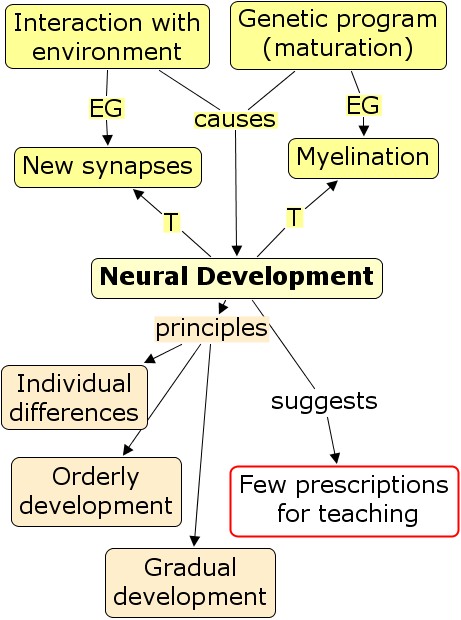
| Stage | Approximate Age | Characteristics |
|---|---|---|
| Sensorimotor | 0 to 2 years | Develops object permanence |
| Preoperational | 2 to 7 years | Develops symbolic thinking and language but shows high egocentrism |
| Concrete-operational | 7 to 11 years | Shows concrete, logical problem solving with reversibility (e.g., conservation) and decentring |
| Formal-operational | 11 to adult | Shows abstract, logical problem solving |

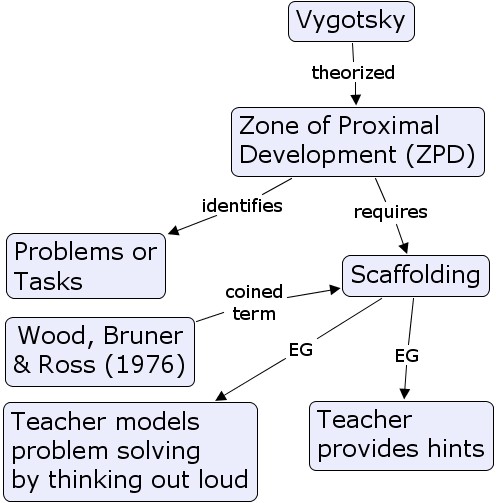
There are many types of scaffolding:
* regulating task difficulty
* procedural facilitators
* partially solved problems
* teacher or peer assistance
"We shape our buildings and thereafter our buildings shape us."
-- Winston Churchill
"We become what we behold. We shape our tools, and thereafter our tools shape us."
-- Marshall McLuhan

* By grade one, children can pronounce most sounds of first language.
* In elementary school, vocabulary grows by 15 to 20 words per day!
* Aspects of language (pronounciation, vocabulary, grammar, pragmatics) are learned more by hearing, observing and using language than through direct instruction.
"Viewing by children of programming aimed at a general or adult audience is correlated with poor language development in pre-schoolers." (Close, 2004. p. 4)
"Evidence suggests that children who are frequently exposed to such programmes tend to have a lower vocabulary, poorer expressive language and to engage in less TV-talk (i.e. talking about television) with adults. This is attributable to both the quality of the content on offer and the quantity of exposure to television more generally." (Close, 2004. p. 4)
Close, R. (2004). Television and language development in the early years: A review of the literature. Retrieved September 13, 2004 from http://www.literacytrust.org.uk/Research/TV.html
Example of Research in Reading and Literacy Development
Armand, F., Lefrancois, P. Baron, A., Gomez, M.-C., & Nuckle, S. (2004). Improving reading and writing learning in underprivileged pluri-ethnic settings. British Journal of Educational Psychology, 74, 437-459.
Research Questions
Does phonological awareness instruction improve reading and writing in low SES grade one students speaking French as a second language?
Does active story listening instruction improve reading and writing?
Which is more beneficial on reading and writing, phonological awareness instruction or active story listening instruction?
Background Theory
* Evidence that reading stories in the classroom to "at-risk" primary students increases number of books read during free time, word decoding, and comprehension.
* Explicit teaching of story structure and narrative elements increases story comprehension.
* Phonological awareness is the conscious awareness of words' sound elements such as syllables, rhymes, alliteration, consonants, vowels, and accents.
* Active story listening consists of activities such as predicting story content from the title and pictures, and then from time to time interrupting a reading to predict what will happen next, imagine scenes, and discuss the structure of the story.
Method
* Nine, first grade classes (202 students) were divided into a control group, a phonological awareness (PA) group, and an active story listening (ASL) group.
* PA group received direct instruction in phonological awareness.
* ASL group received active story listening instruction and worked in groups to produce their own stories.
* Control group did the regular reading program (word recognition practice, reading books from library, etc.)
* All groups were given phonological awareness and reading tests before treatment.
* All groups were given phonological awareness, word recognition, comprehension and spelling tests after treatment.
Results
* PA group did better than other two on the phonological awareness test.
* PA group did better than the control group on the word recognition test.
* No significant difference on the text comprehension test.
* PA group did better than other two on the spelling test.
Implications
* Phonological awareness training is effective for low-SES, multi-ethnic, grade one students learning to read and write in French.