Doreen Kimura
Visiting Professor
Department of Psychology
Simon Fraser University

Updated for fall, 2005
| Adults (over 20) with postsecondary education | 50% |
| Adults with university degree | 18% |
| Adults without high school diploma | 17% |
| Families with income less than $20,000 | 12% |
| Adults receiving income assistance | 3% |
| Children receiving income assistance | 4% |
| Teen pregnancies (women 15-17) | 2% |
| Abused children (per 1000) | 7 |
This article from the Vancouver Courier reports that Sir William MacDonald elementary school in East Vancouver obtained the lowest ranking in the annual Fraser Institute report card on schools. It describes challenges facing the staff, parents and children of this low SES school.

According to a study conducted by the BC Ministry of Education (McBride & McKee, 2001), Aboriginal children have a much greater risk of being identified with severe behaviour disorders (3.5%) than non-aboriginal children (0.8%).
Children are identified with severe behaviour disorders (SBD) on evidence of aggression, violence, ADHD, drug abuse, psychosis, sexually inappropriate behavior, bullying, fire-setting, and other behavior.
The study interviewed school district personnel and Aboriginal community leaders to better understand the reasons why First Nations children are at greater risk, and how schools can respond to reduce that risk.
|
WHY IS THERE OVER-REPRESENTATION OF ABORIGINAL STUDENTS IN SBD?
Responses across districts were highly consistent. Most common responses included:
|
|
-- Quoted from BC Ministry of Education Report (McBride & McKee, 2001, p. 41) |
The study concluded with recommendations to reduce the risk to aboriginal children:
|
The most significant finding is that those districts that most closely adhere to what is described in the literature as good educational practice are also those districts that appear to have the most success in the education of Aboriginal learners and the lowest rate of behavioural problems. They tend to:
|
| -- Quoted from BC Ministry of Education Report (McBride & McKee, 2001, p. 61) |
|
Doreen Kimura |
|
Cognitive differences between males and females have been reliably measured on verbal, spatial, memory and psychomotor tasks.
According to Kimura (1999), males tend to outperform females on spatial orientation, visualization, line orientation, mathematical reasoning, and throwing accuracy.

Tests used in Kimura's research
Kimura has found that females tend to outperform males on object location memory, perceptual speed, verbal memory, numerical calculation, and dexterity.

Hypothesis: Prenatal hormones affect the developing brain to produce the differing patterns of cognitive ability (Kimura, 2002; 1999; 1992).
Counterpoint:The differences noted by Kimura are due to the social environment (Hyde, 2004; 2000; Hyde & Kling, 2001): |
|
|
|
Janet S. Hyde |
 |
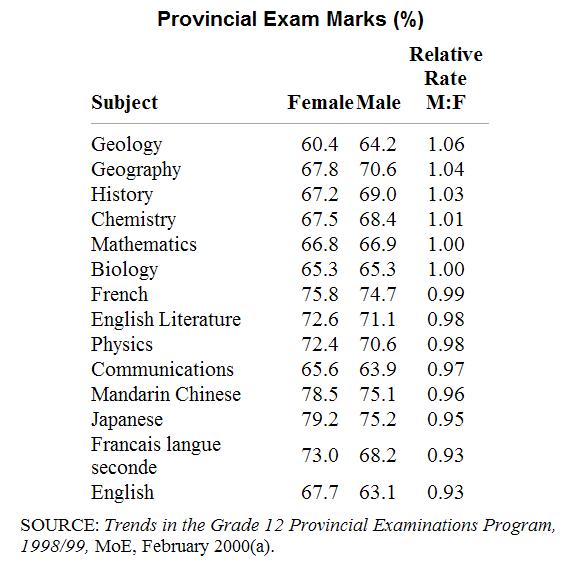
In all academic subjects, female students attain higher average school grades at graduation. The provincial exam scores, shown here for 1998-1999, give a somewhat different picture.
Female participation in computer technology courses has declined markedly in university level programs.
More than half the worlds population is bilingual. What are the effects of bilingualism on cognition and learning?
|
Ellen Bialystok |
 |
Hypothesis: Continual management of two or more languages strengthens cognitive attentional control functions (Bialystok, 2001).
Hypothesis: Bilingualism enhances childrens' metalinguistic development (Vygotsky, 1962).
|
According to a recent study, bilingualism changes the anatomy of the brain. People that speak two languages have more "grey matter" in the language area of the brain. |
|
-- from Reuters, October 13, 2004 |
|
"The early American literature on bilingualism pointed to its negative consequences.... Most of the studies administered IQ tests to immigrant students, and found the bilingual children to have lower scores than native English monolinguals....Critics of this work pointed out that many of these students were probably not bilingual at all, and were handicapped in taking the test because they were not proficient in English. More recent research that has selected subjects carefully, such as choosing only balanced bilinguals, have shown advantages for bilinguals on a variety of verbal and non-verbal tasks.... In general, negative findings tend to appear when bilingualism is a characteristic of low social status, and thus it is more properly understood through sociological rather than psychological analysis." |
||
|
-- Kenji Hakuta (2000) |
A possible but unproven disadvantage for children growing up in some bilingual environments is insufficient language input in either language to develop high levels of competence in either language. This hypothesis is difficult to evaluate because bilingualism is often confounded by SES and other non-linguistic factors.

Bialystok, E. (2001). Bilingualism in development: Language, literacy, and cognition. New York: Cambridge University Press.
Bialystok , E. (1999). Cognitive complexity and attentional control in the bilingual mind. Child Development, 70, 636-644 .
Bialystok, E., Craik, F. I. M., Klein, R., & Viswanathan, M. (2004). Bilingualism, aging, and cognitive control: Evidence from the simon task. Psychology and Aging, 19, 290–303.
Bialystok, E., Majumder, S., & Martin, M. M. (2003). Developing phonological awareness: Is there a bilingual advantage? Applied Psycholinguistics, 24, 27-44.
Hakuta, K. (2000). Bilingualism. In A. E. Kazdin (Ed.) Encyclopedia of Psychology. Oxford: Oxford University Press.
Kimura, D. (2002). Sex hormones influence human cognitive pattern. Neuroendocrinology Letters, 23, 67–77.
Kimura, D. (1999). Sex and Cognition. Cambridge, MA: MIT Press.
Kimura, D. (1992) Sex differences in the brain. Scientific American, 267(3), 118-125.
Hyde, J. S. (2000). Sex and Cognition - Review. Journal of Sex Research
Hyde, J. S. (2004). Half the human experience: The psychology of women. Boston, MA: Houghton-Mifflin.
Hyde, J. S., & Kling, K. C. (2001). Women, motivation, and achievement.Psychology of Women Quarterly, 25, 364-378.
McBride, S. R., & McKee, W. (2001). Overrepresentation of aboriginal children reported with behavioral disorders. Report to the British Columbia Ministry of Education. Retrieved October 6, 2004 from http://www.bced.gov.bc.ca/abed/abed_over.pdf
Vygotsky, L. S. (1962). Thought and language. Cambridge, MA: MIT Press.