


Assignment 2 Solutions
 be the average reaction time for experienced swimmers.
(I remark that this is probably one of the many times when the sample
is not randomly drawn from some population and therefore the
confidence methodology is not appropriate; what set of experienced
swimmers is being talked about? If the answer is that this set of 16 is
a random sample from a large group then
be the average reaction time for experienced swimmers.
(I remark that this is probably one of the many times when the sample
is not randomly drawn from some population and therefore the
confidence methodology is not appropriate; what set of experienced
swimmers is being talked about? If the answer is that this set of 16 is
a random sample from a large group then  is the average for that
large group. If the answer is, as I suspect, that this is just a
convenient
group of 16 swimmers who happened to be available then I do not quite
see what
is the average for that
large group. If the answer is, as I suspect, that this is just a
convenient
group of 16 swimmers who happened to be available then I do not quite
see what  is. I will set this aside to do the arithmetic but
I would be unhappy about doing this calculation for a client.) Assuming
that the population of reaction times for experienced swimmers has
a normal distribution then the confidence interval is
is. I will set this aside to do the arithmetic but
I would be unhappy about doing this calculation for a client.) Assuming
that the population of reaction times for experienced swimmers has
a normal distribution then the confidence interval is

I did not talk about this in class so all you could really do is look for obvious outliers or asymmetry. I see no sign of any problem.
 and
and  . The t multiplier
on 15 degrees of freedom is 2.13 so the interval is
. The t multiplier
on 15 degrees of freedom is 2.13 so the interval is
 .
.
 be the mean soil heat flux for
plots
covered with coal dust. The null hypothesis is that
be the mean soil heat flux for
plots
covered with coal dust. The null hypothesis is that  and
the alternative is
and
the alternative is  (you are asked about increasing the mean
flux). The sample mean is 30.7875 and
(you are asked about increasing the mean
flux). The sample mean is 30.7875 and  leading to
  and
and  % (I used a package to get P) so that the the null hypothesis
is not rejected. If you had switched the role of the hypotheses you would
have concluded that the the hypothesis
% (I used a package to get P) so that the the null hypothesis
is not rejected. If you had switched the role of the hypotheses you would
have concluded that the the hypothesis  cannot be rejected
either -- the data are just not very conclusive.
cannot be rejected
either -- the data are just not very conclusive.
 denote the average
flame time for strips of this sort of nightwear, we should test
denote the average
flame time for strips of this sort of nightwear, we should test
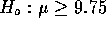 against
 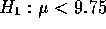 . When you do the
arithmetic however, the sample mean is 9.75 + ( the average of the list
10, 18, 0, 2, -8, 12, -8, 19, 10, 0, 18, 17, 24, 13, 20, 20, 18, 17,
14)/100 which comes to 9.8525. This is well over 9.75 so if you test the
null I just suggested you would simply not reject it (and this would
mean not permitting the use of this nightwear). On the other hand the
hypothesis that
. When you do the
arithmetic however, the sample mean is 9.75 + ( the average of the list
10, 18, 0, 2, -8, 12, -8, 19, 10, 0, 18, 17, 24, 13, 20, 20, 18, 17,
14)/100 which comes to 9.8525. This is well over 9.75 so if you test the
null I just suggested you would simply not reject it (and this would
mean not permitting the use of this nightwear). On the other hand the
hypothesis that  results in a t statistic of
4.75 and a P value that is very small so this hypothesis is not tenable.
Thus in this case the evidence is clear that the standard is not met.
It is clear that the second hypothesis is the one the book expected you to
test but also seems clear that the process of making the more serious
error be the type I error leads to the other hypothesis, namely,
results in a t statistic of
4.75 and a P value that is very small so this hypothesis is not tenable.
Thus in this case the evidence is clear that the standard is not met.
It is clear that the second hypothesis is the one the book expected you to
test but also seems clear that the process of making the more serious
error be the type I error leads to the other hypothesis, namely,
 being the null. The required assumption is that the
population of measured flame times have a normal distribution. The point
of my arithmetic short cut is that
being the null. The required assumption is that the
population of measured flame times have a normal distribution. The point
of my arithmetic short cut is that 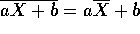 and that the SD of the numbers aX+b is |a| times the SD of the X's.
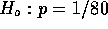 and the alternative is that
  . The relevant
test statistic is
. The relevant
test statistic is

where  . Thus
  ,
,  and the test
rejects at the 20% level but not at the 5% level. In part a) the
type of error you might be making is type II, incorrectly accepting the
null (because you do accept the null in a).
and the test
rejects at the 20% level but not at the 5% level. In part a) the
type of error you might be making is type II, incorrectly accepting the
null (because you do accept the null in a).
 . But hypothesis testing
measures against an assertion so you have to make the assertion you want
evidence for the alternative and thus the assertion you want evidence
against the null. Thus we get
. But hypothesis testing
measures against an assertion so you have to make the assertion you want
evidence for the alternative and thus the assertion you want evidence
against the null. Thus we get  or
or  and
and  . The resulting test statistic is

which leads to a P-value of 9.18% which I would describe as some,
weak, evidence against the null hypothesis and in favour of the assertion
that  .
.
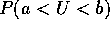 where
where  ,
,
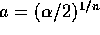 and
and 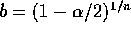 . The definition
of density means that this is
. The definition
of density means that this is

Now solve  to get
  and similarly for a.
 then
then  and if
  then
then  . The probability
of this event is just as in a) but with the limits a and b changed
to
. The probability
of this event is just as in a) but with the limits a and b changed
to  and 1 so the probability is
  and the
interval runs from Y to
and the
interval runs from Y to  .
.
 which
is shorter in the case of b) (For instance in the example with
which
is shorter in the case of b) (For instance in the example with  and n = 5 we find the interval in a) has length 4.56 while that
in b has length 3.45.) For the data in hand
and n = 5 we find the interval in a) has length 4.56 while that
in b has length 3.45.) For the data in hand  , and
the limits in b) are 4.2 to 7.65.
, and
the limits in b) are 4.2 to 7.65.
I remark that this model assumes that the buses always run exactly  minutes apart and the writer arrives at a ``random time'' --- not very realistic.