


STAT 330 Lecture 12
Reading for Today's Lecture: 6.1, 6.2
Goals of Today's Lecture:
Today's notes
Data:  (or more general is possible).
Model: A family  of possible
densities for the data or a family
of possible
densities for the data or a family  of
possible cumulative distribution functions for the data.
of
possible cumulative distribution functions for the data.
Example:
Model: independent and each  has density

where  is a vector of two parameters.
(Other examples might be iid with density
 for x>0 or iid Poisson
  or
or  .)
.)
Point estimate:

is a ``statistic'' (meaning function of the data) which is a guess for
 .
.
Examples:  ,
,  ,
,  , etc.
Principles of Estimation
The quality of  is measured by averaging over all
possible data sets not just by looking at the actual data set you have.
The resulting measure of quality usually depends on the true value
of .
is measured by averaging over all
possible data sets not just by looking at the actual data set you have.
The resulting measure of quality usually depends on the true value
of .
[Aside: I have just stated the frequentist philosophy; another, increasingly popular view, is that of the Bayesian statistician - see STAT 460.]
First idea:  should be small. So some have
suggested averaging the quantity , that is
computing
should be small. So some have
suggested averaging the quantity , that is
computing

Definition: is unbiased if  for all , that is,

Examples:
A: . Then

B:  .
.

Now use the following property of variance:

and rearrange it to get

.
We use this both for  and for
  to get

and

Put these all together to get
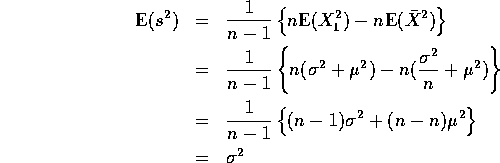
so that  is an unbiased estimate of
  .
.
WARNING:  because:

or

But  so
so

and, taking square roots,

More examples: 
 and
and  are all unbiased estimates of the obvious parameters.
Criticism of unbiasedness:
Large negative errors can be balanced out by large positive errors.
Definition: The Mean Squared Error (abbreviated to MSE) of
is

There is a close relation between the MSE, the variance and the bias.
To show it use the temporary notation  . Then
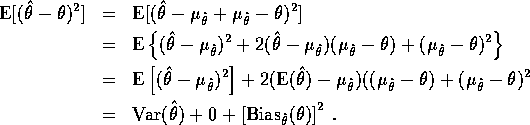
So: a good estimate has small bias and small variance. In practice there is a trade-off, to get one small you have to make the other big.
Finding (good) Point Estimates
Method of Moments
Basic strategy: set sample moments equal to population moments and solve for the parameters.
Definition: The  sample moment (about the origin)
is
sample moment (about the origin)
is

The population moment is

(Central moments are

and
