


STAT 330 Lecture 14
Reading for Today's Lecture: 6.2, 8.1, 8.2
Goals of Today's Lecture:
 the probability of a Type II error.
Today's notes
Two general methods to develop estimators:
 . Need 1 equation for each component of .
 to be the value of
which maximizes
to be the value of
which maximizes

This is easier to understand for discrete data.
General framework for MLEs:
If  are independent and
 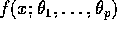 is
the probability mass function for an individual
is
the probability mass function for an individual  and if
we actually observe
and if
we actually observe  then the likelihood
function is
then the likelihood
function is

Example: independent Poisson  rvs. So

The likelihood is

It is easier to maximize the logarithm of this:

To do the maximization set the derivative with respect to  equal to 0.
Get
equal to 0.
Get

from which we get

so that  is the mle (maximum likelihood estimate) of .
Extension to Continuous Distributions:
If are independent and  is
the probability density of an individual (so that the X's are continuous
rvs) then we can interpret the density as follows. Let
is
the probability density of an individual (so that the X's are continuous
rvs) then we can interpret the density as follows. Let  denote a small
positive number. Then
denote a small
positive number. Then

(The equation is the definition of density and the approximation is the meaning of integration over very small intervals -- it expresses the idea that integration is the opposite of differentiation.)
This prompts us to define

and

The MLE of  maximizes the Likelihood or equivalently
the log likelihood.
maximizes the Likelihood or equivalently
the log likelihood.
Example: a sample from  population.


We need to set  and
and
 to find estimates of
  and of
  .
.
We find:

and

Set to get

so that  . Then put this solution in the second equation to get

which produces the solution

Notice that in the denominator there is an n and not n-1. The MLE
is not quite the usual estimate of  .
.
Property of MLE
Suppose a different statistician used  where
where  as the parameters? What would
  and
and  be? The log likelihood is now

When you take the derivatives and set them equal to 0 the equation is unchanged and . The derivative with respect to  gives
the estimate (I leave you to do the algebra)
gives
the estimate (I leave you to do the algebra)

so that  . This is a general principle. If

is a transformation (for some function like say  or any other function) of the parameters then the mles satisfy

Power, , Sample Size
Definition: the power function of a hypothesis test procedure is

Recall: Type I error is incorrect rejection. Type 2 error is incorrect acceptance.
Definition: The level of a test is the largest probability of rejection for
in the null hypothesis:

Typically if the null hypothesis is like  the value of
  is actually
  , that is, the edge of the null hypothesis gives the
highest risk of incorrect rejection.
, that is, the edge of the null hypothesis gives the
highest risk of incorrect rejection.
Definition: The probability of a type two error is a function  defined for
  by
by

Thus
for not in the Null:
