STAT 330 Lecture 16
Reading for Today's Lecture: 8.1, 8.2, 8.3, 9.1, 9.2, 9.4: focus on power and sample size calculations.
Goals of Today's Lecture:
Today's notes
Sample Size Calculations
Set

and solve for n. You need to specify:

 .
.
Our example had  and
and  .
So
.
So

which happens if

which we solve to get

or

In our example
 |  | |
 |  | |
 |  |  |
so that

We round up to n=20 to get the type II error rate to be definitely under 10%.
CRITICISM: the catalyst may very well have changed  and
will normally be unknown.
and
will normally be unknown.
You would then use the equation

Notice that n shows up in two places in the formula.
Problem: Solution depends not on the alternative  but really on
 and you need to specify a value for this quantity
which is harder to interpret than
and you need to specify a value for this quantity
which is harder to interpret than  usually. You then look up
 versus n in the graph in Appendix A.13. The solution is generally
bigger than the formula above for the same value of d.
versus n in the graph in Appendix A.13. The solution is generally
bigger than the formula above for the same value of d.
A two sample example


(A calculation of this sort might have been made ahead of the 1954 Salk polio vaccine trials.)
WARNING: Polio is a contagious disease (though not terribly so) and so the independence between people is in grave doubt.
Sample size determination requires the following ingredients:
 ,
,  .
.
We take and  and try various values of
in the range of 30 to 50 per 100,000 and in the range of
1 to 40 per 100,000 but in any case with
and try various values of
in the range of 30 to 50 per 100,000 and in the range of
1 to 40 per 100,000 but in any case with  .
.
We use the usual test statistic with n=m, namely,

We make the approximation that the value of  will be roughly
 and then compute

So to find n set

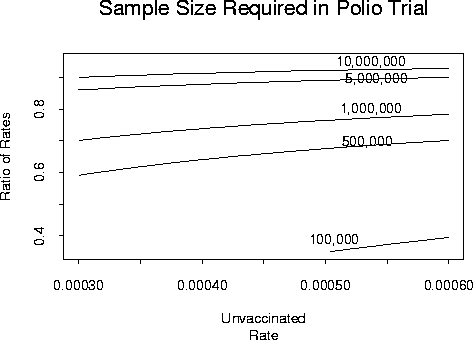
and solve for n. This can be done. Here is a contour plot of the results. The contours
indicate combinations of and which require the sample size indicated
on the line. Notice that the sample sizes are VERY large.