


STAT 350: Lecture 33
Theory of Generalized Linear Models
If Y has a Poisson distribution with parameter  then
then

for k a non-negative integer. We can use the method of
maximum likelihood to estimate k if we have a sample
 of independent Poisson random variables all
with mean . If we observe
of independent Poisson random variables all
with mean . If we observe  ,
,  and so
on then the likelihood function is
and so
on then the likelihood function is

This function of can be maximized by maximizing its
logarithm, the log likelihood function. We set the derivative of the
log likelihood with respect to equal to 0, getting

This is the likelihood equation and its solution  is the maximum likelihood estimate of .
In a regression problem all the  will have different means
 . Our log-likelihood is now

If we treat all n of the we can maximize the log
likelihood by setting each of the n partial derivatives with
respect to  for k from 1 to n equal to 0.
The kth of these n equations is just
for k from 1 to n equal to 0.
The kth of these n equations is just

This leads to  . In glm jargon this model is the
saturated model.
. In glm jargon this model is the
saturated model.
A more useful model is one in which there are fewer parameters but more than 1. A typical glm model is

where the  are covariate values for the ith observation
(often including an intercept term just as in standard linear
regression).
are covariate values for the ith observation
(often including an intercept term just as in standard linear
regression).
In this case the log-likelihood is

which should be treated as a function of  and maximized.
The derivative of this log-likelihood with respect to  is
is

If has p components then setting these p derivatives
equal to 0 gives the likelihood equations.
It is no longer possible to solve the likelihood equations
analytically. We have, instead, to settle for numerical techniques.
One common technique is called iteratively re-weighted least
squares. For a Poisson variable with mean the variance
is  . Ignore for a moment the fact that if we
knew
. Ignore for a moment the fact that if we
knew  we would know and consider fitting our
model by least squares with the
we would know and consider fitting our
model by least squares with the  known. We would
minimize (see our discussion of weighted least squares)
known. We would
minimize (see our discussion of weighted least squares)

by taking the derivative with respect to and (again
ignoring the fact that depends on we
would get

But the derivative of with respect to is
 and replacing by we get the
equation
and replacing by we get the
equation

exactly as before. This motivates the following estimation scheme.
(taking them all equal to 1 is simple). .
. .
Go back to do weighted least squares with these weights.
.
Go back to do weighted least squares with these weights.
Non-linear least squares
In a regression model of the form

we call the model linear if  for some covariates
and a parameter . Often, however, we have non-linear
models such as
for some covariates
and a parameter . Often, however, we have non-linear
models such as  or in general
 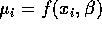 for some function f which need not
be linear in . If the errors are
homo-scedastic normal errors then the maximum likelihood estimates of
the
for some function f which need not
be linear in . If the errors are
homo-scedastic normal errors then the maximum likelihood estimates of
the  are least squares estimates, minimizing
 . The value then solves

This equation can usually not be solved analytically. In general the process of solving it numerically is iterative. One approach is:
 .
. around
by doing a Taylor expansion. This involves writing
around
by doing a Taylor expansion. This involves writing

where is the vector of partial derivatives of with respect to
the entries in .
in the sum of squares by this approximation and get that you
are trying to minimize

with respect to .
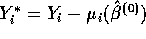 on
on  . Let
. Let  be the
  matrix with ith row
 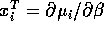 where the
derivative is evaluated at . Then we are to minimize
where the
derivative is evaluated at . Then we are to minimize

where  . The solution is
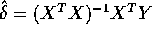 . We compute this
  .
.
to 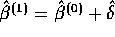 .
. , get a
new
, get a
new  then a
  and so on.
Example
In thermoluminescence dating ( see Lecture 1) a common model is

Thus in this case

The derivatives of with respect to the entries of are


and

Software and computing details
In SAS the procedure proc nlin will do non-linear least squares.
You need to specify quite a few ingredients. The model statement must
specify the exact functional form of the function . You have a
statement parms which is needed to specify the initial guess for .
You usually will have a bunch of der statements to specify derivatives of
the predicted values with respect to each parameter and, if you use some algorithms,
you will even specify some second derivatives. (You get a choice of 5 different
iterative algorithms. The one described above is called Gauss-Newton.)
In Splus the function nls can be used to to the same thing.