 design matrix.
Let
design matrix.
Let  be the
  row of X (so that,
  is a column vector
or dimension p). Let
is a column vector
or dimension p). Let  be the design matrix with case i
deleted and
be the design matrix with case i
deleted and  the vector of n-1 responses with case i
deleted.
the vector of n-1 responses with case i
deleted.
- Use partitioned matrices to show

Write
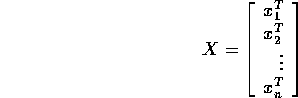
and
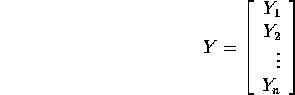
Then
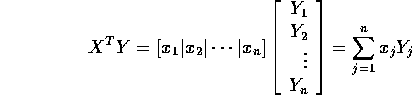
Since
and simply omit the ith rows we see
- Show

We have
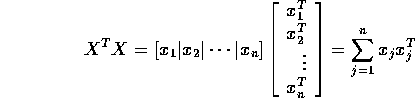
Again omitting the ith term we find
- Suppose B is an invertible symmetric
 matrix
and v is a column vector of dimension p. Show, by direct
multiplication, that
matrix
and v is a column vector of dimension p. Show, by direct
multiplication, that  is of the form

and give a formula for the scalar r.
Simply multiply

The trick most students missed is that in the last term the quantity
 is a scalar, that is, just a single number
(check that it is a
is a scalar, that is, just a single number
(check that it is a  matrix). It may help to give it a
name like s to see that the last term is
matrix). It may help to give it a
name like s to see that the last term is

Thus

which is the identity matrix if

Solving gives
 . Many students
got a formula like
. Many students
got a formula like

which is a
matrix not a scalar. - Apply to previous part to show

and give a formula for
 in terms of the leverage
 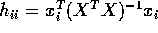 .
.
Put
 and
and  . You get

and

- Show
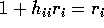 .
.
We have

- Show that

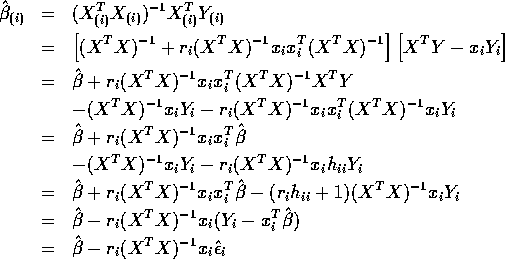
- Deduce that
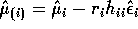 .
.
Multiply
 by to get

- Show that the PRESS residual
 is given by


- Derive the formula for the
externally studentized (case deleted) residual.
The variance of the PRESS residual is
 .
The externally studentized residual is the PRESS residual divided
by an estimate of its standard error where
.
The externally studentized residual is the PRESS residual divided
by an estimate of its standard error where  is
estimated by
is
estimated by  . Thus the externally studentized residual
is
. Thus the externally studentized residual
is

To get the simplest formula we must actually simplify
.
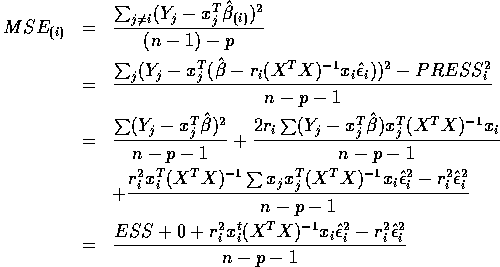
The middle term vanishes because

Use
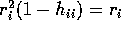 to get

and then you can deduce the final formula given in class.
Here is code for all the methods and with all subsets done both
using  and using adjusted
  .
.
data nit;
  infile 'nit.dat' ;
  input nitexc weight dryin wetin nitin ;
proc reg  data=nit;
   model nitexc = weight dryin wetin nitin /selection=FORWARD;
run ;
proc reg  data=nit;
   model nitexc = weight dryin wetin nitin /selection=BACKWARD;
run ;
proc reg  data=nit;
   model nitexc = weight dryin wetin nitin /selection=STEPWISE;
run ;
proc reg  data=nit;
   model nitexc = weight dryin wetin nitin /selection=CP;
run ;
proc reg  data=nit;
   model nitexc = weight dryin wetin nitin /selection=ADJRSQ;
run ;
The conclusion of the
output
is that BACKWARD and STEPWISE settle
for the model containing only Nitrogen Intake as a predictor. The
forward selection method also includes Wet Intake because of the very high
level of  (0.5) to enter. The all subsets method using
would settle on the model using only nitrogen intake but the adjusted
method also includes Wet Intake. However, overall there seems
little reason to include Wet Intake since it improves the fit very
little and is not very significant at all.
(0.5) to enter. The all subsets method using
would settle on the model using only nitrogen intake but the adjusted
method also includes Wet Intake. However, overall there seems
little reason to include Wet Intake since it improves the fit very
little and is not very significant at all.
Here is code for the analysis of variance.
options pagesize=60 linesize=80;
data electron;
 infile 'anova.dat' firstobs=2;
 input Time Sex Sequence Exper Replic;
proc glm  data=electron;
 class Sex Sequence Exper ;
 model time = Sex|Sequence|Exper ;
 means sex sequence exper sex*sequence*exper;
 estimate 'sexdif' sex 1 -1;
 estimate 'seq12dif' sequence 1 -1 0;
 estimate 'seq13dif' sequence 1 0 -1;
 estimate 'seq23dif' sequence 0 1 -1;
 estimate 'expdif' exper 1 -1;
 output out=anovres r=resid;
proc rank data=anovres normal=blom out=ressc;
 var resid;
 ranks nscores;
proc corr data=ressc;
 var resid nscores;
run;
COMMENTS
- You use the class statement to let SAS know that the factors are categorical.
- The model statement requests that all two way and the three way interaction terms be fitted.
- The means statement computes means and standard deviations for the groups defined by the levels of sex, of sequence, of exper and of all the 3 way combinations.
- The estimate statements compute the differences in means between the two sexes, between the 1st and second sequence, the first and third sequence and between the two levels of experience. This hinges on the use of a balanced design.
- The proc rank statements compute approximations to the expected values of normal order statistics needed for the correlation test in 23.12b.
- The correlation is actually computed by proc corr.
You can read the type III sums of squares table to do F tests without doing multiple runs because each effect has a sum of squares which is unaffected by the presence of the others. The conclusion is that the three way interaction is insignificant and all three two way interactions are insignificant. All three main effects are significant; none can be eliminated.
In the question on Bonferroni confidence intervals the 5 quantities to be estimated are each estimated by a difference of two averages so that the variance of the estimated difference is of the form

You work out standard t type confidence intervals by estimating
the means as usual (see the means statment) and replacing
by the MSE in the formula for the variance. The
Bonferroni method just replaces the of 0.01 by
 for 5 confidence intervals. The t critical
value is
for 5 confidence intervals. The t critical
value is 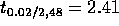 . For the sex difference for instance the
average time for men is 1155.933 seconds while for women it is 966.1333.
The difference is 189.8 and this is computed by the means statement whose
output is
. For the sex difference for instance the
average time for men is 1155.933 seconds while for women it is 966.1333.
The difference is 189.8 and this is computed by the means statement whose
output is
                         T for H0:    Pr > |T|   Std Error of
Parameter   Estimate    Parameter=0                Estimate
sexdif    189.800000          25.10     0.0001     7.56325180
seq12dif  -57.250000          -6.18     0.0001     9.26305385
seq13dif    6.600000           0.71     0.4796     9.26305385
seq23dif   63.850000           6.89     0.0001     9.26305385
expdif    159.666667          21.11     0.0001     7.56325180
Notice the standard errors. The mean squared error in the model is 858.06. There
are 30 men and 30 women so the variance of the difference between men's average
and women's average is 858.06(1/30+1/30) = 57.204. The standard error of the estimate
of  is then
 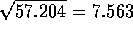 as in the
output. The desired confidence intervals are all and estimate from the column
labelled Estimate plus or minus 2.41 times a standard error from the last column.
as in the
output. The desired confidence intervals are all and estimate from the column
labelled Estimate plus or minus 2.41 times a standard error from the last column.
The needed mean for  is produced by means. The key point is that
the standard error to attach to the mean is
is produced by means. The key point is that
the standard error to attach to the mean is  which is based
on 48 degrees of freedom, not on 4.
which is based
on 48 degrees of freedom, not on 4.
For this question I used the SAS code
data knees;
  infile 'knees.dat' firstobs=2;
  input Days Fitness Patient Age ;
proc glm  data=knees;
  class Fitness ;
  model Days = Fitness|Age ;
proc glm  data=knees;
  class Fitness ;
  model Days = Fitness Age ;
  output out=anovres r=resid p=fitted;
proc rank data=anovres normal=blom out=ressc;
  var resid;
  ranks nscores;
proc corr data=ressc;
  var resid nscores;
proc print data=ressc;
  var fitted fitness age resid nscores;
run;
getting the output ( complete output )
                        General Linear Models Procedure
Dependent Variable: DAYS
                           Sum of            Mean
Source        DF          Squares          Square   F Value     Pr > F
Model          5     1082.0560870     216.4112174    655.36     0.0001
Error         18        5.9439130       0.3302174
Correctd Totl 23     1088.0000000
        R-Square             C.V.        Root MSE            DAYS Mean
        0.994537         1.795767       0.5746454            32.000000
Source        DF      Type III SS     Mean Square   F Value     Pr > F
FITNESS        2       5.44989183      2.72494592      8.25     0.0029
AGE            1     369.44147783    369.44147783   1118.78     0.0001
AGE*FITNESS    2       0.22183487      0.11091744      0.34     0.7191

                        General Linear Models Procedure
Dependent Variable: DAYS
                           Sum of            Mean
Source        DF          Squares          Square   F Value     Pr > F
Model          3     1081.8342521     360.6114174   1169.72     0.0001
Error         20        6.1657479       0.3082874
Correctd Totl 23     1088.0000000
        R-Square             C.V.        Root MSE            DAYS Mean
        0.994333         1.735114       0.5552363            32.000000
Source        DF      Type III SS     Mean Square   F Value     Pr > F
FITNESS        2     246.08370505    123.04185252    399.11     0.0001
AGE            1     409.83425209    409.83425209   1329.39     0.0001

                              Correlation Analysis
                    Pearson Correlation Coefficients

                                RESID
                 NSCORES      0.99488

           OBS     FITTED    FITNESS     AGE      RESID      NSCORES

             1    28.7930       1       18.3     0.20697     0.26136
             2    42.4503       1       30.0    -0.45028    -0.87524
             3    38.3648       1       26.5    -0.36478    -0.60318
             4    40.2324       1       28.1    -0.23244    -0.48332
             5    42.1001       1       29.7     0.89991     1.94690
             6    39.8822       1       27.8     0.11775     0.05171
             7    30.5440       1       19.8    -0.54396    -1.03865
             8    41.6332       1       29.3     0.36682     0.73241
             9    29.8639       2       20.8     0.13613     0.15568
            10    34.9999       2       25.2     0.00007    -0.05171
            11    39.6691       2       29.2    -0.66907    -1.23590
            12    28.9300       2       20.0    -0.93004    -1.49843
            13    30.6810       2       21.5     0.31903     0.60318
            14    31.3813       2       22.1    -0.38134    -0.73241
            15    28.5799       2       19.7     0.42015     0.87524
            16    34.4163       2       24.7     0.58372     1.03865
            17    29.1635       2       20.2    -0.16349    -0.26136
            18    32.3152       2       22.9     0.68483     1.23590
            19    25.2062       3       22.7     0.79380     1.49843
            20    32.2099       3       28.7    -0.20991    -0.37006
            21    20.7705       3       18.9     0.22949     0.37006
            22    19.7199       3       18.0     0.28005     0.48332
            23    24.0389       3       21.7    -1.03891    -1.94690
            24    22.0545       3       20.0    -0.05452    -0.15568
For part a of 25.11 the residuals are printed out above. For part b the plots desired are:
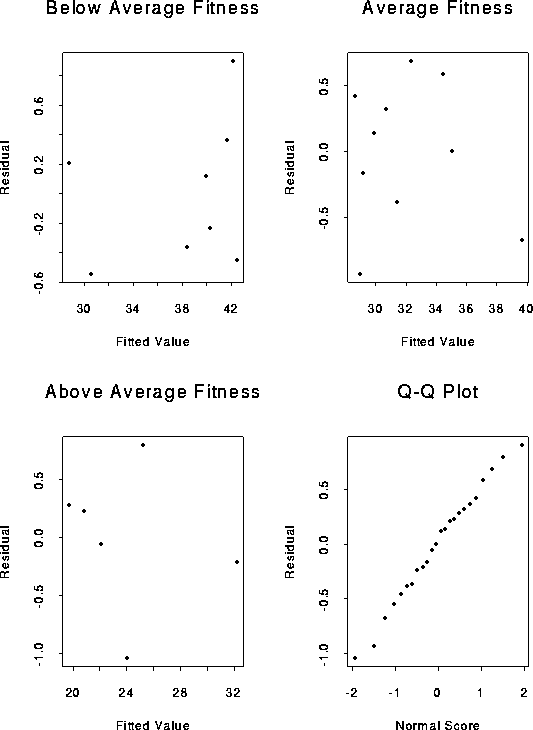
For part c, the generalized model is

and the null hypothesis is that all the  are equal. This is tested by
comparing the two model statements
model days = fitness | age and model days = fitness age, doing an
extra sum of squares F test. The resulting F statistic is the
Type III sum of squares for fitness*age giving F=0.34 and P=0.7191.
The null hypothesis is accepted.
are equal. This is tested by
comparing the two model statements
model days = fitness | age and model days = fitness age, doing an
extra sum of squares F test. The resulting F statistic is the
Type III sum of squares for fitness*age giving F=0.34 and P=0.7191.
The null hypothesis is accepted.
For 25.12 part c the F statistic is obtained from the Type III sum of squares for fitness for the model days = fitness age statement. This has F=399.11 and P=0.0001 There is clearly an effect of the variable Fitness.
The estimate statements permit us to compare the three levels of fitness. SAS prints out estimates of the differences in the intercepts. The relevant output is
                                   T for H0:    Pr > |T|   Std Error of
Parameter              Estimate   Parameter=0                Estimate
High v Low Fitness    -8.72289277    -26.20     0.0001     0.33296397
High v Med Fitness    -6.87551411    -23.84     0.0001     0.28837673
Med  v Low Fitness    -1.84737866     -6.44     0.0001     0.28694289
Notice that the fit group appears to recuperate about 9 days faster than the unfit group!