 ,
,  ,
,  ,
,  and
and  so that the design matrix is
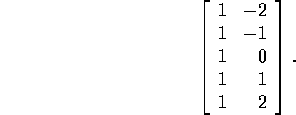
If we fit a simple linear regression of the form

for which the design matrix is as above,
evaluate the non-centrality parameter of the t test of  when in fact
  and
and  . What would the power of a
two sided 1% level t test of this null hypothesis be? How many
times would we have to replicate this design to get a power of 0.9 for
a 1% level test?
. What would the power of a
two sided 1% level t test of this null hypothesis be? How many
times would we have to replicate this design to get a power of 0.9 for
a 1% level test?
Solution: We have

and

The variance of  is
is  and the non-centrality
parameter is
and the non-centrality
parameter is 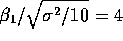 . From Table B 5 p 1347 I get
a power of 0.31 (3 df for error). If we replicate the design m times we
would have a non-centrality parameter of
. From Table B 5 p 1347 I get
a power of 0.31 (3 df for error). If we replicate the design m times we
would have a non-centrality parameter of  . The infinity line in
the table would suggest an m of 1 but because the degrees of freedom is
so low we have to do some trial and error. An m of 2 would give a
non-centrality parameter of 5.66. There would be 8 degrees of freedom and
the power would be around 0.95 so m=2 would be adequate.
. The infinity line in
the table would suggest an m of 1 but because the degrees of freedom is
so low we have to do some trial and error. An m of 2 would give a
non-centrality parameter of 5.66. There would be 8 degrees of freedom and
the power would be around 0.95 so m=2 would be adequate.
 as in the previous question evaluate the
non-centrality parameter of the F test of the hypothesis
as in the previous question evaluate the
non-centrality parameter of the F test of the hypothesis  in the model

Assume that in fact  and
and  .
.
Solution: The non-centrality parameter is

Here 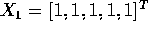 ,
,
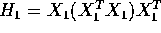 is a
is a  matrix with all entries
equal to 1/5
and
matrix with all entries
equal to 1/5
and
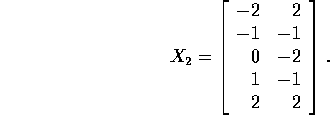
We find  and finally
that the non-centrality parameter is 66/2.5=26.4.
and finally
that the non-centrality parameter is 66/2.5=26.4.
The data set in the text has one number different than the data set on the computer disk. The results below are for the data off the disk. Students who took the data from the book got somewhat different results but I marked them right, since they were right for the data they used.
Solution: The fitted line is

a) The residual plot is

This plot suggests that the residuals are bigger when Speed is bigger; this is evidence of heteroscedasticity.
c) The desired plot is

This plot suggests a linear fit of  against Speed might
work.
against Speed might
work.
d) The regression equation is

The required weights are
 0.0146 0.0032 0.0052 0.0032 0.0146 0.0052
 0.0052 0.0032 0.0146 0.0032 0.0146 0.0052
e) The weighted least squares regression line is

These estimates are little changed compared to the standard errors.
| OLS | WLS | OLS | WLS | |
| Parameter | Estimate | Estimate | SE | SE |
| Intercept | -5.75 | -6.23 | 16.73 | 13.17 |
| Slope | 0.1875 | 0.1891 | 0.0538 | 0.0506 |
f) The standard errors from weighted least squares are rather smaller though more so for the less important parameter, the intercept.

where the errors  have variances
  and
the
and
the  are known quantities.
Find an explicit algebraic formula for the weighted least squares
estimate of
are known quantities.
Find an explicit algebraic formula for the weighted least squares
estimate of  .
.
Solution: The matrix X is a single column of n ones.
The matrix W is diagonal with down the diagonal. The vector
WX has entries  and finally
 . Next
  is the inner product between the vector
WX with ith entry and Y with ith entry
is the inner product between the vector
WX with ith entry and Y with ith entry  so
so  . Finally
  which is what is
called a weighted average.
which is what is
called a weighted average.