


Reading: 6.5, Chapter 15, Appendix A.
An informal method of selecting p, the model order, is based on

Note: adding more terms always increases R2.
Formal methods can be based on hypothesis tests. We can
test
 and then, if we accept this test
 and then, if we accept that test
 and so on stopping when we first reject a hypothesis. This is
``backwards elimination''.
and so on stopping when we first reject a hypothesis. This is
``backwards elimination''.
Justification: Unless  there is no good reason to
suppose that
there is no good reason to
suppose that  and so on.
Apparent conclusion in our example: p=5 is best; look at the P values in the SAS outputs.
Problems arising with that conclusion:
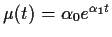 then the best
polynomial approximation might well have high degree.
then the best
polynomial approximation might well have high degree.
Question: What is distribution theory?
Answer: How to compute the ``distribution'' of an estimator, test or other statistic, T:
 ,
the Cumulative Distribution Function (CDF) of T.
,
the Cumulative Distribution Function (CDF) of T.
 ,
Gamma, Geometric, Negative Binomial, Poisson, Weibull, Logistic ...)
,
Gamma, Geometric, Negative Binomial, Poisson, Weibull, Logistic ...)
 ,
,
 or other ``moments'' of T
In this course we
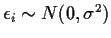
 are not normal?''
The standard normal density is

 if the density of Z is standard normal:

Reminder: if X has density f(x) then

So:
implies


Next we compute the variance of Z remembering that
 :
:

where
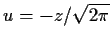 and
dv = -ze-z2/2 dz. We do integration
by parts and see that
v=e-z2/2 and
and
dv = -ze-z2/2 dz. We do integration
by parts and see that
v=e-z2/2 and
 .
This gives
.
This gives

because the integral of the normal density is 1. We have thus shown
that

Definition: If
then
 .
.
Note:

Definition: If
 are independent N(0,1)
then
are independent N(0,1)
then
![\begin{displaymath}Z = \left[ \begin{array}{c} Z_1 \\ \vdots \\ Z_n \end{array} \right] \sim
MVN(0,I)
\end{displaymath}](img31.gif)
We can define
 and
and
 for vectors like Z as
follows:
for vectors like Z as
follows:
If X is a random vector of length n, say
![$X^T = \left[ X_1 \cdots X_n
\right]
$](img34.gif) then
then
![\begin{displaymath}\mu_X \equiv {\rm E}(X) = \left[
\begin{array}{c} {\rm E}(X_1) \\ \vdots \\ {\rm E}(X_n) \end{array} \right]
\end{displaymath}](img35.gif)
 is an
is an  matrix
![\begin{displaymath}{\rm E}\left[ (X-\mu_X)(X-\mu_X)^T\right]
\end{displaymath}](img38.gif)
 is
is

Definition:
![\begin{align*}{\rm Cov}(X_i,X_j) & = {\rm E} \left[
(X_i - {\rm E}(X_i))(X_j-{\r...
...m E}(X_j)\right]
\\
&= {\rm E}(X_i X_j) - {\rm E}(X_i){\rm E}(X_j)
\end{align*}](img41.gif)
Definition: If M is a matrix then
 is a matrix
whose ijth entry is
is a matrix
whose ijth entry is
 .
.
So
has ijth entry
 and
diagonal entries
and
diagonal entries
 .
.
In class I started discussion of the Normal distribution. I computed the
mean and variance of a standard normal and then of
 .
Here I will just show you a few more integrals:
.
Here I will just show you a few more integrals:
The kth moment of a standard normal is

 .
This makes
.
This makes  and
du = -(k-1)tk-2dt so that by integration by parts
and
du = -(k-1)tk-2dt so that by integration by parts

 and
and
 we see that
 if k is odd and
 if k is even.
We can also compute the moment generating function of Z, that is,



Now if
 then
then
 so
that the
so
that the
 central moment of X, namely
 is 0 for odd k and
 for k even.
Similarly
