


Reading: Chapter 3, Chapter 9.
Model Assessment and Residual Analysis:
Recall that



Critique: when the model is wrong a bad data point
can inflate
 leaving the internally studentized residual small.
Suggestion:

 is the fitted value using all the data
except case i.
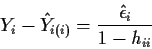
This residual is called a ``PRESS prediction error for case i''.
The acronym PRESS stands for Prediction Sum of Squares.
is the fitted value using all the data
except case i.
This residual is called a ``PRESS prediction error for case i''.
The acronym PRESS stands for Prediction Sum of Squares.
But:
 must be compared to other residuals or
to
must be compared to other residuals or
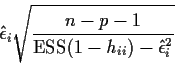
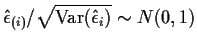
to  so we suggest Externally Studentized Residuals which are
also called Case Deleted Residuals:
so we suggest Externally Studentized Residuals which are
also called Case Deleted Residuals:

Apparent problem: If n=100 do I have to run SAS 100 times? NO.
FACT 1:

FACT 2:




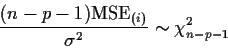
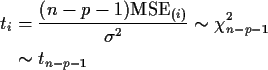
Cubic Fit:
| Year |
 |
Internally | PRESS | Externally | Leverage |
| Studentized | Studentized | ||||
| 1975 | 1.17 | 0.59 | 1.54 | 0.56 | 0.24 |
| 1980 | -1.09 | -1.15 | -6.20 | -1.19 | 0.82 |
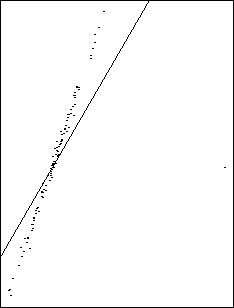
Note the influence of the leverage.
Note that edge observations (1980) have large leverage.
Quintic Fit:
| Year |
|
Internally | PRESS | Externally | Leverage |
| Studentized | Studentized | ||||
| 1978 | 0.82 | 1.79 | 1.43 | 3.48 | 0.43 |
| 1980 | 0.08 | 1.02 | 4.79 | 1.03 | 0.98 |
Notice 1978 residual is unacceptably large.
Notice 1980 leverage is huge.
 by the number of tests to be done, 10 in our case giving
0.025/10 = 0.0025. The corresponding critical point is
by the number of tests to be done, 10 in our case giving
0.025/10 = 0.0025. The corresponding critical point is
Suppose X is the design matrix of a linear model and
that X1 is the design matrix of the linear model we get by imposing
some linear restrictions on the model using X. A good example is on
assignment 3 but here is another. Consider the one way layout,
also called the K sample problem. We have K samples from K
populations with means  for
for
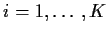 .
Suppose the ith
sample size is n+i. This is a linear model, provided
we are able to assume that all the population variances are the same.
.
Suppose the ith
sample size is n+i. This is a linear model, provided
we are able to assume that all the population variances are the same.
The resulting design matrix is
![\begin{displaymath}X = \left[\begin{array}{rrrrr}
1 & 0 & 0 & \cdots & 0 \\
&...
...\\
& & \vdots \\
0 & 0 & 0 & \cdots & 1
\end{array}\right]
\end{displaymath}](img25.gif)
![$[1,0,\ldots,0]$](img26.gif) and
then n2 copies of
and
then n2 copies of
![$[0,1,0,\ldots,0]$](img27.gif) and so on. Under the restriction
and so on. Under the restriction
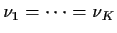 there is just one parameter, say
  ,
and the
design matrix X* is just a column of
,
and the
design matrix X* is just a column of
 1s. Notice
that X* is not a submatrix of the original design matrix X.
However, if A is the
1s. Notice
that X* is not a submatrix of the original design matrix X.
However, if A is the  matrix with all entries equal to 1
we have X* = XA so that the column space of X* is a subspace
(of dimension 1) of the K dimensional column space of X.
The extra sum of squares principle can thus be used to test the null
hypothesis
matrix with all entries equal to 1
we have X* = XA so that the column space of X* is a subspace
(of dimension 1) of the K dimensional column space of X.
The extra sum of squares principle can thus be used to test the null
hypothesis
 by fitting the two models and
computing, using the notation of ANOVA from STAT 330:
by fitting the two models and
computing, using the notation of ANOVA from STAT 330:
![\begin{displaymath}F=\frac{ [\sum (Y_{ij}-\bar{Y}_{\cdot\cdot})^2 -
\sum (Y_{i...
...t})^2]/(K-1)}{
\sum (Y_{ij}-\bar{Y}_{i\cdot})^2 /(\sum n_i-K)}
\end{displaymath}](img33.gif)
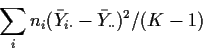
It is actually quite common to reparametrize the full model in such
a way that the null hypothesis of interest is of the form
 .
For the 1 way ANOVA there are two such reparametrizations in common use.
.
For the 1 way ANOVA there are two such reparametrizations in common use.
The first of these defines a grand mean parameter
 and individual ``effects''
 .
This new
model has K+1 parameters apparently and the corresponding design
matrix, X1, would not have full rank; its rank would be K
although it would have K+1 columns. As such the matrix X1T X1
would be singular and we could not find unique least squares estimates.
The problem is that we have defined the parameters
in such a way that there is a linear restriction on them, namely,
.
This new
model has K+1 parameters apparently and the corresponding design
matrix, X1, would not have full rank; its rank would be K
although it would have K+1 columns. As such the matrix X1T X1
would be singular and we could not find unique least squares estimates.
The problem is that we have defined the parameters
in such a way that there is a linear restriction on them, namely,
 .
We get around this problem by dropping
.
We get around this problem by dropping  and remembering in
our model equations that
and remembering in
our model equations that
 .
.
If you now write out the model equations with  and the
 as parameters you get the design matrix
![\begin{displaymath}X_2 = \left[\begin{array}{rrrrr}
1 & 1 & 0 & \cdots & 0 \\
...
...}{n_K} & \cdots & -\frac{n_{K-1}}{n_K}
\end{array}\right] \, .
\end{displaymath}](img43.gif)
Students will have seen this matrix in 330 in the case where all the
ni are the same and the fractions in the last nK rows of X2
are all equal to -1. Notice that the hypothesis
is the same as
 .
.
The other reparametrization is ``corner-point coding'' where we define
new parameters by
 and
and
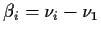 .
For
this parameterization the
null hypothesis of interest is
.
For
this parameterization the
null hypothesis of interest is
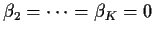 .
The
design matrix is
.
The
design matrix is
![\begin{displaymath}X_3 = \left[\begin{array}{rrrrr}
1 & 0 & 0 & \cdots & 0 \\
...
... & \vdots \\
1 & 0 & 0 & \cdots & 1
\end{array}\right] \, .
\end{displaymath}](img48.gif)