


options pagesize=60 linesize=80;
data scenic;
 infile 'scenic.dat' firstobs=2;
 input Stay  Age Risk Culture Chest Beds School
      Region Census Nurses Facil;
 Nratio = Nurses / Census  ;
 R1 = -(Region-4)*(Region-3)*(Region-2)/6;
 R2 = (Region-4)*(Region-3)*(Region-1)/2;
 R3 = -(Region-4)*(Region-2)*(Region-1)/2;
 S1 = School-1;
proc reg  data=scenic;
  model Risk = S1 Culture Stay Nurses Nratio { R1 R2 R3 }
  Chest Beds Census Facil / selection=stepwise
  groupnames = 'School' 'Culture' 'Stay' 'Nurses' 'Nratio'
  'Region' 'Chest' 'Beds' 'Census' 'Facil';
run ;
EDITED SAS OUTPUT (Complete output)
      Stepwise Procedure for Dependent Variable RISK
Step 1 Group Culture Entered R-square=0.312659 C(p)=58.3641
            Parameter   Standard    Type II
Variable     Estimate      Error Sum of Squares   F  Prob>F
INTERCEP   3.19789965 0.19376813 339.64905575 272.37 0.0001
--- Group Culture  --             62.96314170  50.49 0.0001
CULTURE    0.07325862 0.01030975  62.96314170  50.49 0.0001
-----------------------------------------------------------
Step 2 Group Stay Entered R-square=0.45040256 C(p)=26.82419
            Parameter   Standard   Type II
Variable     Estimate      Error Sum of Squares F  Prob>F
INTERCEP   0.80549102 0.48775579  2.74400250  2.73 0.1015
--- Group Culture  ---           33.39687778 33.19 0.0001
CULTURE    0.05645147 0.00979843 33.39687778 33.19 0.0001
--- Group Stay     ---           27.73884588 27.57 0.0001
STAY       0.27547211 0.05246473 27.73884588 27.57 0.0001
-----------------------------------------------------------
Step 3 Group Facil Entered R-square = 0.4934 C(p)=18.3545
            Parameter   Standard   Type II
Variable     Estimate      Error Sum of Squares F  Prob>F
INTERCEP   0.49133226 0.48163614  0.97401801  1.04 0.3099
--- Group Culture  ---           30.59827862 32.69 0.0001
CULTURE    0.05419997 0.00947933 30.59827862 32.69 0.0001
--- Group Stay     ---           16.47664606 17.60 0.0001
STAY       0.22390748 0.05336561 16.47664606 17.60 0.0001
--- Group Facil    ---            8.65883687  9.25 0.0029
FACIL      0.01963027 0.00645392  8.65883687  9.25 0.0029
---------------------------------------------------------
Step 4 Group Nratio Entered R-square=0.52548 C(p)=12.5433
            Parameter   Standard   Type II
Variable     Estimate      Error Sum of Squares F  Prob>F
INTERCEP  -0.49505513 0.59376426  0.61507231  0.70 0.4063
--- Group Culture  ---           22.84513509 25.82 0.0001
CULTURE    0.04818092 0.00948204 22.84513509 25.82 0.0001
--- Group Stay     ---           21.44995791 24.24 0.0001
STAY       0.26758404 0.05434637 21.44995791 24.24 0.0001
--- Group Nratio   ---            6.46014750  7.30 0.0080
NRATIO     0.79262357 0.29333869  6.46014750  7.30 0.0080
--- Group Facil    ---            6.75349077  7.63 0.0067
FACIL      0.01747585 0.00632554  6.75349077  7.63 0.0067
---------------------------------------------------------
Step 5 Group Chest Entered R-square=0.53792 C(p)=11.513
            Parameter  Standard    Type II
Variable   Estimate     Error   Sum of Squares  F  Prob>F
INTERCEP  -0.76804342 0.61022741  1.37763165  1.58 0.2109
--- Group Culture  ---           16.71979631 19.23 0.0001
CULTURE    0.04318856 0.00984976 16.71979631 19.23 0.0001
--- Group Stay     ---           14.43814950 16.60 0.0001
STAY       0.23392650 0.05741114 14.43814950 16.60 0.0001
--- Group Nratio   ---            4.38883521  5.05 0.0267
NRATIO     0.67240318 0.29931440  4.38883521  5.05 0.0267
--- Group Chest    ---            2.50619510  2.88 0.0925
CHEST      0.00917860 0.00540681  2.50619510  2.88 0.0925
--- Group Facil    ---            7.45710068  8.57 0.0042
FACIL      0.01843860 0.00629673  7.45710068  8.57 0.0042
---------------------------------------------------------
Step 6 Group Region Entered R-square=0.56826 C(p)=10.1269
            Parameter   Standard   Type II
Variable     Estimate      Error  Sum of Squares F Prob>F
INTERCEP  -0.66156855 0.68931767  0.77004723  0.92 0.3394
--- Group Culture  ---           19.41848300 23.23 0.0001
CULTURE    0.04717749 0.00978882 19.41848300 23.23 0.0001
--- Group Stay     ---           18.64724032 22.31 0.0001
STAY       0.28408192 0.06015054 18.64724032 22.31 0.0001
--- Group Nratio   ---            1.86769604  2.23 0.1380
NRATIO     0.47735146 0.31936579  1.86769604  2.23 0.1380
--- Group Region   ---            6.10861501  2.44 0.0689
R1        -0.91152625 0.33831556  6.06877293  7.26 0.0082
R2        -0.61170886 0.30630883  3.33408744  3.99 0.0484
R3        -0.54005754 0.30531855  2.61565335  3.13 0.0799
--- Group Chest    ---            3.10587423  3.72 0.0566
CHEST      0.01029102 0.00533912  3.10587423  3.72 0.0566
--- Group Facil    ---            7.66252029  9.17 0.0031
FACIL      0.01883340 0.00622080  7.66252029  9.17 0.0031
--------------------------------------------------------
Step 7 Group School Entered R-square=0.5783 C(p)= 9.68028
            Parameter   Standard    Type II
Variable     Estimate      Error Sum of Squares F Prob>F
INTERCEP  -1.29313397 0.79443852  2.18445103  2.65 0.1066
--- Group School   ---            2.02343484  2.45 0.1203
S1         0.45874175 0.29282732  2.02343484  2.45 0.1203
--- Group Culture  ---           21.14238169 25.64 0.0001
CULTURE    0.05016596 0.00990650 21.14238169 25.64 0.0001
--- Group Stay     ---           19.90843811 24.15 0.0001
STAY       0.29583936 0.06020399 19.90843811 24.15 0.0001
--- Group Nratio   ---            1.42881407  1.73 0.1909
NRATIO     0.42026288 0.31924279  1.42881407  1.73 0.1909
--- Group Region   ---            7.09035688  2.87 0.0402
R1        -0.99737538 0.34041455  7.07745167  8.58 0.0042
R2        -0.64425716 0.30489819  3.68115979  4.46 0.0370
R3        -0.59950685 0.30557155  3.17349874  3.85 0.0525
--- Group Chest    ---            2.85453005  3.46 0.0656
CHEST      0.00987802 0.00530873  2.85453005  3.46 0.0656
--- Group Facil    ---            9.68526975 11.75 0.0009
FACIL      0.02391008 0.00697611  9.68526975 11.75 0.0009
----------------------------------------------------------
Step 8 Group Nratio Removed R-square=0.57121 C(p)=9.40791
            Parameter   Standard    Type II
Variable     Estimate      Error Sum of Squares F Prob>F
INTERCEP  -0.83240584 0.71570292  1.12313185  1.35 0.2475
--- Group School   ---            2.46231681  2.97 0.0880
S1         0.50274483 0.29193670  2.46231681  2.97 0.0880
--- Group Culture  ---           23.66688888 28.50 0.0001
CULTURE    0.05233635 0.00980270 23.66688888 28.50 0.0001
--- Group Stay     ---           18.47964968 22.26 0.0001
STAY       0.27469386 0.05822575 18.47964968 22.26 0.0001
--- Group Region   ---            9.68716458  3.89 0.0111
R1        -1.10696516 0.33123989  9.27275385 11.17 0.0012
R2        -0.76673818 0.29137725  5.74922078  6.92 0.0098
R3        -0.75936643 0.28139304  6.04647398  7.28 0.0081
--- Group Chest    ---            3.92124933  4.72 0.0320
CHEST      0.01132621 0.00521177  3.92124933  4.72 0.0320
--- Group Facil    ---           11.30278424 13.61 0.0004
FACIL      0.02545939 0.00690031 11.30278424 13.61 0.0004
----------------------------------------------------------
All groups of variables left in the model are
significant at the 0.1500 level.  No other group
of variables met the 0.1500 significance level for
entry into the model.
  Summary of Stepwise Procedure for Dependent Variable RISK
      Group          Number Partial Model
Step Entered Removed  In   R**2    R**2    C(p)       F  Prob>F
 1   Culture          1   0.3127  0.3127 58.3641 50.4918 0.0000
 2   Stay             2   0.1377  0.4504 26.8242 27.5690 0.0000
 3   Facil            3   0.0430  0.4934 18.3545  9.2513 0.0029
 4   Nratio           4   0.0321  0.5255 12.5433  7.3012 0.0080
 5   Chest            5   0.0124  0.5379 11.5130  2.8818 0.0925
 6   Region           8   0.0303  0.5683 10.1269  2.4357 0.0689
 7   School           9   0.0100  0.5783  9.6803  2.4542 0.1203
 8           Nratio   8   0.0071  0.5712  9.4079  1.7330 0.1909
COMMENTS ON OUTPUT

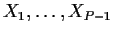 .
Choose subset of
size p-1 of the possible P-1. Define
.
Choose subset of
size p-1 of the possible P-1. Define

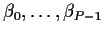 such that the errors
in
such that the errors
in

 based on subset of regressors. Can work out
total mean squared prediction error
based on subset of regressors. Can work out
total mean squared prediction error
![\begin{displaymath}\sum \left[(E(\hat\mu_i) - \mu_i)^2 + Var(\hat\mu_i)\right]
\end{displaymath}](img8.gif)
 values but for set of p-1 are 0 then
SSEp should be about
values but for set of p-1 are 0 then
SSEp should be about
 while
while
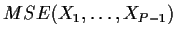 should be around
  so that Cp is close to
(n-p)-(n-2p)=p.
so that Cp is close to
(n-p)-(n-2p)=p.
 is based on the idea of using the model
which leads to the smallest estimate ESS/(n-p) of .
In general
is based on the idea of using the model
which leads to the smallest estimate ESS/(n-p) of .
In general


Up to now our theory has been used to compute P-values or fix
critical points to get desired  levels. We have assumed that
all our null hypotheses are True. I now discuss power or Type II error
rates of our tests. Read Chapter 26, section 4, 5 and 6.
levels. We have assumed that
all our null hypotheses are True. I now discuss power or Type II error
rates of our tests. Read Chapter 26, section 4, 5 and 6.
Consider a t-test of  .
The test statistic is
.
The test statistic is

![\begin{displaymath}\frac{\hat\beta_k/\left[\sigma\sqrt{(X^TX)^{-1}_{kk}}\right]}{
\sqrt{[ SSE/\sigma^2]/(n-p)}}\end{displaymath}](img20.gif) is true the numerator
is standard normal, the denominator is the square root of a chi-square
divided by its degrees of freedom and the numerator and denominator
are independent. When, in fact
is true the numerator
is standard normal, the denominator is the square root of a chi-square
divided by its degrees of freedom and the numerator and denominator
are independent. When, in fact  is not 0 the numerator is
still normal and still has variance 1 but its mean is
is not 0 the numerator is
still normal and still has variance 1 but its mean is
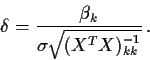

 is the noncentrality parameter.
Table B.5 on page 1346 gives the probability that the absolute
value of a non-central t exceeds a given level. If we take the level
to be the critical point for a t test at some level
then
the probability we look up is the corresponding power, that is,
the probability of rejection. Notice that the power depends on
two unknown quantities,
and  and on 1 quantity
which is sometimes under the experimenter's control (in a designed
experiment) and sometimes not (as in an observational study.)
and on 1 quantity
which is sometimes under the experimenter's control (in a designed
experiment) and sometimes not (as in an observational study.)
Same idea applies to any linear statistic of the form
 - you get a non-central t distribution on
the alternative. So, for example, if testing
- you get a non-central t distribution on
the alternative. So, for example, if testing
 but in fact
 the non-centrality parameter is

Before an experiment is run it is sensible, if the experiment is
costly, to try to work out whether or not it is worth doing. You
will nly do an experiment if the probability of Type I and II errors
are both reasonably low.
The simplest case arises when you prespecify a level, say
 and an acceptable probability of Type II error,
say 0.10. Then you need to specify
and an acceptable probability of Type II error,
say 0.10. Then you need to specify
 ;
this value comes from a physically
motivated understanding of what value of
would be important
to detect and from some understanding of the roughly what values
might be reasonable for .
;
this value comes from a physically
motivated understanding of what value of
would be important
to detect and from some understanding of the roughly what values
might be reasonable for .
 and then
use each member of that set say m times so that the aggregate sample
size is mk. This gives a non-centrality parameter of the form
and then
use each member of that set say m times so that the aggregate sample
size is mk. This gives a non-centrality parameter of the form
 .
If the solution is large,
however, then all the rows in B.5 at the bottom of the table are very
similar so that effectively only
depends on n; we can then
solve for n.
.
If the solution is large,
however, then all the rows in B.5 at the bottom of the table are very
similar so that effectively only
depends on n; we can then
solve for n.
The simplest example of the power of an F test arises in regression through the
origin (that is, a model with no intercept term.) Consider the model

 we use the F statistic

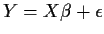 in
the formula for the F statistic. Use the fact that HX=X (and so (I-H)X=0) to
see that the denominator is
in
the formula for the F statistic. Use the fact that HX=X (and so (I-H)X=0) to
see that the denominator is
 has the distribution of a
  on n-p degrees of freedom
divided by its degrees of freedom. It is also true that the numerator and denominator
are independent of each other even when the null hypothesis is false.
on n-p degrees of freedom
divided by its degrees of freedom. It is also true that the numerator and denominator
are independent of each other even when the null hypothesis is false.
The numerator, however, is
 we can rewrite this as
 has a multivariate normal distribution with
mean
has a multivariate normal distribution with
mean
 and variance the identity matrix.
FACT:
If W is a
 random vector and Q is idempotent with rank pthen WTQW has a non-central
distribution with non-centrality parameter
random vector and Q is idempotent with rank pthen WTQW has a non-central
distribution with non-centrality parameter

 variable is
called central and has
variable is
called central and has  .
.
FACT
If U and V are independent
variables with degrees of freedom
 and
and  ,
V is central and U is non-central with non-centrality
parameter
,
V is central and U is non-central with non-centrality
parameter  then
then
 and degrees of freedom
and .
and degrees of freedom
and .
POWER CALCULATIONS
Table B 11 gives powers of F tests for various small numerator
degrees of freedom and a range of denominator degrees of freedom for
or
 .
In the table
.
In the table  is simply our
 (that is, the square root of what I called the non-centrality parameter
divided by the square root of 1 more than the numerator degrees of freedom.)
(that is, the square root of what I called the non-centrality parameter
divided by the square root of 1 more than the numerator degrees of freedom.)
SAMPLE SIZE CALCULATIONS
Sometimes done with charts and sometimes with tables; see table B 12.
This table depends on a quantity
 (one of 0.2, 0.1, 0.05 or 0.01) and
a power (
(one of 0.2, 0.1, 0.05 or 0.01) and
a power ( in the notation of the table) which must be one of 0.7, 0.8, 0.9 or 0.95
and a value of non-centrality per data point, that is of
in the notation of the table) which must be one of 0.7, 0.8, 0.9 or 0.95
and a value of non-centrality per data point, that is of
 .
Then you look up n. Realistic specification of
is difficult.
in practice.
.
Then you look up n. Realistic specification of
is difficult.
in practice.