


Reading for Today's Lecture:
Goals of Today's Lecture:
Today's notes
Definition: A model is a family
 of possible distributions for some random variable X. (Our
data set is X, so X will generally be a big vector or matrix or even
more complicated object.)
of possible distributions for some random variable X. (Our
data set is X, so X will generally be a big vector or matrix or even
more complicated object.)
We will assume throughout this course that the true distribution P of Xis in fact some
 for some
 .
We call
.
We call
 the true value of the parameter. Notice that this assumption
will be wrong; we hope it is not wrong in an important way. If we are very
worried that it is wrong we enlarge our model putting in more distributions
and making
the true value of the parameter. Notice that this assumption
will be wrong; we hope it is not wrong in an important way. If we are very
worried that it is wrong we enlarge our model putting in more distributions
and making  bigger.
Our goal is to observe the value of X and then guess
or some
property of .
We will consider the following classic mathematical
versions of this:
 which lies in
(or something close to ).
which lies in
(or something close to ).
 :
we must compute an estimate
:
we must compute an estimate
 of
of
 .
.
which we think will contain .
 where
where
 .
.
.
Typically Yis the value of the variable X in a repetition of the experiment.
There are several schools of statistical thinking with different views on how these problems should be done. The main schools of thought may be summarized roughly as follows:
.
as being
random just like X. We compute the conditional distribution of what
we don't know given what we do know. In particular we ask how a procedure
will work on the data we actually got - no averaging over data we might
have got.
as random.
For the next several weeks we do only the Neyman Pearson approach, though we use that approach to evaluate the quality of likelihood methods.
Suppose you toss a coin 6 times and get Heads twice. If p is the
probability of getting H then the probability of getting 2 heads is
Definition: A model is a family
of possible distributions for some random variable X.
Typically the model is described by specifying
 the set of possible densities of X.
Definition: The likelihood function is the function L whose domain
is
and whose values are given by

The key point is to think about how the density depends on
not
about how it depends on X. Notice that X, the observed value of the
data, has been plugged into the formula for the density. Notice also
that the coin tossing example is like this but with f being the discrete
density. We use the likelihood in most of our inference problems:
which lies in .
The maximum likelihood estimate
(MLE) of
is the value
 which maximizes
 over
over
 if such a
exists.
if such a
exists.
:
we must compute an estimate
of
.
We use
 where
is the MLE of .
where
is the MLE of .
which we think will contain .
We will use

where
.
We base our decision
on the likelihood ratio

Maximum Likelihood Estimation
To find an MLE we maximize L. This is a typical function maximization problem which we approach by setting the gradient of L equal to 0 and then checking to see that the root is a maximum, not a minimum or saddle point.
We begin by examining some likelihood plots in examples:
Cauchy Data
We have a sample
 from the Cauchy
 density


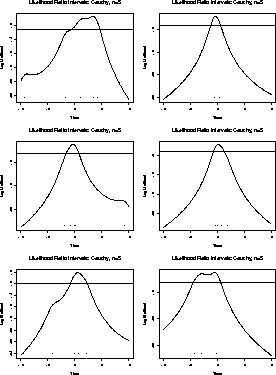
Here are some plots of this function for 6 samples of size 5.
 between -2 and 2.

 between -2 and 2.

(which is 0 for the data sets I generated).
 which has exactly
the same shape as L but runs from 0 to 1 on the vertical scale.
which has exactly
the same shape as L but runs from 0 to 1 on the vertical scale.
To maximize this likelihood we would have to differentiate L and
set the result equal to 0. Notice that L is a product of n terms
and the derivative will then be

Definition: The Log Likelihood function is

For the Cauchy problem we have



 .
.
You can see that the likelihood will tend to 0 as
 so that the maximum of
will occur at a root of
so that the maximum of
will occur at a root of
 ,
the derivative of
with respect to .
,
the derivative of
with respect to .
Definition: The Score Function is the gradient of

The MLE
usually solves the Likelihood Equations

In our Cauchy example we find

Here are some plots of the score functions for n=5 for our
Cauchy data sets. Each score is plotted beneath a plot of the
corresponding .


If X has a Binomial
 distribution then

The function L is 0 at  and at
  unless X=0or X=n so for
 the MLE must be found by setting
U=0 and getting
the MLE must be found by setting
U=0 and getting

 so that the likelihood is an increasing
function of
which is maximized at
so that the likelihood is an increasing
function of
which is maximized at
 .
Similarly when X=0 the maximum is at
.
Similarly when X=0 the maximum is at
 .
.
The Normal Distribution
Now we have
iid
 .
There are
two parameters
.
There are
two parameters
 .
We find
.
We find
![\begin{align*}L(\mu,\sigma)& = (2\pi)^{-n/2} \sigma^{-n}
\exp\{-\sum(X_i-\mu)^2/...
...rac{\sum(X_i-\mu)^2}{\sigma^3} -\frac{n}{\sigma}
\end{array}\right]
\end{align*}](img46.gif)
Notice that U is a function with two components because
has
two components.
Setting the likelihood equal to 0 and solving gives

 is
is
![\begin{displaymath}\left[\begin{array}{cc}
\frac{-n}{\sigma^2} & \frac{-2\sum(X_...
...m(X_i-\mu)^2}{\sigma^4}
+\frac{n}{\sigma^2}
\end{array}\right]
\end{displaymath}](img49.gif)
![\begin{displaymath}H(\hat\theta) = \left[\begin{array}{cc}
\frac{-n}{\hat\sigma^2} & 0
\\
0 & \frac{-2n}{\hat\sigma^2}
\end{array}\right]
\end{displaymath}](img50.gif) must be a local maximum.
must be a local maximum.
Here is a contour plot of the normal log likelihood for two data sets with n=10 and n=100.
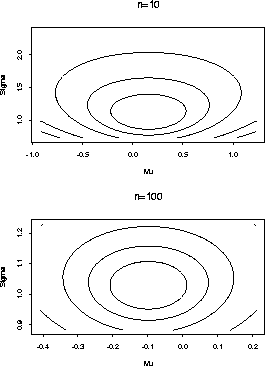
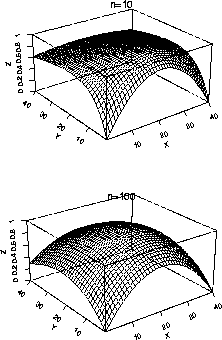
We now turn to theory to explain the features of these plots, at least approximately in large samples.