 )
distribution.
)
distribution.
 and scale parameter
 .
.
/home/math4/lockhart/research/software/quadrature/.Data.A handout on these functions is available here.
 be
the characteristic function of X.
be
the characteristic function of X.
- (a)
- Show that

- (b)
- Suppose further that X is a random variable such that
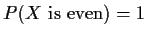 .
Show that
.
Show that

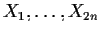 are independent random variables such that
 .
Prove that as
.
Prove that as


where
 is the standard normal density.
You should use part b) of the previous
problem and Taylor expansion of the characteristic function around 0.
Also do the same thing using Sterling's formula.
is the standard normal density.
You should use part b) of the previous
problem and Taylor expansion of the characteristic function around 0.
Also do the same thing using Sterling's formula.
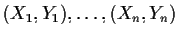 are independent bivariate normal
random variables find the limiting distribution of
are independent bivariate normal
random variables find the limiting distribution of
 where r is the sample correlation coefficient and
  is the
population correlation. HINTS: the problem is easier for
is the
population correlation. HINTS: the problem is easier for
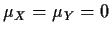 and
and
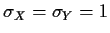 so prove that you can assume these values for
the parameters without loss of generality. Next remember that the
correlation coefficient can be computed from the 5 summary statistics
so prove that you can assume these values for
the parameters without loss of generality. Next remember that the
correlation coefficient can be computed from the 5 summary statistics
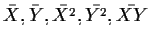 .
Use the central limit
theorem (multivariate version) to compute an approximate normal distribution
for this vector.
.
Use the central limit
theorem (multivariate version) to compute an approximate normal distribution
for this vector.