


Non Gaussian series.
The fitting methods we have studied are based on the likelihood for a normal fit. However, the estimates work reasonably well even if the errors are not normal.
Example: AR(1) fit. We fit
 using
using
 which is consistent for non-Gaussian errors.
(In fact
which is consistent for non-Gaussian errors.
(In fact

 and apply the law of large numbers to
 to
see that
to
see that  is consistent.)
Here is an outline of the logic of what follows. We will assume that
the errors are iid mean 0, variance  and finite fourth
moment
and finite fourth
moment
 E
E . We will not assume that
the errors have a normal distribution.
. We will not assume that
the errors have a normal distribution.
 and
and  are consistent.

![$\displaystyle B = \left[\begin{array}{cc}
\frac{1}{1-\rho^2} & 0 \\ 0 & \frac{ \mu_4-\sigma^4}{\sigma^6}
\end{array}\right]
$](img13.gif)
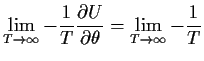 E
E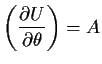
![$\displaystyle A = \left[\begin{array}{cc}
\frac{1}{1-\rho^2} & 0 \\ 0 & \frac{2}{\sigma^2}
\end{array}\right]
$](img16.gif)
 is the (conditional) Fisher information
then
is the (conditional) Fisher information
then
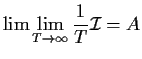
 about
about  and get
![$\displaystyle \hat\theta - \theta = \left[\frac{1}{T} I(\theta_0) \right]^{-1} \left[
T^{-1/2} U(\theta_0)\right] +$](img21.gif) negligible remainder
negligible remainder

![$\displaystyle \Sigma = A^{-1} B A^{-1} = \left[\begin{array}{cc}
1-\rho^2 & 0 \\ 0 & \frac{\mu_4-\sigma^4}{4\sigma^2}
\end{array}\right]
$](img24.gif)
 even for
non-normal errors.
even for
non-normal errors.
has a limiting
distribution which will be different for non-normal errors (because
it depends on  which is
  for normal errors and
something else in general for non-normal errors).
for normal errors and
something else in general for non-normal errors).
Here are details.
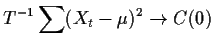
Consistency: One of our many nearly equivalent
estimates of is
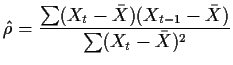 . You need essentially to prove

Score function: asymptotic normality
The score function is
![$\displaystyle U(\rho,\sigma) = \left[\begin{array}{c}
\frac{\sum X_{t-1}(X_t-\r...
...ac{\sum(X_t-\rho X_{t-1})^2}{\sigma^3}- \frac{T-1}{\sigma}
\end{array}\right]
$](img31.gif) and are the true values of the parameters then
and are the true values of the parameters then
![$\displaystyle U(\rho,\sigma) = \left[\begin{array}{c}
\frac{\sum X_{t-1}\epsilo...
...\\
\frac{\sum \epsilon_t^2}{\sigma^3}- \frac{T-1}{\sigma}
\end{array}\right]
$](img32.gif)
 . This
is proved by the martingale central limit theorem. Technically
you fix an
. This
is proved by the martingale central limit theorem. Technically
you fix an  and study
 ,
proving that the limit is
,
proving that the limit is
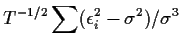
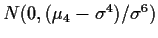
 . I do here only the
special cases
. I do here only the
special cases  and
and  . The second of these is
simply
. The second of these is
simply
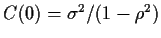
 . For the claim is
that
. For the claim is
that

 .
.
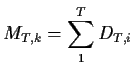
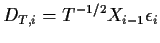
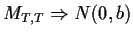
To prove this assertion we define for each a martingale
 for
for
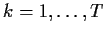 where
where

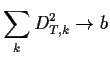
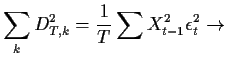 E
E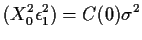
Second derivative matrix and Fisher information: the matrix of negative second derivatives is
![$\displaystyle -\frac{\partial U}{\partial\theta} = \left[\begin{array}{cc}
\fra...
...ac{\sum(X_t-\rho
X_{t-1})^2}{\sigma^4} -\frac{T-1}{\sigma^2}\end{array}\right]
$](img52.gif) the matrix
and the expected value of the matrix converge to
the matrix
and the expected value of the matrix converge to
![$\displaystyle A= \left[\begin{array}{cc}
\frac{C(0)}{\sigma^2} & 0 \\ 0 & \frac{2}{\sigma^2}
\end{array}\right]
$](img53.gif)
Taylor expansion: In the next step we are supposed
to prove that a random vector has a MVN limit. The usual tactic to
prove this uses the so called Cramér-Wold device -- you prove that
each linear combination of the entries in the vector has a univariate
normal limit.
Then
 and Taylor's theorem is
that
and Taylor's theorem is
that
![$\displaystyle 0=U(\hat\rho,\hat\sigma) = U(\rho,\sigma) +
\left[\frac{\partial U(\theta)}{\partial\theta}\right] (\hat\theta -
\theta)
+R
$](img55.gif)
 and
and  is a remainder
term -- a random variable with the property that
is a remainder
term -- a random variable with the property that

 .) Multiply through by
![$\displaystyle \left[\frac{\partial U(\theta)}{\partial\theta}\right] ^{-1}
$](img60.gif)
![$\displaystyle T^{1/2}(\hat\theta - \theta) = \left[-T^{-1}\frac{\partial
U(\theta)}{\partial\theta}\right] ^{-1} (T^{-1/2}U(\rho,\sigma) +T^{-1/2}R)
$](img61.gif)
![$\displaystyle \left[-T^{-1}\frac{\partial
U(\theta)}{\partial\theta}\right] ^{-1}(T^{-1/2}R)
\to 0
$](img62.gif)
Asymptotic normality: This is a consequence of
Slutsky's theorem applied to the Taylor expansion and the results
above for  and
and  . According to Slutsky's theorem the asymptotic
distribution of
. According to Slutsky's theorem the asymptotic
distribution of
 is the same as that
of
is the same as that
of
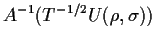
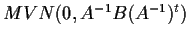 . Now since
![$\displaystyle A^{-1} B (A^{-1})^t = \left[\begin{array}{cc}
1-\rho^2 & 0 \\ 0 & \frac{\mu_4-\sigma^4}{4\sigma^4}
\end{array}\right]
$](img68.gif)
Behaviour of  : pick off the first component
and find
: pick off the first component
and find

Behaviour of
 : on the other hand
 in it and will match the normal theory limit if and only
if
in it and will match the normal theory limit if and only
if
 .
.
More general models: For an ARMA model the parameter
vector is
model the parameter
vector is

 and
and  are of the form
![$\displaystyle B=\left[\begin{array}{cc} B_1 & 0 \\ 0 & \frac{\mu_4-\sigma^4}{\sigma^6}
\end{array}\right]
$](img78.gif)
![$\displaystyle A = \left[\begin{array}{cc} A_1 & 0 \\ 0 & \frac{2}{\sigma^2}
\end{array}\right]
$](img79.gif)
 and
and  is a function of the parameters
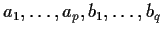 only and is the same for both
normal and non-normal data.
only and is the same for both
normal and non-normal data.
Model assessment.
Having fitted an ARIMA model you get (essentially automatically)
fitted residuals
 . Most of the fitting methods lead to
fewer residuals than there were in the original series. Since the
parameter estimates are consistent (if the model fitted is correct,
of course) the fitted residuals should be essentially the true
. Most of the fitting methods lead to
fewer residuals than there were in the original series. Since the
parameter estimates are consistent (if the model fitted is correct,
of course) the fitted residuals should be essentially the true
 which is white noise. We will assess this by plotting the estimated
ACF of
and then seeing if the estimates are all close
enough to 0 to pass for white noise.
which is white noise. We will assess this by plotting the estimated
ACF of
and then seeing if the estimates are all close
enough to 0 to pass for white noise.
To judge close enough we need asymptotic distribution theory for autocovariance estimates.