


Given data
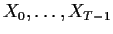 our goal will be to guess, or
forecast,
our goal will be to guess, or
forecast,  or more generally
  . There are a variety
of ad hoc methods as well as a variety of statistically
derived methods. I illustrate the ad hoc methods with the
exponentially weighted moving average (EWMA). In this case
we simply take
. There are a variety
of ad hoc methods as well as a variety of statistically
derived methods. I illustrate the ad hoc methods with the
exponentially weighted moving average (EWMA). In this case
we simply take

 makes it a weighted average:
 .
If we take
.
If we take  near to 1 we are almost using the sample mean while if
we take near 0 we are virtually using
near to 1 we are almost using the sample mean while if
we take near 0 we are virtually using  . You are supposed
to choose to trade off the desire to use lots of data against the
possibility that the structure of the series has changed over time.
. You are supposed
to choose to trade off the desire to use lots of data against the
possibility that the structure of the series has changed over time.
Statistically based methods concentrate on some measure of the size of
 ;
the mean squared prediction error
;
the mean squared prediction error
![$ {\rm E}([X_T-{\hat X}_T]^2)$](img10.gif) is
the most common.
is
the most common.
In general
 must be some function
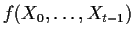 .
The mean squared prediction error can be seen by conditioning
on the data to be minimized by
.
The mean squared prediction error can be seen by conditioning
on the data to be minimized by

 's this would be hard to compute but
for Gaussian processes the solution is the usual linear regression of
on the data, namely
's this would be hard to compute but
for Gaussian processes the solution is the usual linear regression of
on the data, namely
 is given by

When  is large the computation of these forecasts is difficult
in general. There are some shortcuts, however.
is large the computation of these forecasts is difficult
in general. There are some shortcuts, however.
Forecasting AR( ) processes
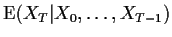
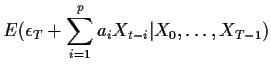
When the process is an AR the computation of the conditional
expectation is easier:
 |
 |
 |
|
|
 |
||
|
 |
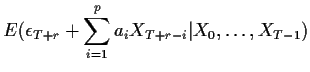
 we have the recursion
 |
|
 |
|
|
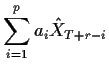 |
Notice the the forecast into the future uses current values
where these are available and forecasts already calculated
for the other 's.
Forecasting ARMA( ) processes
An ARMA() can be inverted to be an infinite order AR
process. We could then use the method just given for the
AR except that now the formula actually mentions values of  for
for  . In practice we simply truncate the series and
ignore the missing terms in the forecast, assuming that the
coefficients of these omitted terms are very small. Remember
each term is built up out of a geometric series for
. In practice we simply truncate the series and
ignore the missing terms in the forecast, assuming that the
coefficients of these omitted terms are very small. Remember
each term is built up out of a geometric series for
 with
with
 .
.
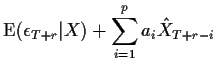
A more direct method goes like this:
 |
|
 |
|
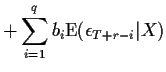 |
 '' means given the observed data.
Whenever the time index on an epsilon is or more the conditional
expectations are 0. For 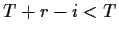 we need to guess the value
of
we need to guess the value
of
 . The same recurtion can be re-arranged to
help compute
. The same recurtion can be re-arranged to
help compute
 for
for
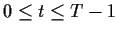 , at least
approximately:
, at least
approximately:
 |
|
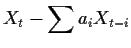 |
|
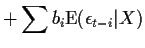 |

 and then using the recursion. The coefficients
  are such that the effect of getting these values of
  wrong
is damped out at a geometric rate as we increase so if we have
enough data and the smallest root of the characteristic polynomial for
the MA part is not too close to 1 then we will have accurate values
for
wrong
is damped out at a geometric rate as we increase so if we have
enough data and the smallest root of the characteristic polynomial for
the MA part is not too close to 1 then we will have accurate values
for
 for near .
As we discussed in the section on estimation these computed
estimates of the epsilon's can be improved by backcasting the
values of
 for negative and then forecasting and
backcasting, etc.
for negative and then forecasting and
backcasting, etc.
Forecasting ARIMA( ) series
If
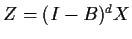 and is ARIMA() then we:
compute
and is ARIMA() then we:
compute  , forecast and reconstruct by
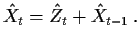
undoing the differencing. For
, forecast and reconstruct by
undoing the differencing. For  for example we
just have
for example we
just have
Forecast standard errors
You should remind yourself that the computations of conditional
expectations we have just made used the fact that the 's and
's are constants - the true parameter values. In fact we
then replace the parameter values with estimates. The quality of
our forecasts will be summarized by the forecast standard error:
![$\displaystyle \sqrt{{\rm E}[(X_t-{\hat X}_t)^2]} \, .
$](img55.gif)
If
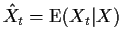 then
then
 so that our forecast standard error is just the variance of
 .
.
Consider first the case of an AR(1) and one step ahead forecasting:
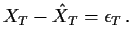
 so that
the forecast standard error is just
so that
the forecast standard error is just
 .
.
For forecasts further ahead in time we have
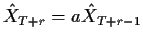


 we can check that the forecast variance converges
to
we can check that the forecast variance converges
to
 s. When you forecast a
stationary series far into the future the forecast error is just the
standard deviation of the series.
s. When you forecast a
stationary series far into the future the forecast error is just the
standard deviation of the series.
Turn now to a general ARMA(). Rewrite the process as the infinite
order AR
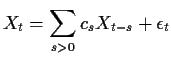
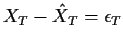 .
.
Parallel to the AR(1) argument we see that
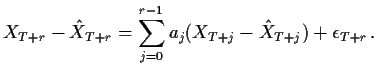
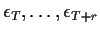 .
.
A simpler approach is to write the process as an infinite order MA:
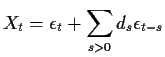
 . Now if we treat conditioning on the data
as being effectively equivalent to conditioning on all for
. Now if we treat conditioning on the data
as being effectively equivalent to conditioning on all for  we
are effectively conditioning on
for all . This means that
we
are effectively conditioning on
for all . This means that
 |
|
 |
|
|
 |
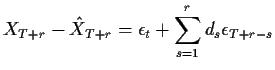
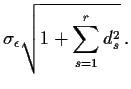 this converges to
  .
.
Finally consider forecasting the ARIMA() process
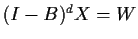 where
where  is ARMA().
The forecast errors in can clearly be written as a linear combination of
forecast errors for permitting the forecast error in to be written as
a linear combination of the underlying errors
. As an example consider
first the ARIMA(0,1,0) process
is ARMA().
The forecast errors in can clearly be written as a linear combination of
forecast errors for permitting the forecast error in to be written as
a linear combination of the underlying errors
. As an example consider
first the ARIMA(0,1,0) process
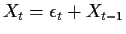 . The forecast of
 is just 0 and so the forcast of is just

The forecast error is

 . Notice that the forecast standard
error grows to infinity as
. For a general ARIMA(
. Notice that the forecast standard
error grows to infinity as
. For a general ARIMA( )
we have
)
we have
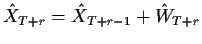
 )
to compute standard errors.
)
to compute standard errors.
Software
The S-Plus function arima.forecast can do the forecasting.
Comments
I have ignored the effects of parameter estimation throughout. In ordinary least squares
when we predict the  corresponding to a new
  we get a forecast standard error
of
we get a forecast standard error
of

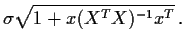
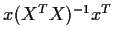 which is
the variance of the fitted value. Typically this value is rather smaller than the 1 to
which it is added. In a 1 sample problem for instance it is simply
which is
the variance of the fitted value. Typically this value is rather smaller than the 1 to
which it is added. In a 1 sample problem for instance it is simply  . Generally
the major component of forecast error is the standard error of the noise and the
effect of parameter estimation is unimportant.
. Generally
the major component of forecast error is the standard error of the noise and the
effect of parameter estimation is unimportant.