


Definition: If
 is a white noise series and
  and
and
 are constants then

Question: From observations on X can we estimate the
b's and
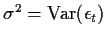 accurately? NO.
Definition: A model for data X is a family
 of possible distributions for X.
Definition: A model is identifiable if
 implies
that
implies
that
 ;
that is different
;
that is different  's
give different distributions for the data.
's
give different distributions for the data.
When a model is unidentifiable there are different values of which make exactly the same predictions about the data so the data
do not permit you to distinguish between these
values.
Example: Suppose  is an iid
 series and that
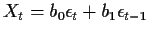 .
Then the series X has
mean 0 and covariance
.
Then the series X has
mean 0 and covariance
 's by a and divide both b0 and b1 by a then the
covariance function of X is unchanged. Thus we cannot hope to estimate
all three parameters, b0, b1 and
's by a and divide both b0 and b1 by a then the
covariance function of X is unchanged. Thus we cannot hope to estimate
all three parameters, b0, b1 and  .
We choose to set
the parameter b0 to be 1. Now are the parameters b1 and identifiable? We try to solve the equations
.
We choose to set
the parameter b0 to be 1. Now are the parameters b1 and identifiable? We try to solve the equations


You should notice two things:

 we can see that
C(1)/C(1) is the correlation between Xt and Xt+1. We
have proved that for an MA(1) process this correlation cannot
be more than 1/2 in absolute value.
we can see that
C(1)/C(1) is the correlation between Xt and Xt+1. We
have proved that for an MA(1) process this correlation cannot
be more than 1/2 in absolute value.

The two solutions multiply together to
give the constant term 1 in the quadratic equation. If the two roots
are distinct it follows that one of them is larger than 1 and the other
smaller in absolute value. Let b and b* denote the two roots.
Let
 and
and
 .
Let
.
Let
 be
iid
be
iid
 and
and
 be iid
 .
Then
.
Then
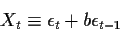
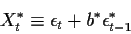
 .
.
Reason: We can manipulate the model equation for Xjust as we did for and autoregressive process last time:
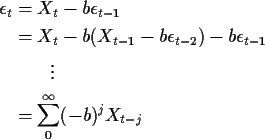
This manipulation makes sense if |b| < 1. If so then we can
rearrange the equation to get

If, on the other hand, |b| > 1 then we can write

 ;
;
 is also white noise.
We find
is also white noise.
We find


Definition: An MA(p) process is invertible if it can be written in the form

Definition: A process X is an autoregression of order p (written AR(p))
if

Definition: The backshift operator transforms a time series into another
time series by shifting it back one time unit; if X is a time series
then BX is the time series with

 to denote B composed with itself j times so that
Now we use B to develop a formal method for studying the
existence of a given AR(p) and the invertibility of
a given MA(p). An AR(1) process satisfies


If b is a real number then


Now consider a general AR(p) process:


 is a polynomial of degree p. It thus has
(a theorem of C. F. Gauss) p roots
is a polynomial of degree p. It thus has
(a theorem of C. F. Gauss) p roots
 .
(None of the roots is 0 because the constant term in
is 1.) This means we can factor
as
.
(None of the roots is 0 because the constant term in
is 1.) This means we can factor
as


 is larger
than 1 in absolute value (actually the roots can be complex
and I mean larger than 1 in modulus).
is larger
than 1 in absolute value (actually the roots can be complex
and I mean larger than 1 in modulus).
 is invertible if and only if all roots of the characteristic
polynomial
is invertible if and only if all roots of the characteristic
polynomial
 lie outside
the unit circle in the complex plain.
lie outside
the unit circle in the complex plain.
 for which the
process is invertible.
for which the
process is invertible.
 is
asymptotically stationary if and only if all roots of the characteristic
polynomial
is
asymptotically stationary if and only if all roots of the characteristic
polynomial
 lie outside the
unit circle in the complex plain.
lie outside the
unit circle in the complex plain.
(Asymptotically stationary means this: if you make
 anything at all and use the equation defining the AR(p)to define all the rest of the X values then as
 the process
gets closer to being stationary. The assertion of asymptotic stationarity
is equivalent here to the existence of an exactly stationary solution
of the equations.)
the process
gets closer to being stationary. The assertion of asymptotic stationarity
is equivalent here to the existence of an exactly stationary solution
of the equations.)
Definition: A process X is an ARMA(p,q) (mixed autoregressive of order pand moving average of order q) if it satisfies
 is white noise and


The ideas we used above can be stretched to show that the process X is
identifiable and causal (can be written as an infinite order
autoregression on the past) if the roots of  lie outside the
unit circle. A stationary solution, which can be written as an infinite
order causal (no future s in the average) moving average, exists
if all the roots of
lie outside the
unit circle. A stationary solution, which can be written as an infinite
order causal (no future s in the average) moving average, exists
if all the roots of  lie outside the unit circle.
Other Stationary Processes:
random variables and that  is a constant.
Then
is a constant.
Then

![\begin{align*}\text{Cov}(X_t,X_{t+h}) & = \sigma^2 \left[\cos(\omega t)\cos(\ome...
...n(\omega t)\sin(\omega(t+h))\right]
\\
& = \sigma^2 \cos(\omega h)
\end{align*}](img72.gif)

 are suitable random variables so that the
trajectory of X is just a sine wave.
are suitable random variables so that the
trajectory of X is just a sine wave.
A Poisson process is a process N(A) indexed by subsets A of the
real line with the property that each N(A) has a Poisson distribution
with parameter
 and if
 are any non-overlapping subsets of R then
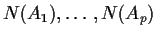 are independent. We often use N(t) for
N([0,t]).
are independent. We often use N(t) for
N([0,t]).
To define a shot noise process we let X(t) =1 at those t where
there is a jump in N and 0 elsewhere. The process X is stationary.
If we have some function g defined on
 and decreasing
sufficiently quickly to 0 (like say
g(x) =e-x) then the process
and decreasing
sufficiently quickly to 0 (like say
g(x) =e-x) then the process

