There are a wide range of strategies employed to make the experience of elearning more interactive, ranging from organizing a layered social structure (e.g. student peer groups, peer groups-to-TA, student-to-TA, student-to-instructor channels of communication and work flows), to embedding polls and short quizzes into the lecture material, to using Slack or Discord for fast messaging in a remote work context, using other productivity tools established for all the industries where remote work is common (e.g. Trello, Microsoft Teams), etc.
Most MOOCs that I've seen have pretty lively forums managed by TAs, so there is a gradient between people who do it purely in a self-learning mode while others rely more on the social interaction features, depending on their level of expertise or learning preferences etc.
It also could be an interesting time for new experiments, e.g. it's a lot easier to justify having two professors team-teach a course if you have 400 students in it! The larger the online enrollment, the more FTEs in the budget, the more jobs there are for grad students, etc.
Maybe the TPCs across the university should give
everyone a one semester 'break' on professional obligations for this year as everyone applies their research skills to
catching up on elearning literature and practices as it applies to their course areas?
A much-weakened economy means a lot less money going into govt coffers, which means less money for education and for everything else. However, high unemployment means more people looking to upgrade their skills, knowledge and professional capacities. So, I think one way or the other (whether we embrace online learning reluctantly or by necessity, or even enthusiastically!), there are new ideas and practices we all have to catch up on, and balances to be struck in managing societal needs and the institutional bottom lines, etc.
A straightforward step would be to see if there are areas in a unit's curriculum that can be 'unbundled' into an online certificate to meet increased demand in online learning. That sort of thing is relatively easy to do and doesn't require inventing new programs or content, but rather is more about optimizing one's current offerings.
Similarly, new shorter-term study options can be put together by combining courses across units for more interdisciplinary possibilities. Another option might be an accelerated second bachelors which waives all the extra UG requirements (UBC has a comp sci program like this). Looking around at what other institutions have done gives a pretty clear sense of what's possible.
Michael Filimowicz, PhD
Faculty of Communication, Art and Technology
School of Interactive Arts and Technology | Simon Fraser University
Office: SUR 2818 | 250-13450 102 Ave. Surrey, BC V3T 0A3
T: 778-782-8178 | Skype ID: michael.filimowicz
Sent: Sunday, April 5, 2020 11:49 AM
To: David Hik; Philippe Pasquier; Michael Filimowicz
Cc: academic-discussion (academic-discussion@sfu.ca)
Subject: Re: addressing the unemployment problem
I think the issue may NOT be MOOcs., of which there are many. How do we teach effectively and interactively to classes of 20-150? Note I say interactively. MOOCs are usually very self-driven. WE need to consider how we engage students in near-real-time and collaborative contexts. For someone like me who teaches applied science, programming and design, types of courses, it’s a critical question.
Lyn Bartram
Professor | School of Interactive Arts and Technology
Director | Vancouver Institute of Visual Analytics
Simon Fraser University | Surrey
250, 13450 102 Ave., Surrey, B.C. V3T 0A3
T: 778.782.7439 | M: 604.908.9954 | www.sfu.ca/~lyn

From: David Hik <david_hik@sfu.ca>
Date: Sunday, April 5, 2020 at 11:41 AM
To: Philippe Pasquier <pasquier@sfu.ca>, Michael Filimowicz <michael_f@sfu.ca>
Cc: "academic-discussion (academic-discussion@sfu.ca)" <academic-discussion@sfu.ca>
Subject: Re: addressing the unemployment problem
Hi Phillippe and Michael
I agree with you, that MOOCs have great potential to take what we do inside the classroom and make this material available (to quote Michael) “at scale”. Not every course or topic can be best delivered online or at scale, but this could be a good time to have more conversations about how to facilitate access to online SFU course materials (both for credit, for life-long learning, and as a public service), and accelerate the development of new online courses and programs (esp. as CODE courses are transitioned to the departments). There is a good discussion about some of these issues on @HigherEdSurge https://www.edsurge.com/higher-ed
As Phillippe mentions below, I have had a some experience with MOOCs, co-developing two courses that curiously continue to attract students from around the world.
Sheep in the Land of Fire of Ice (hosted by University of Iceland on EdX platform) is a shorter 4-Lesson course, and it is probably not suitable to offer for credit to SFU students (but could be used as a supplemental resource for other courses).
Mountains 101 (hosted by University of Alberta on Coursera platform) is a 12-Lesson MOOC that I have decided to adapt and offer for-credit as SCI 190 in the Spring 2020 Semester (http://www.sfu.ca/outlines.html?2020/summer/sci/190/d100). There are no prerequistites. So please let your students know about this in case they are interested (course description below).
cheers
David
David Hik
Associate Dean - Academic, Faculty of Science
&
Professor
Department of Biological Sciences (SSB 8157 - office; B9223 - lab)
8888 University Drive, Simon Fraser University
Burnaby, BC, V5A 1S6, Canada
Phone: 778-782-6547 (office)
https://www.sfu.ca/biology/people/profiles/dhik.html
Acknowledging that we live and work on the unceded territory of the Musqueam, Tsleil-Waututh, and Squamish First Nations
SUMMER 2020 - SCI 190 D100
SPECIAL TOPICS IN SCIENCE INTERDISCIPLINARITY (3): Intro to Mountain Studies
Class Number: 5677 Delivery Method: Distance Education - http://www.sfu.ca/outlines.html?2020/summer/sci/190/d100
Course Description: Mountain Studies is an interdisciplinary field of scholarship emphasizing the interconnections between the physical, biological, and human dimensions of mountain environments. This introductory course focuses on the physical (geology, climate, hydrology, glaciers, hazards), the physiological (bodies at altitude), the biological (plants, animals, ecology, conservation), and the social and cultural (mountains in popular imagination, literature, tourism, economies) dimensions of these global landscapes. Focusing on western Canada, we will examine the complex processes of change that are shaping local and regional mountain environments around the globe, past and present. Melding practice and theory, this lecture-based survey course provides a general introduction draws from scholarship from the earth sciences, biological sciences, applied physiology and environmental sciences. Crossing conventional disciplinary borders, this course will provide a foundational introduction to further study.
Prerequisite: None. The final exam will be held on August 14 from 12:00 - 15:00.
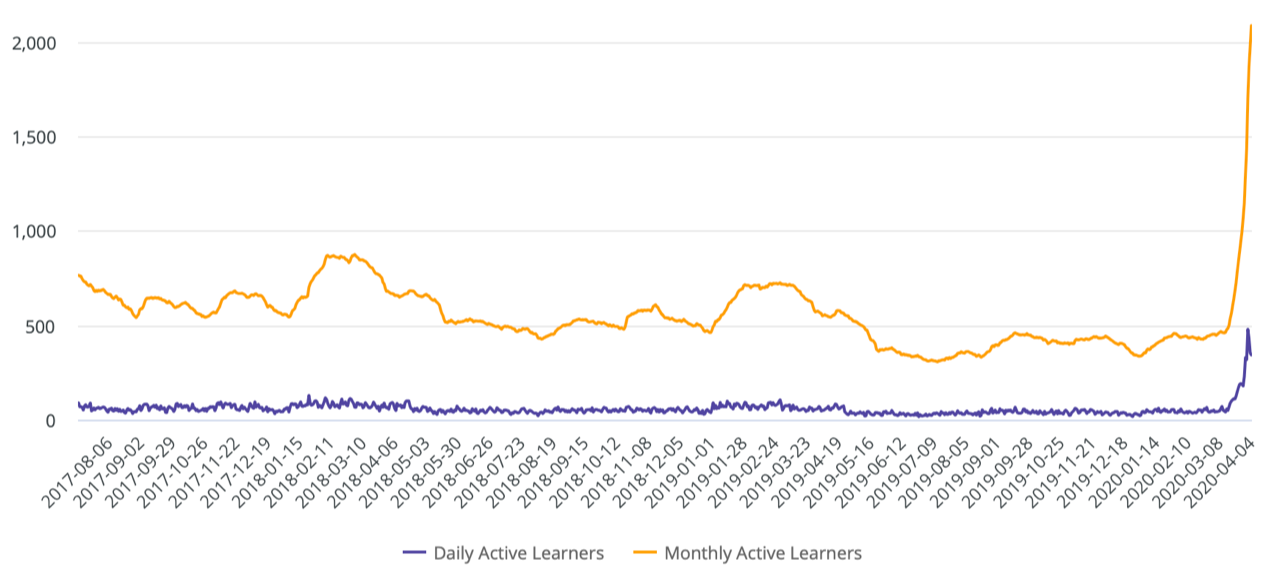
PS - the uptick in global online learning has been hard to ignore in the past month! - here is the increase in both daily and monthly active learners for Mountains 101 since the start of #stayathome
On Apr 4, 2020, at 4:36 PM, Philippe Pasquier <pasquier@sfu.ca> wrote:
Well said, Michael.
While the COVID-19 pandemic is not a conspiracy to accelerate the CODE transition, now is a good time to consider the potential virtues of online education (given that we already know and value in-person teaching).
I have been fortunate to get SFU to sign in for a course on the Kadenze MOOC:
and, in fact, students can get SFU credits by completing the two courses online.
There are probably others reaching both SFU and non-SFU students. I know that Pr. David Hik is also teaching a popular MOOC class, but not sure if students can get SFU credits in his case:
Stay safe everyone.
Regards,
--
Philippe Pasquier
------------------------------------------------PhD, MSc, Associate Professor,
Associate Dean Academic,
Faculty of Communication, Arts and Technology (FCAT)
Director, Metacreation Lab for Creative AI.
School of Interactive Arts and Technology (SIAT),
Simon Fraser University, Vancouver, Canada.
http://www.sfu.ca/pasquier | http://www.Metacreation.net
http://MusicalMetacreation.org | http://MovementComputing.org/
Kadenze Class on Creative AI: https://tinyurl.com/ycvleqlm
---------------------------------------------------------------
<OutlookEmoji-157231183098239dc9244-b96c-4d92-a63a-95ca8db5cd3a.png>Simon Fraser University is based on the unceded traditional territories of the Coast Salish people.
From: Michael Filimowicz <michael_f@sfu.ca>
Sent: April 4, 2020 9:39 AM
To: academic-discussion (academic-discussion@sfu.ca)
Subject: addressing the unemployment problem
I think it's important to look beyond our own needs to consider those of the wider society. Millions of jobs lost, which even if the pandemic ended tomorrow, many won't be coming back. The university, as a core institution of civilization, has a special obligation to do what it can to help those suddenly economically dislocated to gain a foothold in the economy.
While many in the academy are not thrilled with online learning (it seems no number of decades of research can counter general perceptions based on Medieval traditions), there's really no other way to educate at scale than online delivery methods. Society is going to have a major education-at-scale problem (actually, it has already had this problem for many years, given the millions of annually vacant technology jobs, which the 'bootcamp' industry has addressed– now this education-at-scale problem has become much worse).
South of the border, University of Washington invested years ago in infrastructure to educate millions of students online, and its Continuum College annually awards 50,000 + certificates and degrees. A forward-thinking approach to address vast society unemployment would be to consider ideas that often seem to be anathema to the general local discourse, such as awarding university credit to students who complete courses on the MOOC platforms, which many other universities (and, very high quality ones, too), have pursued:
Best,
Michael Filimowicz, PhD
Faculty of Communication, Art and Technology
School of Interactive Arts and Technology | Simon Fraser University
Office: SUR 2818 | 250-13450 102 Ave. Surrey, BC V3T 0A3
T: 778-782-8178 | Skype ID: michael.filimowicz