| |
functional description
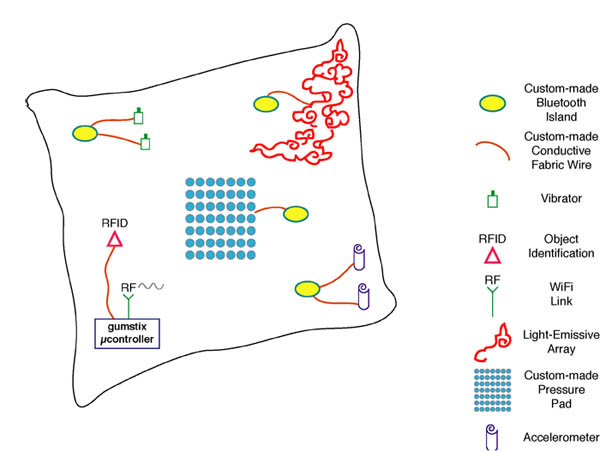
- A (soft) object is custom-made fabric sac filled with soft cushion-like material and embedded with electronics. Each soft object forms a sensory-motor communication system that can exchange physiological signals and responses with other objects in the system.
- Each soft object has a small gumstix controller, that coordinates and interprets the data communication. Along with gumstix controller, there are several small circuits that control embedded transducers - which include be light emmisive array(s) and vibrating motors - and that are mounted on individual circuit boards, called ‘islands’. These ‘islands’ interact with the gumstix unit via a Personal Area Network, or PAN, constructed using Bluetooth technology.
- Connections that cannot be made wirelessly are made using conductive fabric ‘wires’ which are composed of a transparent directionally conductive fabric contained in a non-conductive fabric or sewn directly into the cushion to form portions of the cushion itself.
- There is also a pressure-sensitive pad area, constructed of the conductive fabric wires, connected to one of the gumstix controller, to provide touch-based gesture data.
- The gumstix has an RFID sensor that is used to identify nearby soft objects via small tags embedded within each soft object.
- This signal is conveyed to the gumstix via the encoder, where it is analyzed and then transmitted to a central system, along with information on which (soft) objects are near to this soft-object as well as any gestures reported from the pressure-sensitive pad.
- The central system routes the analyzed signals to other (soft) objects, based on the ‘neighbourhood’ information that has been gathered. At the same time, the touch signals from groups of soft-objects are gathered together and analyzed; movement data can also be displayed on each soft-object as a pattern of light using special light-emissive fibres controlled by the gumstix. The Gumstix also activates vibrating motors, using their Bluetooth ‘islands’, when the gesture matches their criteria.
- The central system converts the data obtained from the cushions - the physiological data, the RFID data and the pressure pad data - into a visible and audible representation of the state of the installation space and its participants. A video projection system and multiple speakers are used to convey this representation to the participants within the space.
|