
Chapter Contents

Previous

Next
|
Chapter Contents |
Previous |
Next |
| UCHART Statement |
| See SHWUEX1 in the SAS/QC Sample Library |
This example illustrates how you can apply tests for special causes to make u charts more sensitive to special causes of variation.
A textile company inspects rolls of fabric for defects. The rolls are one meter wide and 30 meters long. The following statements create a SAS data set named FABRIC3, which contains the number of fabric defects for 20 rolls of fabric:
   data fabric3;
      input roll defects @@;
      datalines;
    1   6    2   9    3  14    4  17
    5   3    6   8    7   9    8   2
    9  14   10   1   11   3   12   5
   13   6   14   9   15  10   16  12
   17  11   18   4   19   9   20   4
   ;
The following statements create a u chart and tabulate the
information on the chart.
The chart and tables are shown in Output 41.1.1 and Output 41.1.2.
   title1 'u Chart for Fabric Defects';
   title2 'Tests=1 to 4';
   symbol v=dot c=vig;
   proc shewhart data=fabric3;
      uchart defects*roll / subgroupn = 30
                            tests     = 1 to 4
                            ltests    = 20
                            zonelabels
                            tabletests
                            cframe    = steel
                            cinfill   = ligr
                            ctests    = black
                            coutfill  = yellow
                            cconnect  = vig;
   run;
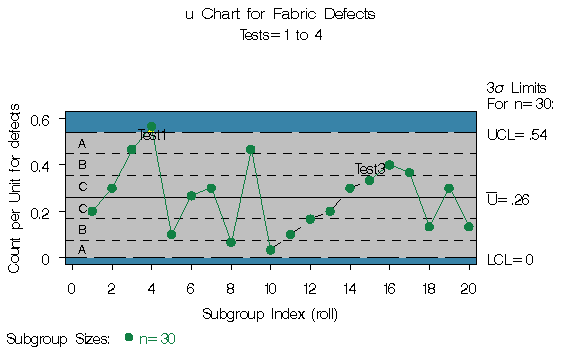
The TESTS= option requests Tests 1, 2, 3, and 4, which are described in Chapter 48, "Tests for Special Causes." Only Tests 1, 2, 3, and 4 are recommended for u charts. The ZONELABELS option requests the zone lines, which are used to define the tests, and displays labels for the zones. The LTESTS= option specifies the line type used to connect the points in a pattern for a test that is signaled. The TABLETESTS option requests a table of the values of ui and the control limits, together with a column indicating the subgroups at which the tests are positive.
Output 41.1.1 and Output 41.1.2 indicate that Test 1 is positive for Roll 4 and Test 3 is positive at Roll 15.
Output 41.1.1: Tests for Special Causes Displayed on u Chart
|
Output 41.1.2: Tabular Form of u Chart
|
Chapter Contents |
Previous |
Next |
 Top |
Copyright © 1999 by SAS Institute Inc., Cary, NC, USA. All rights reserved.