The Auditory Perception of SpaceHow does it differ from the visual model?Does the visual model bias our understanding of space: a fixed, detailed and stable entity through which we can move?

Perceived Auditory Space Depends on Time
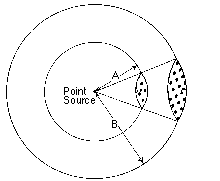
(1) The space or volume within a sound.
(2) The sense of space created by all of the sounds within a soundscape.
Note: traditional "design" strategies (such as music performance and applied acoustics) try to balance this "inner space" of sounds with the "external space" into which they are projected. Imbalances may be regarded as "noise" or intrusions where such sounds are "inappropriate" for the given environment.
Speed and Frequency
v = f . λ
where v is the speed of sound (feet or metres/sec)λ is the wavelength for a given frequency f (vibrations/sec)
Substance Temperature (°C) Speed (m/sec) Speed (ft/sec) CO2 0 258 816 CO2 35 274 900 Air 0 331.5 1,087 Air 20 344 1,130 Water Vapour 35 402 1,320 Helium 20 927 3,040 Hydrogen 0 1,270 4,165 Water 15 1,437 4,714 Steel - 5,000 16,400

All frequencies travel at the same speed, so they have different wavelengths and arrive simultaneously at the ear as a coherent, complex vibration analogous to the original source.
Reflected Sound and Reverberation
Time delays caused by travelling longer paths due to reflection (approx. 1 foot per ms)
Frequency differences in absorption, reflection and sound propagation
The Perceived Sound Source and its Space are Linked
Voice in different spaces, indoors and outdoors
Echo produced by longer distances to the reflecting surface
Soprano singing close to a mike, then two steps back, showing a change of depth perception
Actor convolved with the impulse response of a theatre, with direct and reverberant portions varied
Footsteps recorded in a covered bridge near Chatham, New Brunswick
Footsteps recorded in a fixed position, processed to simulate movement in an acoustically dry stairwell, and a highly reverberant one (example by Gary Kendall, quoted in M. Mathews, ed. Current Directions in Computer Music Research)
IMPULSE RESPONSE AND CONVOLUTION
Convolving a sound with the impulse response of a space results in the sound appearing to be located in that space.
Impulse response of cathedral in Busetto, ItalyDry vocal sound recorded in a studioConvolution of vocal sound with impulse responseAuto-Convolution of the sound with itself to expand its inner space
Uncorrelated reflections (highly coloured in frequency) arrive later at the ear and create a sense of space.
Perception of Space and Interaction with the Space
Binaural localization and Recording
Cocktail Party Effect
Auditory Scene Analysis
Kemar artificial head (kunstkopf)
Note: binaural stereo experiments date back to the 1930s at Bell Labs with "Oscar" and the Neumann Kunstkopf's in the 1960s and 70s
Binaural recording of clarinet & drums
Binaural recording of a jet passing overhead (examples from R. Duda's Auditory Localization Demonstrations)
Cocktail Party Effect Same voice doubled at same location (mono), and then at two locations (stereo); notice how easy it is to follow even the same voice when spatially separated from another; this reflects the brain's ability to enhance one neural signal and suppress others (assuming you have good hearing ability! those with hearing impairment cannot do this readily)
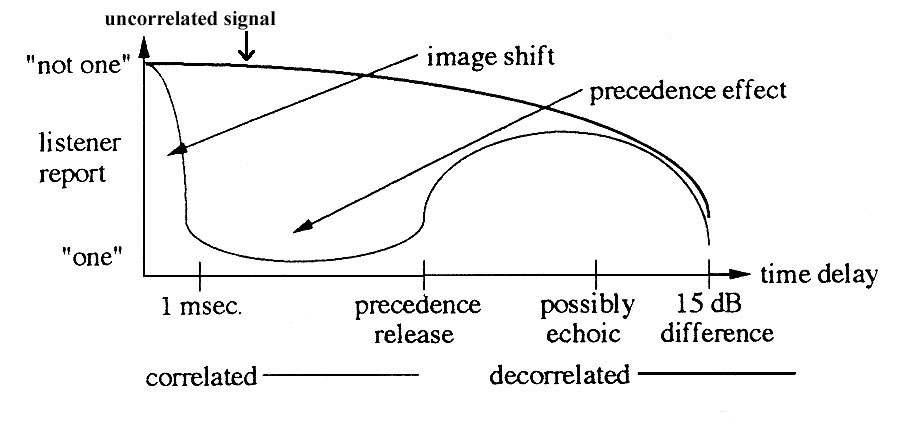
Precedence Effect
Listeners' subjective impression of correlated and uncorrelated sound sources based on delay time of arrival (from Gary Kendall, "The effects of multi-channel signal decorrelation in audio reproduction", ICMC Proceedings 1994, pp. 319-326.
Brick struck twice, then reversed in low and highly reverberant rooms; this demonstrates how the brain suppresses late arriving sounds (e.g. reverberant decay); when the decay is heard first, it usually sounds twice as long
Speech reversed in reverberant space and
Reversed speech in reverberant space played backwards; notice how the reverberant voice is almost decorrelated enough to become a separate entity
ANECHOIC SPACE <---> INTERACTIVE SPACES <---> DIFFUSE SOUND FIELD "the sound is the sound" ------ sound interacts with the space -------- "the sound is the space" Recording of a brick being struck in an anechoic chamber
Anechoic chamber, Bell labs
Marble-lined lecture hall, Fogg Museum, 1895,
studied by Wallace SabineIndoor swimming pool creating a diffuse sound field
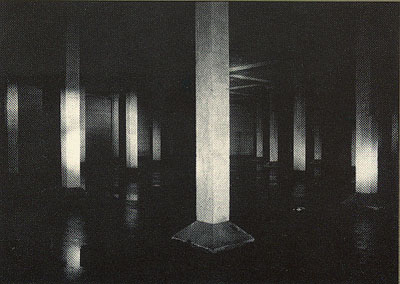
Recording by Pauline Oliveros in the underground "Cistern", Fort Worden, Washington with 45 sec. reverb time
Subjective impressions of concert halls (after M. Barron, "Subjective study of British symphony concert halls," Acustica, 66, 1-14, 1988), quoted in J.S. Bradley, "The evolution of newer auditorium acoustic measures," Canadian Acoustics, 18(4), 13-23, 1990.
Two subgroups, one preferring reverberance, the second preferring intimacy (i.e. clarity and definition), after Barron, op cit. ---->
Auditory Scene Analysis Piazza in Cembra, Italy, with three components to the auditory scene (foreground events, bell in distance, church interior with choir in middle)
Vancouver Stock Exchange, trading floor, 1970s, with competing voices
Is there a relation to Bernie Krause's "Niche Hypothesis"? Acoustic space as habitat?
Acoustic Ecology and the Architectural Design of Acoustic Space
Sound mediates the listener's relationship to the environment (positively or negatively), starting with orientation
Note: the simultaneous perception of the qualities of a sound and the space in which it occurs, is an example of auditory "dual processing"
A balance between listening and soundmaking creates an interactive relationship
The Acoustic Community A bounded space where the shared experience of sound creates identity and interaction.
What is "local" and what is coming from "the outside"What "belongs" and what is an "intrusion", creating sound pollution
Characteristic ambience, and keynote sounds that are background to other perceptions
Information rich through familiar sound signals and contextually informative foreground sounds
Culturally rich through a tradition of Soundmarks
Lo-Fi Soundscapes: information poor, sounds lack character, high degree of masking, not on a human scale
a few dominant species with little diversity crowd out numerous smaller speciesHi-Fi Soundscapes: information rich, sounds have character and aural complexity, operate on a human scale
the acoustic community is characterized by a Variety of sounds, the Complexity of their interpretation and a Balance created by various factors
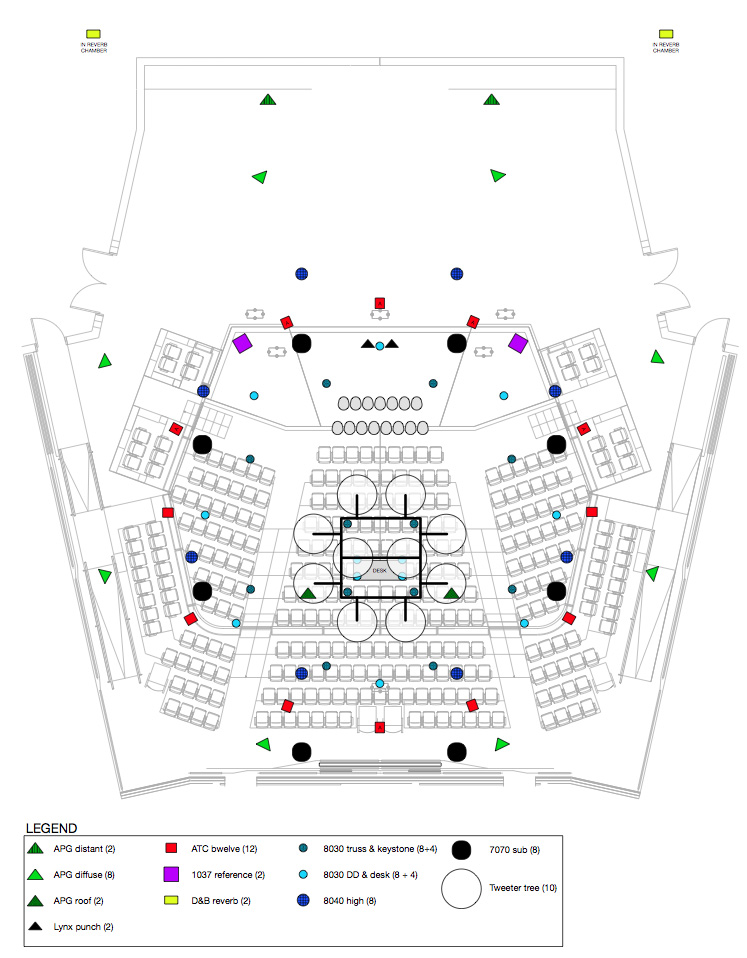
Multi-channel / multi-speaker diffusion
Philips Pavilion at the 1958 Brussels World's Fair where Edgard Varèse's Poème Electronique was projected over 425 loudspeakers linked in a number of trajectories
Stereo Diffusion onto Multiple Speakers
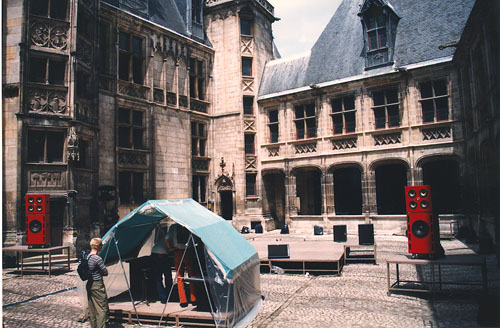
Gmebaphone speaker array at the Palais Jacques Coeur, Bourges, France during the 1970s
Palais Jacques Coeur, 2001 
Speaker layout in the large hall of the Maison de la Culture, Bourges, showing speakers chains V1, V2, V3, W4
Academic Quadrangle, Simon Fraser University, site of ICMC 1985 "quad" concert
ZKM, Karlsruhe, Germany, equipped with 16+ channel playback system (Media Theatre)
and 40+ speaker Klangdom (Kubus Theatre)
Sonic Arts Research Centre, Belfast, equipped with 32 speaker setup on 4 vertical levels Key elements:Immersive, 3-dimensional sonic architectureSpeakers treated as point sources, with minimal "phantom imaging" (i.e. panning)
Uncorrelated material in various speakers can be simultaneously localized
Stereo channels are placed adjacent to each other, not across the L/R field which is more typical of acousmatic diffusion
Common material in various speakers (e.g. similar ambience, reverberation) creates sense of connected space, not an abstract space
Moving sound sources create trajectories of sound
Ideal for soundscape composition
Reference: B. Truax, "Composition and diffusion: space in sound in space," Organised Sound, 3(2), 141-6, 1999.