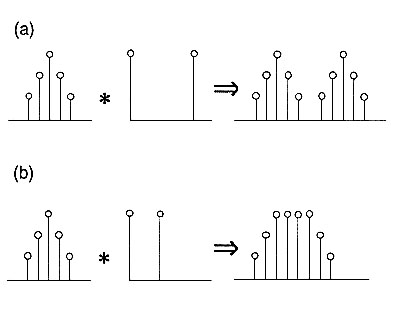
Convolving two waveforms in the time domain means that you are multiplying their spectra (i.e. frequency content) in the frequency domain. By "multiplying" the spectra we mean that any frequency that is strong in both signals will be very strong in the convolved signal, and conversely any frequency that is weak in either input signal will be weak in the output signal.
TIME DOMAIN
FREQUENCY DOMAIN CONVOLUTION < ------------------------------ > MULTIPLICATION MULTIPLICATION < ------------------------------ > CONVOLUTION
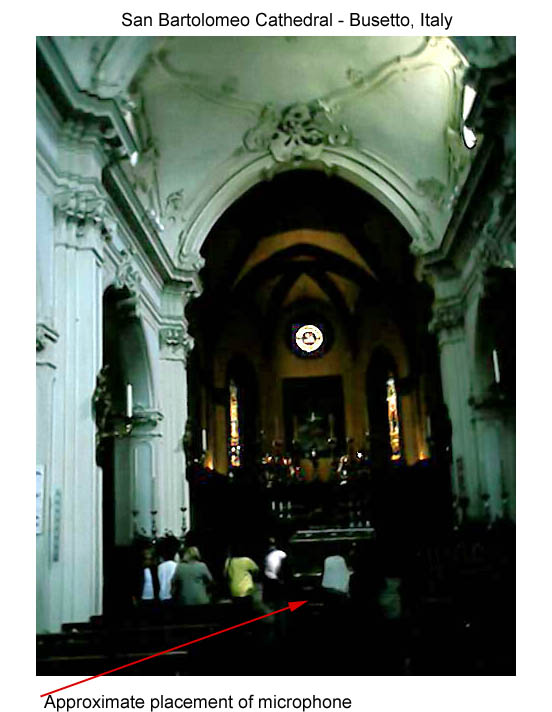
In practice, a relatively simple application of convolution is where we have the "impulse response" of a space. This is obtained by recording a short burst of a broad-band signal and recording the reverberant characteristics of the space. When we convolve any "dry" signal with that impulse response, the result is that the sound appears to have been recorded in that space. In other words, it has been processed by the frequency response of the space similar to how that process would work in the actual space. In fact, convolution in this example is simply a mathematical description of what happens when any sound is "coloured" by the acoustic space within which it occurs, which is in fact true of all sounds in all spaces except an anechoic chamber. The convolved sound will also appear to be at the same distance as in the original recording of the impulse. If we convolve a sound twice with the same impulse response, its apparent distance will be twice as far away.
For instance, in a reverberant space, one might clap one's hands to get a sense of the acoustics of the space. However, a more accurate impulse response would be obtained by firing a starter pistol, as that sound's spectrum would be more evenly distributed and the sound is very short. Given the intrusiveness of such an action as firing a gun, a more acceptable approach would be breaking a balloon and recording the response of the space.
|
|
|
|
|
|
Sue McGowan |
Busseto Cathedral, Italy |
McGowan * Busseto |
McG*McG*Busseto |
| |
Santa Chiara, Italy |
McGowan * SantaChi |
|
| |
San Francesco |
McGowan * SanFran |
|
| |
Nikolai Church |
McGowan * Nikolai |
|
| |
Temple |
McGowan * Temple |
|
| |
Domkyrkan, Sweden |
McGowan * Domkyrkan |
|
|
Derrick Christian (lowD) |
|
DC low D * Busseto |
DC lowD*DC lowD |
|
Christopher Gaze |
Royal Drama Theatre, Sweden |
Gaze * Theatre |
|
| |
Cistern, Fort Worden, WA |
Oliveros * Cistern |
|
|
Piano |
Concertgebouw
|
|
|
Comparison of male
and female voices in smaller church spaces.
In fact, one can convolve any sound with another, not just an impulse responses. In that case, we are "filtering" the first sound through the spectrum of the second, such that any frequencies the two sounds have in common will be emphasized. A particular case is where we convolve the sound with itself, thereby guaranteeing maximum correlation between the two sources. In this case, prominent frequencies will be exaggerated and frequencies with little energy will be attenuated.
|
|
|
|
Bassoon (low)
|
Voice
Bassoon Low
|
|
Bassoon (high)
|
Voice
* Bassoon High
brightened
|
|
Cello Glissando
|
Cello
* Bassoon Low
|
|
Voice counting
|
Cello
* Bassoon High
|
|
John Cage
|
Cage
* Bassoon Low
|
| |
Cage
* Bassoon High
|
However, the output duration of a convolved signal is the sum of the durations of the two inputs. With reverberation we expect the reverberated signal to be longer than the original, but this extension and the resultant "smearing" of attack transients also occurs when we convolve a sound with itself, or with another sound. Transients are smoothed out, and the overall sound is lengthened (by a factor of two in the case of convolving a sound with itself). When we convolve this stretched version with the impulse response of a space, the result appears to be half way between the original and the reverberant version, a "ghostly" version of the sound, so to speak.
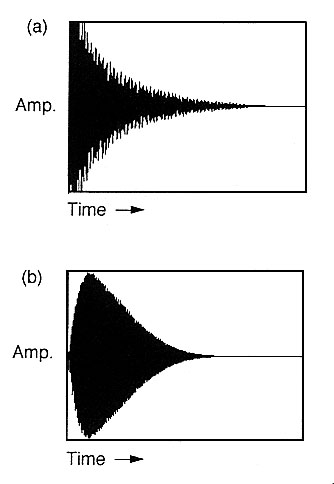
Smearing of attack transients
Ichigenkin (with slide)
Ich * 2
Ich * 4
Ich * 8
Ich * 16
Ich * 32
Shakuhachi (trill)
Shak * 2
Shak * 4
Shakuhachi (breathy)
Shak2 * 2
Shak2 * 4
Since most acoustic sounds (but not common electronic and digital sounds, unfortunately) have spectra that taper off with increasing frequency, the high frequencies may be weak when convolved with a spectrum with similar characteristics. Therefore, some programs such as SoundHack allow the high frequencies to be boosted during convolution. This can also result in the result being "hissy" and therefore equalization needs to be applied.
The inverse of convolving two waveforms is multiplying them, as in ring modulation. In this case we are convolving their spectra which is why ring modulation results in the sum and difference frequencies of each component being present in the output, though an understanding of this result depends on the mathematics of the complex domain. In other words, the basic theorem about the time domain and the frequency domain is that multiplication in one domain is equivalent to convolution in the other domain.
Ring modulation, where the sidebands are the sum and difference of the two inputs, one of which is held constant at 100 Hz, the other swept from 0 Hz to 300 Hz.
Finally, there is a technical difference between "direct convolution", which is a very slow process given that every sample in each signal must be multiplied by every sample in the other signal, and the faster version used by programs like SoundHack which analyzes each signal using an FFT (Fast Fourier Transform) then multiplying those results and performing the Inverse FFT to return the result to the time domain. Besides increasing the speed of the calculation (thereby bringing it into a reasonable working process), other variables involved in the analysis phase are brought into play, such as the window shape used in the analysis. However, in practice, this variable only affects the result quite subtly.

Art text
Art * Art
Art* Art
(1" moving impulse)
Art * Art * Art * Art
Art * Free
Art*Free * Art*Free
Free text
Free * Free
Free * Free * Free * Free
Free text (in Theatre)
Free * Free
Free * Free * Free * Free
Convolution has been used extensively in Barry
Truax's work Temple, as well
as Prospero's Voyage, The Shaman
Ascending, The Way of
the Spirit, From the Unseen World,
as well as the soundscape compositions Chalice Well, Fire Spirits, Aeolian Voices, and Earth and Steel.
Reference:
C. Roads, The Computer Music Tutorial, MIT Press, 1996