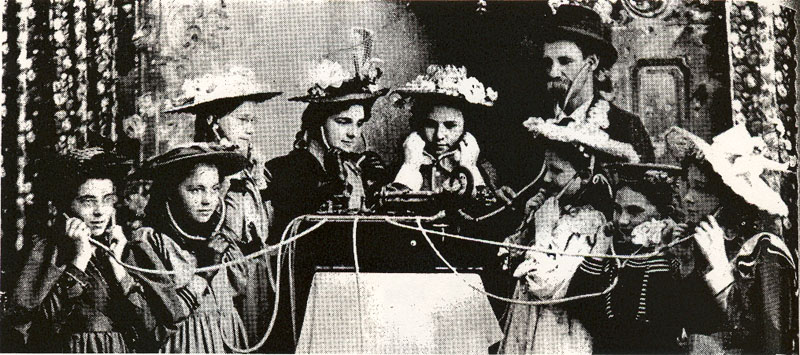
Telharmonium piped into upscale New York restaurants, 1907 to create a pleasant musical ambience – and coincidentally to increase liquor consumption, a side-effect that has been observed in modern times as well (Milliman 1986)
(from R.Weidenaar, Magic Music from the Telharmonium, Scarecrow Press, 1995)
Reference: Milliman, R. 1986. The influence of background music on the behavior of restaurant patrons. Journal of Consumer Research 13: 286-289.
CNR radio in a lounge car, ca. 1923
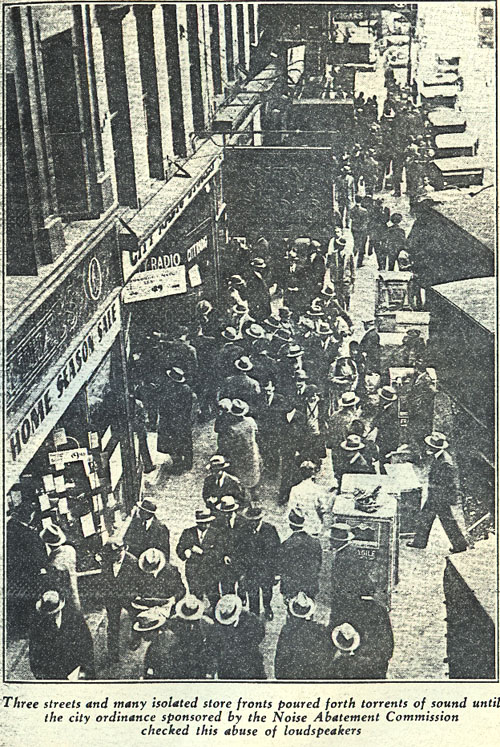
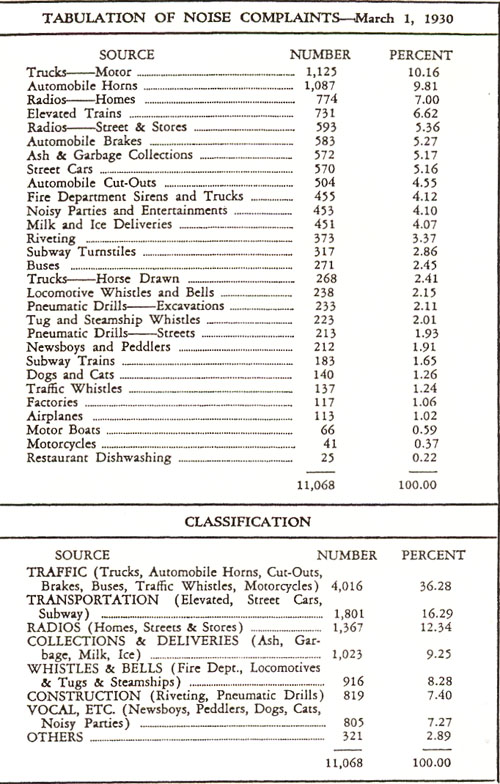
"Radio Row" in New York City, the source of many noise complaints, 1929
The balconies of the houses stood wide open and the voices of the radio sets poured through them. Every bar had its loudspeaker on. The people sitting on the terraces carried on their discussions in shouts and screams. Gossiping women were sitting in the doorways and flocks of children played and made a noise in the middle of the street. Taxis carrying members of the Worker's Militia on their rounds drove up and down the slope. Their brakes screeched when they stopped outside one of the bars. The loudspeaker bawled out the news, and the streets submerged in silence to listen and to hear... It was strange to hear the phrase proclaimed in a badly synchronized chorus along the street, from different altitudes. No two voices were the same. They reached one's ear clashing and repeating each other.Arturo Barea, The Clash, Faber and Faber, London, p. 89.
TIME: mid-1930's
PLACE: Madrid
CIRCUMSTANCE: Spanish Civil War
Music in Industry
"By this time [1943] the number of factories using music in the United States had increased to an estimated 2,000 to 4,000 .... [while in England] an estimated 8,000 war plants were furnishing music to their employees. This figure represented about 90 per cent of British industry. ... by reception of the BBC broadcasts or by playing phonograph records."
"Functional music is that music which, when properly administered, accomplishes specific predetermined ends other than entertainment or pleasure. ... Investigation has shown that a maximum of two and half to three hours of music in any eight-hour work period is the correct amount to use for the most beneficial results. The effects of the music increase in proportion to the amount of music used until this point is reached. After that the effects diminish as more music is added until, with continual music during the work spell, the effects return to the no-music starting point. The employees become conditioned to rejecting the music to the same extent that the machinery noise is rejected. ... Music is placed to counteract the points of fatigue just prior to and during the time when the fatigue peak is setting in. The degree of stimulation is determined by the character of the music used."
R.L. Cardinell, "Music in Industry," in Schullian & Schoen, eds., Music and Medicine, 1948.
__________________________________________________________________________________________________________________________________________________________________________
George Orwell, "Pleasure Spots", 1946
1. One is never alone2. One never does anything for oneself
3. One is never within sight of wild vegetation or natural objects of any kind
4. Light and temperature are always artificially regulated
5. One is never out of the sound of music
"The music - and if possible it should be the same music for everybody - is the most important ingredient. Its function is to prevent thought and conversation, and to shut out any natural sound, such as the song of birds or the whistling of the wind, that might otherwise intrude. The radio is already consciously used for this purpose by innumerable people. In very many English homes the radio is literally never turned off, though it is manipulated from time to time so as to make sure that only light music will come out of it. I know people who keep the radio playing all through a meal and at the same time continue talking just loudly enough for the voices and the music to cancel out."
__________________________________________________________________________________________________________________________________________________________________________
Hildegard Westerkamp, Listening and Soundmaking: A Study of Music-as-Environment, 1990
It is my claim that the music we encounter in the public sphere of the urban soundscape (music-as-environment), constitutes a dominant voice, throwing the relationship between listening and soundmaking off balance. Not only does this music have the power to silence us but it can also change our relationship to listening, that is, it can make us passively accept what we hear. Music-as-environment has become an inescapable presence in the public sphere of our lives ... widely accepted, often desired sound which is at the same time ignored.
Music can be defined as environmental when it accompanies the activities of daily life. In other words, when the activity is the focal point and not the music. This definition applies to any music that has been put into the environment with or without our choosing and with the specific purpose of forming an acoustic backdrop to another activity. There is an inherent contradiction in music-as-environment: the more of it there is, the less it is listened to; the more its presence suggests a musical status quo in the soundscape, the less we tend to use our own voices to make our own music. It has the power to reduce us to passive listeners and discourage us from soundmaking. It can, in fact, rob us of our desire to listen and make sounds.
H. Westerkamp's Cool Drool; background music and the embedding model
__________________________________________________________________________________________________________________________________________________________________________
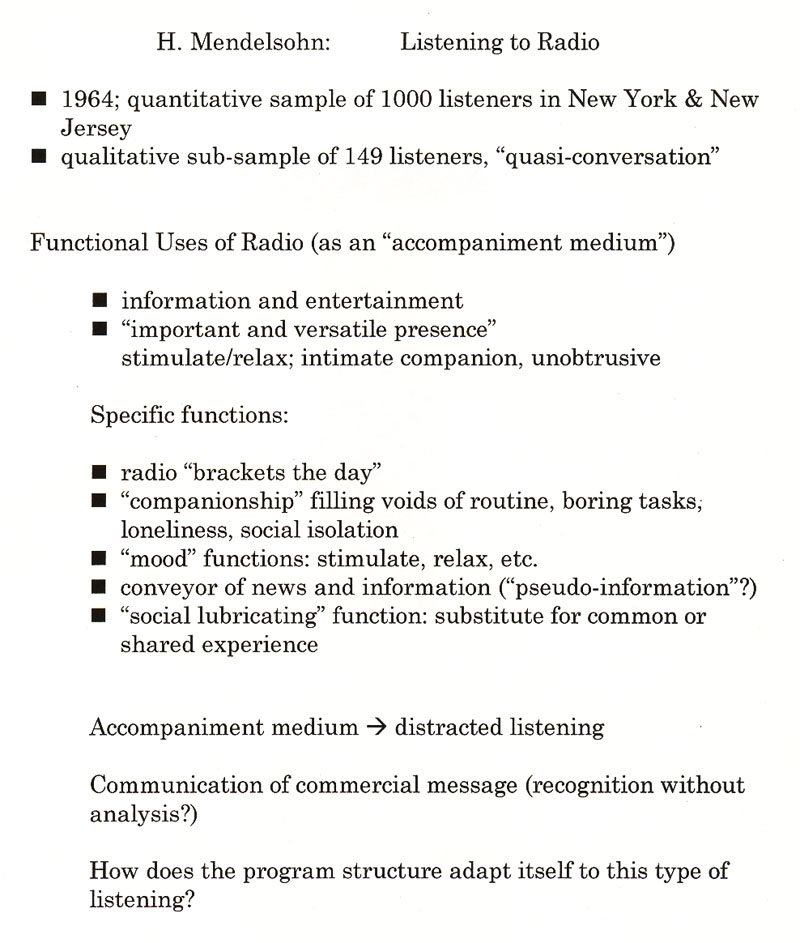
Harold Mendelsohn, "Listening to Radio", in Dexter & White, eds. People, Society and Mass Communication, 1964.