


Monte Carlo computation of expected value:
To compute
 : do experiment
  times to generate
independent observations all with same distribution as
times to generate
independent observations all with same distribution as
 .
.
Get
 .
.
Use
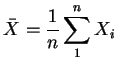
To estimate
 : use same
  and compute

In practice: random quantities are not used.
Use: pseudo-random uniform random numbers.
They ``behave like'' iid Uniform(0,1) variables.
Many, many generators. One standard kind: linear congruential generators.
Start with  an integer in range
 .
Compute
.
Compute

 .
.
Integers  and
and  are chosen so that
 runs through the set
 (or as much of it is possible, sometimes).

 .
.
 .
.
Use

We now pretend we can generate
 which are iid Uniform(0,1).
Monte Carlo methods for generating a sample:
Fact:  continuous CDF and
  satisfy

 Uniform(0,1) if and only if
  .
.
Proof: For simplicity: assume strictly increasing on
inverval  with
with  and
and  .
.
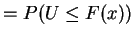
If Uniform(0,1) then
 |
 |
|
 |
||
 |
Conversely: if and  then
there is a unique
then
there is a unique  such that
 |
|
|
 |
||
|
||
 |
Application: generate  and solve
  for
to get
for
to get
 which has cdf .
Example:For the exponential distribution
 and solve to get

Observation:
 so
so
 also has
an Exponential(
also has
an Exponential( ) distribution.
Example:: for the standard normal cdf solving

Special purpose transformations:
Example:: If and  are iid
  define
 and
and
 by
by

NOTE: Book says

 ; notation

 in
in  so that

Then

 . (Start at
  and go clockwise
to angle
and go clockwise
to angle  .)
.)
Compute joint cdf of  at
at
 .
.
Define

 |
 |
|
 |
 integral just gives

 integral then gives

So

 and
and  are independent.
Moreover
 has cdf

 .
.
is Uniform .
.
So: generate  iid Uniform(0,1).
Define


You have generated two independent variables.
If difficult to solve (eg hard
to compute) sometimes use acceptance rejection.
Goal: generate where
 .
.
Tactic: find density  and constant
  such that
 from density .
Algorithm:
which has density .
Uniform(0,1) independent of .
 let
let  .
.
and go back to step 1;
repeat, generating new and (independently)
till you accept a .
Facts:
 , success is Geometric (and sure to
be finite).
, success is Geometric (and sure to
be finite).
 |
![$\displaystyle \le f(Y)/\{cg(Y)\}]$](img92.gif) |
|
![$\displaystyle = \int P[U \le f(y)/\{cg(y)\}\vert Y=y]g(y) dy$](img93.gif) |
||
 |
||
 |
||
 |

Most important fact:  :
:
Proof: this is like the old craps example:
We compute
![$\displaystyle P( X \le x) = P[ Y \le x\vert U \le f(Y)/\{cg(Y)\}]
$](img99.gif)
Condition on to get
 |
 |
|
![$\displaystyle = \frac{\int_{-\infty}^x P[U \le f(Y)/\{cg(Y)\}\vert Y=y]g(y)dy}{ P[U \le f(Y)/\{cg(Y)\}]}$](img102.gif) |
||
 |
||
 |
||
|
Example:Half normal distribution: has density
 .)
.)
Use
 . To find maximize
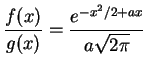

 giving

Choose to minimize (or  ); get
 so
so

Algorithm is then: generate
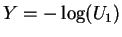 and
then compute
and
then compute

 and if
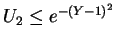 otherwise try again.
To generate : use a third to pick a sign
at random: negative if  otherwise positive.
The inverse transformation method works for discrete distributions.
has possible values
 with
probabilities
with
probabilities
 compute
cumulative probabilities
compute
cumulative probabilities

 .
.
Generate Uniform(0,1).
Find  such that
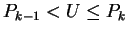
Put  .
.