


For fair random walk  = number of heads minus number of
tails,
= number of heads minus number of
tails,

 are independent and

 |
 |
|
 |
 |

 steps take 1 time unit
and vertical axis so step size is
steps take 1 time unit
and vertical axis so step size is
 .
.
We now turn these pictures into a stochastic process:
For
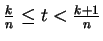 we define


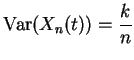
 with
with  fixed we see
  . Moreover:

 by the central limit theorem. Thus

Another observation:
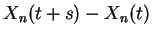 is independent of
  because the
two rvs involve sums of different .
because the
two rvs involve sums of different .
Conclusions.
As
the processes  converge to a process
 with the properties:
 has a
has a  distribution.
has independent increments: if



 .
.
 .
.
Definition:Any process satisfying 1-4 above is a Brownian motion.
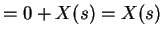
 . Then
 |
 |
|
 |
||
 |
||
 |
 .
.
:
 |
 |
|
 |
||
 |
||
 |
||
 |
Suppose  . Then
 is a sum
of two independent normal variables. Do following calculation:
is a sum
of two independent normal variables. Do following calculation:
 , and
, and
 independent.
  .
.
Compute conditional distribution of given  :
:
 |
 |
|
 |
||
 |
is
 where
where
 so
so
|
 |
|
 |
 and
and  . To find them compare coefficients
of
. To find them compare coefficients
of  ,
,  and
and  .
.
Coefficient of :

 .
.
Coefficient of :


Finally you should check that
 work out as well.
Conclusion: given  the conditional distribution of is
 with and as above.
Application to Brownian motion:
let be and  be
be  so
so
 . Then
 ,
,
 and
and
 .
Thus
.
Thus


Tossing a fair coin:
| HTHHHTHTHHTHHHTTHTH | 5 more heads than tails |
| THTTTHTHTTHTTTHHTHT | 5 more tails than heads |
Both sequences have the same probability.
So: for random walk starting at stopping time:
Any sequence with  more heads than tails in
next
more heads than tails in
next  tosses is matched to sequence with more
tails than heads. Both sequences have same prob.
tosses is matched to sequence with more
tails than heads. Both sequences have same prob.
Suppose is a fair ( ) random walk. Define

Compute
 ?
Trick: Compute
?
Trick: Compute

First: if  then
then

Second: if  then
then

Fix  . Consider a sequence of H's and T's which leads
to say
. Consider a sequence of H's and T's which leads
to say  and
and  .
.
Switch the results of tosses
 to to get a sequence of H's and T's which
has and
to to get a sequence of H's and T's which
has and
 . This proves

This is true for each so
|
 |
|
 |
Finally, sum over all  to get
 |
 |
|
 |
Make the substitution  in the second sum to get
|
|
|
 |
||
 |
Brownian motion version:

 ).
Then
).
Then

Any path with  and
and  is matched
to an equally likely path with
and
is matched
to an equally likely path with
and
 .
.
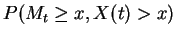
So for 


Let  to get
 |
 |
|
 |
 |
 |
|
 |
 has the distribution
of
has the distribution
of  .
.
On the other hand in view of
 is
is


 is the standard normal density

 is 1 minus the standard normal
cdf.
is 1 minus the standard normal
cdf.
So
 |
 |
|
 |
||
 |
is called a first passage time
NOTE: the preceding is a density when viewed as
a function of the variable .
A stochastic process  indexed by either a
discrete or continuous time parameter is a
martingale if:
indexed by either a
discrete or continuous time parameter is a
martingale if:

 .
.
Examples
 is a Poisson Process with rate
  then
then
 is a martingale.
Note: Brownian motion with drift is a process of the form

 is standard Brownian motion, introduced earlier.
is a martingale if
is standard Brownian motion, introduced earlier.
is a martingale if  . We call
  the drift
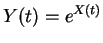
is a Brownian motion with drift then
 and
and
 we can make
  a martingale.
 is the amount of money s/he has after bets then is
a martingale - even if the bets made depend on the outcomes of
previous bets, that is, even if the gambler plays a strategy.
is the amount of money s/he has after bets then is
a martingale - even if the bets made depend on the outcomes of
previous bets, that is, even if the gambler plays a strategy.
Some evidence for some of the above:
Random walk:
 iid with

 with
with  . Then
 |
 |
|
 |
||
 |
||
 |
||
 |
||
 |
 treated as constant given
 .
.
Knowing
is equivalent to knowing
 .
.
For  we have
  independent of
so conditional expectation is unconditional expectation.
independent of
so conditional expectation is unconditional expectation.
Since Standard Brownian Motion is limit of such random walks we get martingale property for standard Brownian motion.
Poisson Process:
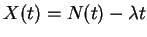 . Fix .
 |
 |
|
 |
||
 |
||
 |
||
 |
||
 |
||
 |
Things to notice:
I used independent increments.
 is shorthand for the conditioning event.
Similar to random walk calculation.
We model the price of a stock as
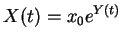
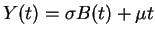 is standard Brownian motion).
If annual interest rates are
 we call
  the
instantaneous interest rate; if we invest $1 at time 0 then
at time we would have
the
instantaneous interest rate; if we invest $1 at time 0 then
at time we would have
 . In this sense
an amount of money
. In this sense
an amount of money  to be paid at time is worth
only
to be paid at time is worth
only
 at time 0 (because that much money at
time 0 will grow to by time ).
at time 0 (because that much money at
time 0 will grow to by time ).
Present Value: If the stock price at time is per share
then the present value of 1 share to be delivered at time is
 as above we see

Now we compute
 . Write
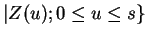
 has independent increments we find
![\begin{multline*}
{\rm E}\left\{ Z(t) \vert B(u);0 \le u \le s\right\}
\\
= x_...
...\mu-\alpha)t} \times
{\rm E}\left[e^{\sigma\{B(t)-B(s)\}}\right]
\end{multline*}](img186.gif)
Note: 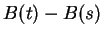 is
is  ; the expected
value needed is the moment generating function of this variable at
.
; the expected
value needed is the moment generating function of this variable at
.
Suppose
 . The Moment Generating Function of
  is
is

Rewrite
 to see
![$\displaystyle {\rm E}\left[e^{\sigma\{B(t)-B(s)\}}\right]= e^{\sigma^2(t-s)/2}
$](img193.gif)
 |
 |
|
 |
||
 |

If this identity is satisfied then the present value of the stock price is a martingale.
Suppose you can pay $ today for the right to pay
  for
a share of this stock at time (regardless of the actual price
at time ).
for
a share of this stock at time (regardless of the actual price
at time ).
If, at time ,  you will exercise your option
and buy the share making
you will exercise your option
and buy the share making  dollars.
If
 you will not exercise your option; it becomes
worthless.
you will not exercise your option; it becomes
worthless.
The present value of this option is

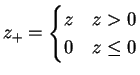
 .)
.)
In a fair market:
 is a martingale.
So:
![$\displaystyle c = {\rm E}\left[ e^{-\alpha t}\left\{X(t) - K\right\}_+\right]
$](img208.gif)
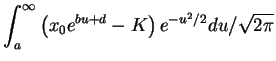
Since


This is
 |
 |
|
 |
 |
|
 |
 |
Evidently

The other integral needed is
 |
 |
|
 |
||
 |
||
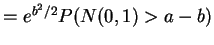 |
Introduce the notation

 |
 |
|
 |
||
 |
This is the Black-Scholes option pricing formula.