


Undergraduate version of central limit theorem:
if
 are iid from a population with mean
  and standard
deviation
and standard
deviation  then
then
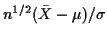 has approximately
a normal distribution.
has approximately
a normal distribution.
Also Binomial random variable
has approximately a
random variable
has approximately a
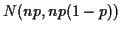 distribution.
Precise meaning of statements
like `` and
and  have approximately the same distribution''?
Desired meaning: and have nearly the same cdf.
But care needed.
Q1) If  is a large number is the
 distribution close to the distribution of
  ?
?
Q2) Is
close to the
 distribution?
Q3) Is close to
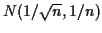 distribution?
Q4) If
 is the distribution
of
is the distribution
of  close to that of ?
Answers depend on how close close needs to be so it's a matter of definition.
In practice the usual sort of approximation we want
to make is to say that some random variable , say,
has nearly some continuous distribution, like  .
.
So: want to know probabilities like  are nearly
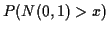 .
.
Real difficulty: case of discrete random variables or infinite dimensions: not done in this course.
Mathematicians' meaning of close:
Either they can provide an upper bound on the distance between the two things or they are talking about taking a limit.
In this course we take limits.
Definition: A sequence of random variables converges in
distribution to a random variable if

 .
.
converges in distribution to . for each
  such
that
such
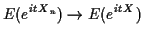
that 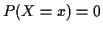 is the characteristic
function of :
is the characteristic
function of :
 .
.
 for some positive
  .
.Now let's go back to the questions I asked:
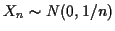 and
and  . Then
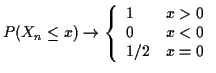 except for
  and the
cdf of is not continuous at so yes, converges
to in distribution.
and the
cdf of is not continuous at so yes, converges
to in distribution.
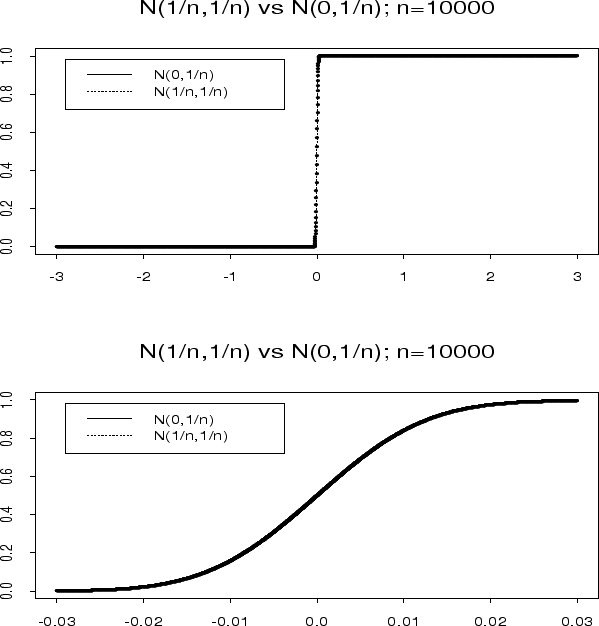
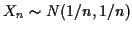 had a distribution close to
that of
had a distribution close to
that of
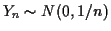 . The definition I gave really requires
me to answer by finding a limit and proving that both and
. The definition I gave really requires
me to answer by finding a limit and proving that both and  converge to in distribution. Take . Then

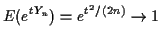 and have the same limit in distribution.
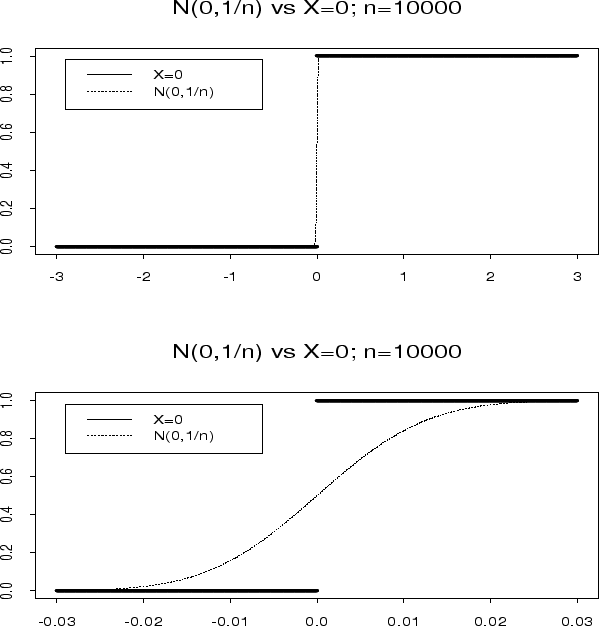


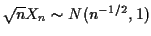
and by  and let
 . Then
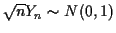
 and
and
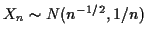
 .
Use characteristic functions to prove that both
.
Use characteristic functions to prove that both
 and
and
 converge to in distribution.
 and
then again both and converge to 0 in distribution.
and
then again both and converge to 0 in distribution.
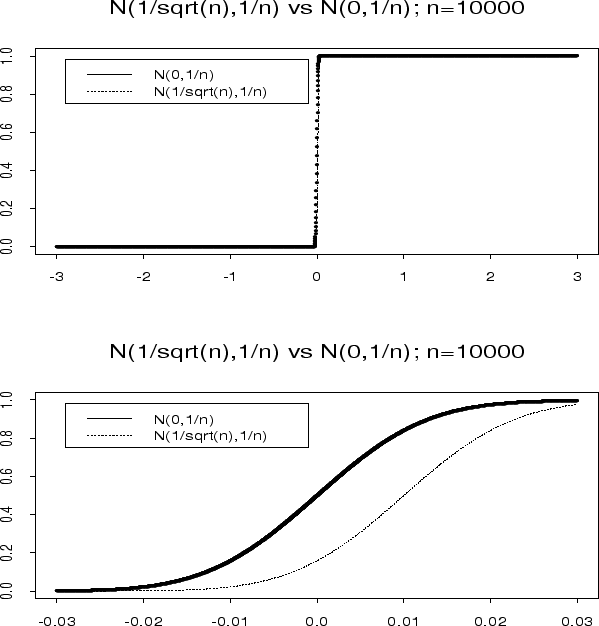
and in the previous point by then
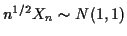 and
and
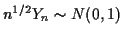 so that
 and
and
 are not close together in distribution.
 in distribution.

Summary: to derive approximate distributions:
Show sequence of rvs converges to some .
The limit distribution (i.e. dstbon of ) should
be non-trivial, like say .
Don't say: is approximately
.
Do say:
converges to in distribution.
The Central Limit Theorem
If
 are iid with mean 0 and variance 1 then
 converges in distribution to . That is,

Proof: As before
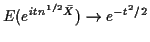 random variable so
we are done by our theorem.
random variable so
we are done by our theorem.
Edgeworth expansions
In fact if
 then
then

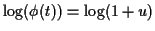

 to get
![\begin{multline*}
\log(\phi(t)) \approx
\\ [-t^2/2 -i\gamma t^3/6 +\cdots]
\\
-[\cdots]^2/2 +\cdots
\end{multline*}](img62.gif)

Now apply this calculation to

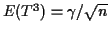 and exponentiate to get
 and get

 can be inverted to get an Edgeworth approximation to
the density (or distribution) of which looks like
can be inverted to get an Edgeworth approximation to
the density (or distribution) of which looks like
![$\displaystyle f_T(x) \approx \frac{1}{\sqrt{2\pi}} e^{-x^2/2} [1-\gamma
(x^3-3x)/(6\sqrt{n}) + \cdots]
$](img69.gif)
Remarks:

 for symmetric densities for which
 .
.
 usually does not converge. When
  it
may help to take the second term but get worse if you include the third
or fourth or more.
it
may help to take the second term but get worse if you include the third
or fourth or more.
Multivariate convergence in distribution
Definition:
 converges in distribution to
  if
if
on  .
.
This is equivalent to either of
Cramér Wold Device:
 converges in distribution to
  for each
or
Convergence of characteristic functions:
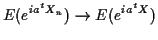 .
.
Extensions of the CLT
 iid in , mean ,
variance covariance
iid in , mean ,
variance covariance  then
then
 converges in distribution to
 .
.
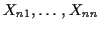 independent rvs with
 |
 |
|
 |
 |
|
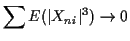 |
 converges to .
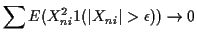
 . Then
converges in
distribution to .
(Lyapunov's condition implies Lindeberg's.)
. Then
converges in
distribution to .
(Lyapunov's condition implies Lindeberg's.)
 -dependent CLT, martingale
CLT, CLT for mixing processes.
-dependent CLT, martingale
CLT, CLT for mixing processes.
 method.
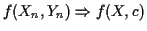
Slutsky's Theorem: If converges in distribution to
and converges in distribution (or in probability) to  , a
constant, then
, a
constant, then  converges in distribution to
  . More
generally, if
. More
generally, if  is continuous then
 .
.
Warning: the hypothesis that the limit of be constant is essential.
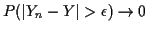
Definition: We say converges to in probability if
 .
.
The fact is that for constant convergence in distribution and in
probability are the same. In general convergence in probability implies
convergence in distribution. Both of these are weaker than almost sure
convergence:
Definition: We say converges to almost surely if

The delta method: Suppose:
of rvs converges to some  , a
constant.
, a
constant.
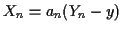 then converges in
distribution to some random variable .
then converges in
distribution to some random variable .
 is differentiable ftn on range of .
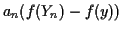 converges in distribution to
 .
.
If
and
 then
then  is
is
 matrix of first derivatives of components of .
Example: Suppose
are a sample from a population with
mean , variance  , and third and fourth central moments
 and
and  . Then

 is notation for convergence in distribution.
For simplicity I define
is notation for convergence in distribution.
For simplicity I define
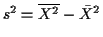 .
.
Take
 .
Then converges to
.
Then converges to
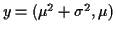 .
Take
.
Take
 . Then
 with
with
![$\displaystyle \Sigma = \left[\begin{array}{cc} \mu_4-\sigma^4 & \mu_3 -\mu(\mu^2+\sigma^2)\\
\mu_3-\mu(\mu^2+\sigma^2) & \sigma^2 \end{array} \right]
$](img122.gif)
Define
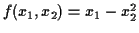 .
Then
.
Then
 . The gradient of has components
 . This leads to
![\begin{multline*}
n^{1/2}(s^2-\sigma^2) \approx
\\
n^{1/2}[1, -2\mu]
\left[\b...
...ne{X^2} -
(\mu^2 + \sigma^2)
\\
\bar{X} -\mu
\end{array}\right]
\end{multline*}](img126.gif)
 .
This rv is
.
This rv is
 where
where
 .
.
Remark: In this sort of problem it is best to learn to recognize that the
sample variance is unaffected by subtracting from each . Thus
there is no loss in assuming  which simplifies and
  .
.
Special case: if the observations are
 then
then  and
and
 . Our calculation has
 and get
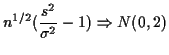
 has a
has a
 distribution and so the
usual central limit theorem shows that
distribution and so the
usual central limit theorem shows that
![$\displaystyle (n-1)^{-1/2} [(n-1)s^2/\sigma^2 - (n-1)] \Rightarrow N(0,2)
$](img139.gif)
 is 1 and variance is 2). Factoring out
 gives the assertion that
 method calculation except for using instead of
. This difference is unimportant as can be checked using Slutsky's
theorem.
method calculation except for using instead of
. This difference is unimportant as can be checked using Slutsky's
theorem.