


Given random variables
 whose joint density
  (or distribution)
is specified and a statistic
(or distribution)
is specified and a statistic
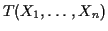 whose distribution you want to know. To compute
something like
whose distribution you want to know. To compute
something like  :
:
from the density .
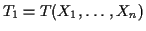 .
.
 times getting
 .
.
 as
as
 where
where  is number of repetitions where
 .
.
 using
using
 .
.
Notice accuracy inversely proportional to  .
There are a number of tricks to make the method more accurate
(but they only change the constant of proportionality - the SE is still
inversely proportional to the square root of the sample size).
.
There are a number of tricks to make the method more accurate
(but they only change the constant of proportionality - the SE is still
inversely proportional to the square root of the sample size).
Transformation
Most computer languages have a facility for generating pseudo uniform
random numbers, that is, variables  which have (approximately of course) a
Uniform
which have (approximately of course) a
Uniform![$ [0,1]$](img16.gif) distribution. Other distributions are generated by
transformation:
distribution. Other distributions are generated by
transformation:
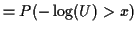
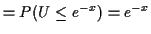
Exponential:  has an exponential distribution:
 |
 |
|
 |
were actually a multiple of  for instance then the largest
possible value of
for instance then the largest
possible value of  is
is  . This problem can be ameliorated by
the following algorithm:
a Uniform[0,1] variable.
. This problem can be ameliorated by
the following algorithm:
a Uniform[0,1] variable.
 like
like  say. If
 take
take
 .
.
 remember that the conditional distribution
of
remember that the conditional distribution
of  given
given  is exponential. You use this by generating
a new
is exponential. You use this by generating
a new  and computing
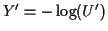 . Then
take
. Then
take
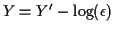 . The resulting
  has an exponential
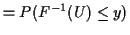
distribution. You should check this by computing
has an exponential
distribution. You should check this by computing  .
.
General technique: inverse probability integral transform.
If is to have cdf  :
:
Generate
![$ U\sim Uniform[0,1]$](img37.gif) .
.
Take
 :
:
 |
 |
|
 |
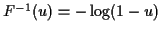
Example: exponential.
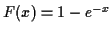 and
and
 .
.
Compare to previous method. (Use instead of
 .)
.)
Normal:  (common notation
for standard normal cdf).
(common notation
for standard normal cdf).
No closed form for  .
.
One way: use numerical algorithm to compute .
Alternative: Box Müller
Generate  two independent Uniform[0,1] variables.
Define


Exercise: (use change of variables)  and
and  are independent
 variables.
Acceptance Rejection
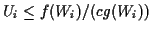
Suppose: can't calculate but know .
Find density  and constant
 such that
 for each
  and
and
 is computable or can generate observations
 independently from .
Algorithm:
 .
.
 .
.
 independent of all
 s.
s.
 if
if  .
.
 ; repeat until you find
 .
.
be last generated.
has density .
Markov Chain Monte Carlo
Recently popular tactic, particularly for generating multivariate observations.
Theorem Suppose
is an
(ergodic) Markov chain with stationary transitions and the stationary
initial distribution of has density . Then starting the
chain with any initial distribution
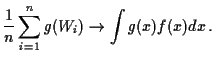
Estimate things like
 by computing the fraction of the
  which land in
 .
.
Many versions of this technique including Gibbs Sampling and Metropolis-Hastings algorithm.
Technique invented in 1950s: Metropolis et al.
One of the authors was Edward Teller ``father of the hydrogen bomb''.
Importance Sampling
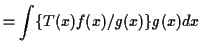
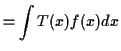
If you want to compute
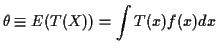 and then
compute
and then
compute

 |
 |
|
 |
||
 |
||
 |
Variance reduction
Consider the problem of estimating the distribution of the sample mean for a Cauchy random variable. The Cauchy density is
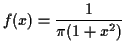
 uniforms and then define
 . Then we compute
  .
Now to estimate
we would use
.
Now to estimate
we would use
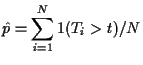 samples of size
  . This
estimate is unbiased and has standard error
. This
estimate is unbiased and has standard error
 .
.
We can improve this estimate by remembering that  also
has Cauchy distribution. Take
also
has Cauchy distribution. Take  . Remember that
  has
the same distribution as
has
the same distribution as  . Then we try (for
  )
)
![$\displaystyle \tilde p = [\sum_{i=1}^N 1(T_i > t) + \sum_{i=1}^N 1(S_i > t) ]/(2N)
$](img90.gif) . The variance of
. The variance of
 is
is

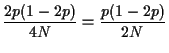
 near 1/2. So this
method of variance reduction has resulted in a need for only half the
sample size to get the same accuracy.
near 1/2. So this
method of variance reduction has resulted in a need for only half the
sample size to get the same accuracy.
Regression estimates
Suppose we want to compute

 is standard normal. We generate iid variables
 and compute
 . But we
know that
. But we
know that
 and can see easily that
 is positively correlated with
 .
So we consider using
.
So we consider using

 and
and
 which minimizes this is
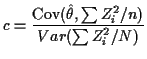
 on the
 !
!