


Example: Decide between 4 modes of transportation to work:
Ingredients of Decision Problem: No data case.
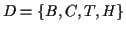 of possible actions.
 of possible ``states of nature''.
 loss incurred if do
  and
and
 is true state of nature.
In the example we might use the following table for  :
:
| C | B | T | H | |
| R | 3 | 8 | 5 | 25 |
| S | 5 | 0 | 2 | 25 |
Notice that if it rains I will be glad if I drove. If it is sunny I will be glad if I rode my bike. In any case staying at home is expensive.
In general we study this problem by comparing various functions of . In this
problem a function of has only two values, one for rain and one for sun and
we can plot any such function as a point in the plane. We do so to indicate the geometry
of the problem before stating the general theory.

Statistical problems have another ingredient, the data. We observe
 a random variable taking values in say
  .
We may make our decision depend on . A
decision rule is a function
.
We may make our decision depend on . A
decision rule is a function  from
from  to
to  .
We will want
.
We will want
 to be small for all . Since
is random we quantify this by averaging over and compare procedures
to be small for all . Since
is random we quantify this by averaging over and compare procedures
 in terms of the risk function

To compare two procedures we must compare two functions of and
pick ``the smaller one''. But typically the two functions will cross each
other and there won't be a unique `smaller one'.
Example: In estimation theory to estimate a real parameter
we used  ,
,
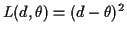
 is
is
![$\displaystyle R_{\hat\theta}(\theta) = E[(\hat\theta-\theta)^2]
$](img18.gif)
 .
We have already seen that there is no unique best estimator in
the sense of MSE. How do we compare risk functions in general?
.
We have already seen that there is no unique best estimator in
the sense of MSE. How do we compare risk functions in general?
to minimize the worst case
risk:
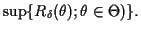
 minimax if

 for
for  and
and  for
for  . This is the source of ``minimax''.
to minimize an average
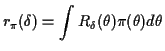
 . We call a prior density
and
. We call a prior density
and  the Bayes risk of for the prior .
Example: Transport problem has no data
so the only possible (non-randomized) decisions are the
four possible actions  . For
. For  and
and  the worst case is rain.
For the other two actions Rain and Sun are equivalent. We have the
following table:
the worst case is rain.
For the other two actions Rain and Sun are equivalent. We have the
following table:
| C | B | T | H | |
| R | 3 | 8 | 5 | 25 |
| S | 5 | 0 | 2 | 25 |
| Maximum | 5 | 8 | 5 | 25 |
Smallest maximum: take car, or transit.
Minimax action: take car or public transit.
Now imagine: toss coin with probability  of getting Heads, take my car if Heads, otherwise take transit.
Long run average daily loss would be
of getting Heads, take my car if Heads, otherwise take transit.
Long run average daily loss would be
 when it rains and
 when it is Sunny. Call this procedure
  ; add it to
graph for each value of . Varying
from 0 to 1 gives a straight line running from
; add it to
graph for each value of . Varying
from 0 to 1 gives a straight line running from  to
to
 . The two losses are equal when
 . For smaller
worst case risk is for sun; for larger
worst case risk is for rain.
. For smaller
worst case risk is for sun; for larger
worst case risk is for rain.
Added to graph: loss functions for each ,
(straight line) and set of  pairs for which
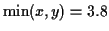 -- worst case risk for when
.
-- worst case risk for when
.

 is actually the minimax
procedure when randomized procedures are permitted.
is actually the minimax
procedure when randomized procedures are permitted.
In general we might consider using a 4 sided coin where we
took action with probability  ,
,  with
probability
with
probability  and so on. The loss function of such
a procedure is a convex combination of the losses of the four basic
procedures making the set of risks achievable with the aid of randomization
look like the following:
and so on. The loss function of such
a procedure is a convex combination of the losses of the four basic
procedures making the set of risks achievable with the aid of randomization
look like the following:

Graph shows many points in the picture correspond to bad decision procedures. Rain or not taking my car to work has a lower loss than staying home; the decision to stay home is inadmissible.
Definition: A decision rule is inadmissible if there is
a rule such that
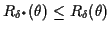 and there is at least one value of where the
inequality is strict. A rule which is not inadmissible is called admissible.
and there is at least one value of where the
inequality is strict. A rule which is not inadmissible is called admissible.
Admissible procedures have risks on lower left of graphs, i.e., lines connecting B to T and T to C are the admissible procedures.
There is a connection between Bayes procedures and admissible procedures. A prior distribution
in our example problem is specified by two probabilities,  and
and  which
add up to 1. If
which
add up to 1. If
 is the risk function for some procedure then the Bayes
risk is
is the risk function for some procedure then the Bayes
risk is
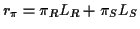 such that this Bayes risk is equal to some constant. On
our picture this is a straight line with slope
such that this Bayes risk is equal to some constant. On
our picture this is a straight line with slope
 . Consider now three priors
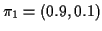 ,
,
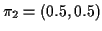 and
and
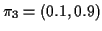 . For say
  imagine a line with slope -9 =0.9/0.1 starting on the far left of the picture and
sliding right until it bumps into the convex set of possible losses in the previous
picture. It does so at point B as shown in the next graph. Sliding this line
to the right corresponds to making the value of
imagine a line with slope -9 =0.9/0.1 starting on the far left of the picture and
sliding right until it bumps into the convex set of possible losses in the previous
picture. It does so at point B as shown in the next graph. Sliding this line
to the right corresponds to making the value of  larger and larger so that
when it just touches the convex set we have found the Bayes procedure.
larger and larger so that
when it just touches the convex set we have found the Bayes procedure.

 (you're pretty sure it will be
sunny) is to ride your bike. If it's a toss up between R and S you take
the bus. If R is very likely you take your car.
Prior
(you're pretty sure it will be
sunny) is to ride your bike. If it's a toss up between R and S you take
the bus. If R is very likely you take your car.
Prior  produces the line shown here:

to
the space  of all probability distributions on .
 of possible ``states of nature''.
which is the loss I incur if I do and
is the true state of nature.
minimax if

on ,.
for a prior is
 the
integral is a sum.
the
integral is a sum.
is Bayes for a prior if
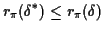 .
.
 on is
a proper prior if
on is
a proper prior if
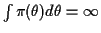
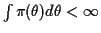 ; divide
by integral to get a density. If
; divide
by integral to get a density. If
 is an improper prior density.
is inadmissible if there is
such that
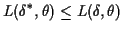 and there is at least one value of where the
inequality is strict. A decision which is not inadmissible is called
admissible.
and there is at least one value of where the
inequality is strict. A decision which is not inadmissible is called
admissible.
 for all ) is admissible.
Proof: If is
Bayes for but not admissible there is a such that
for which the inequality involving is
strict and if the density of is positive at that then
the inequality for is strict which would contradict the hypothesis
that is Bayes for .
Notice: theorem actually
requires the extra hypotheses: positive density, and
risk functions of and continuous.
and its risk is constant on
the set of for which the prior density is positive.
to
the space of all probability distributions on .
of possible ``states of nature''.
: loss I incur if I do and
is true state of nature.
 with model
 : model density
is
: model density
is
 .
.
 .
.
is the expected loss:
![$\displaystyle R_\delta(\theta) =R(\delta,\theta) = {\rm E}\left[L\{\delta(X),\theta\}\right].
$](img72.gif)
minimax if

on ,.
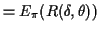
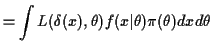
for prior is
 |
 |
|
 |
the
integral is a sum.
is Bayes for a prior if
.
on is
a proper prior if
; divide
by integral to get a density. If
is an improper prior density.
is inadmissible if there is
such that
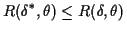 and there is at least one value of where the
inequality is strict. A decision which is not inadmissible is called
admissible.
and there is at least one value of where the
inequality is strict. A decision which is not inadmissible is called
admissible.
for all ) is admissible.
; its risk is constant on
the set of for which the prior density is positive.