


Definition: A level  confidence set for a parameter
 is a random subset
  , of the set of possible values of
  such that for each

Suppose is a level
 confidence set for .
To test
 : reject if
 . This test has level
  .
.
Conversely, suppose
that for each  we have available a level test
of
who rejection region is say
we have available a level test
of
who rejection region is say
 .
.
Define
 is not rejected
 ; get
level
; get
level  confidence set for .
Example: Usual  test gives
rise in this way to the usual confidence intervals
test gives
rise in this way to the usual confidence intervals

Definition: A pivot (pivotal quantity) is a function
 whose distribution is the same for all . (
in pivot is same as being used to
calculate distribution of
.
whose distribution is the same for all . (
in pivot is same as being used to
calculate distribution of
.
Using pivots to generate confidence sets:
Pick a set
 in space of possible values for
  .
.
Let
 ;
since is pivotal is the same for all .
;
since is pivotal is the same for all .
Given
data  solve the relation


Example:
 is a pivot in the
 model.
Given
consider the two points
 and
and 

 .
.
Solve this relation:

![$\displaystyle \left[\frac{(n-1)^{1/2} s}{\chi_{n-1,\alpha/2}},
\frac{(n-1)^{1/2} s}{\chi_{n-1,1-\alpha/2}}\right]
$](img32.gif) confidence interval.
confidence interval.
In the same model we also have

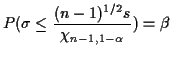 interval

In general the interval from
 to
to 
 . For fixed can
minimize length of resulting interval numerically --
rarely used. See homework for an example.
. For fixed can
minimize length of resulting interval numerically --
rarely used. See homework for an example.