


Toss coin 6 times and get Heads twice.
 is probability of getting H.
Probability of getting exactly 2 heads is
 , is likelihood
function.
, is likelihood
function.
Definition: The likelihood function is map  : domain
 , values given by

Key Point: think about how the density depends on  not
about how it depends on
not
about how it depends on  .
.
Notice: , observed value of the
data, has been plugged into the formula for density.
Notice: coin tossing example uses the discrete
density for  .
.
We use likelihood for most inference problems:
 which lies in . The maximum likelihood estimate
(MLE) of is the value
which lies in . The maximum likelihood estimate
(MLE) of is the value
 which maximizes
 over
over
 if such a
exists.
if such a
exists.
: we must compute an estimate
 of
of
 . We use
 where
is the MLE of .
where
is the MLE of .
 in
which we think will contain
in
which we think will contain  . We will use

 .
.
 where
where
 . We base our decision
on the likelihood ratio
. We base our decision
on the likelihood ratio

Maximum Likelihood Estimation
To find MLE maximize .
Typical function maximization problem:
Set gradient of equal to 0
Check root is maximum, not minimum or saddle point.
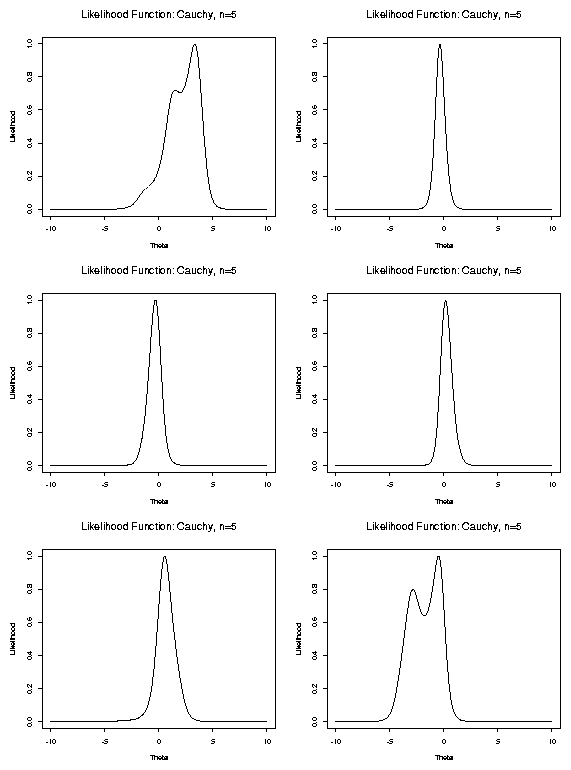
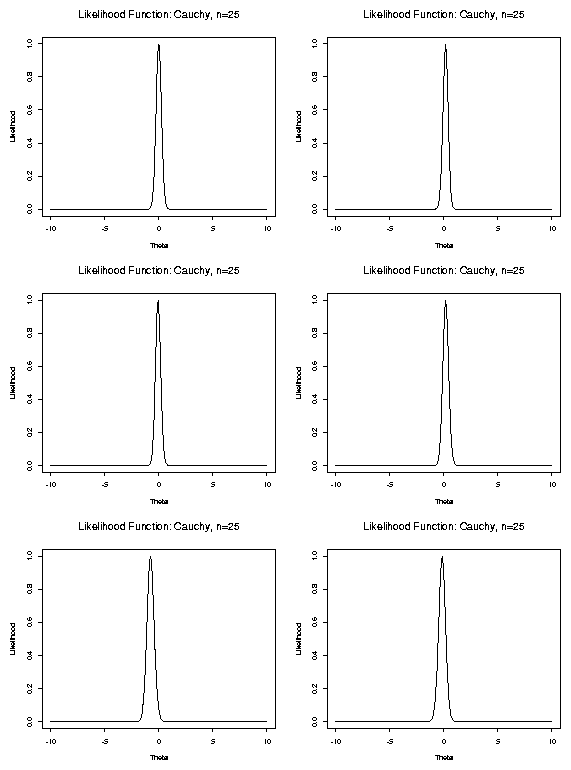
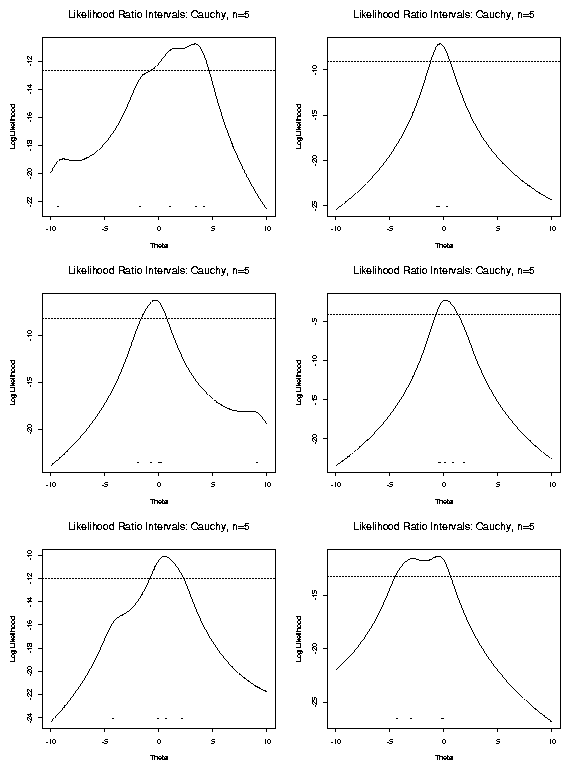
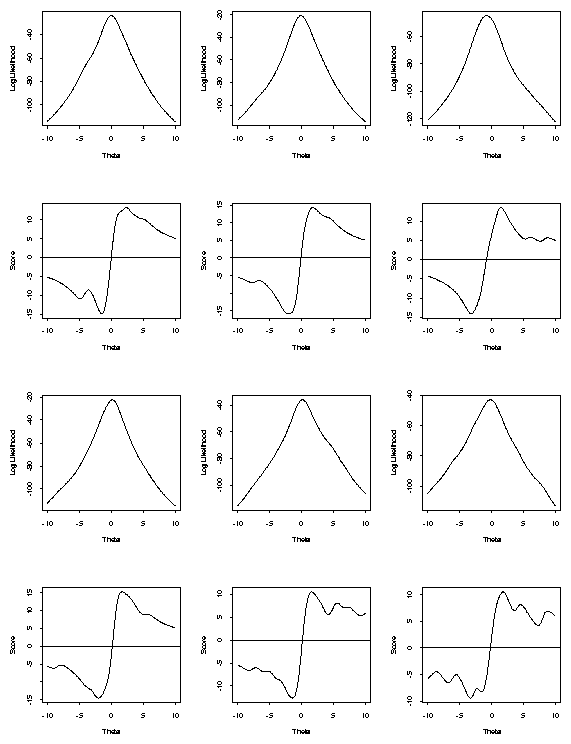
Examine some likelihood plots in examples:
Cauchy Data
Iid sample
 from Cauchy
 density


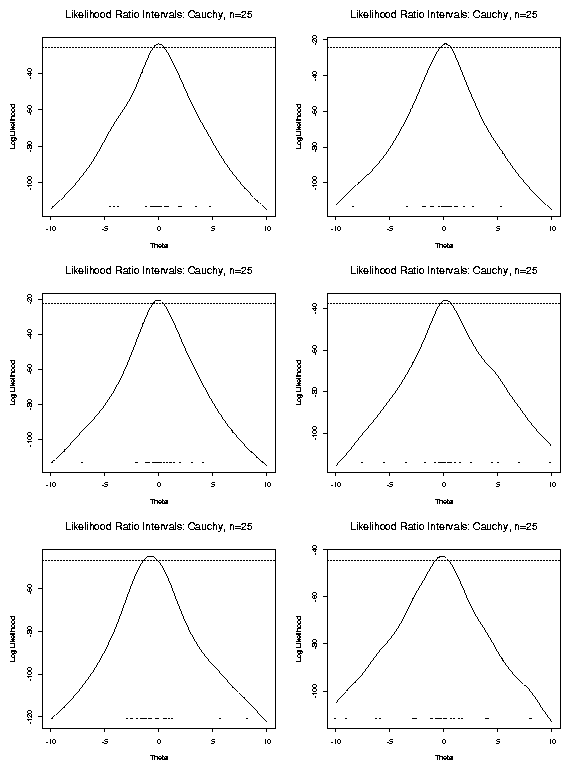
[Examine likelihood plots.]
 <\CENTER>
 <\CENTER>
 <\CENTER>
 <\CENTER>
I want you to notice the following points:
<\CENTER>
I want you to notice the following points:
(which is 0 for the data sets I generated).
 .
.
 which has exactly
the same shape as but runs from 0 to 1 on the vertical scale.
which has exactly
the same shape as but runs from 0 to 1 on the vertical scale.
To maximize this likelihood: differentiate ,
set result equal to 0.
Notice is product of terms;
derivative is
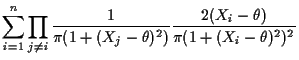
Much easier to work with logarithm
of : log of product is sum and logarithm is monotone
increasing.
Definition: The Log Likelihood function is
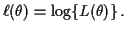
For the Cauchy problem we have

 <\CENTER>
 <\CENTER>
 <\CENTER>
 <\CENTER>
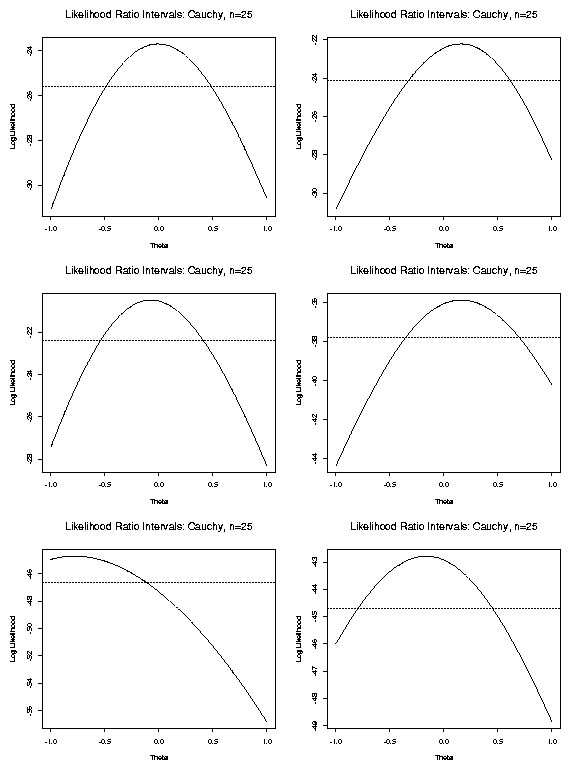
Notice the following points:
<\CENTER>
Notice the following points:
 for
for  quite smooth,
rather parabolic.
quite smooth,
rather parabolic.
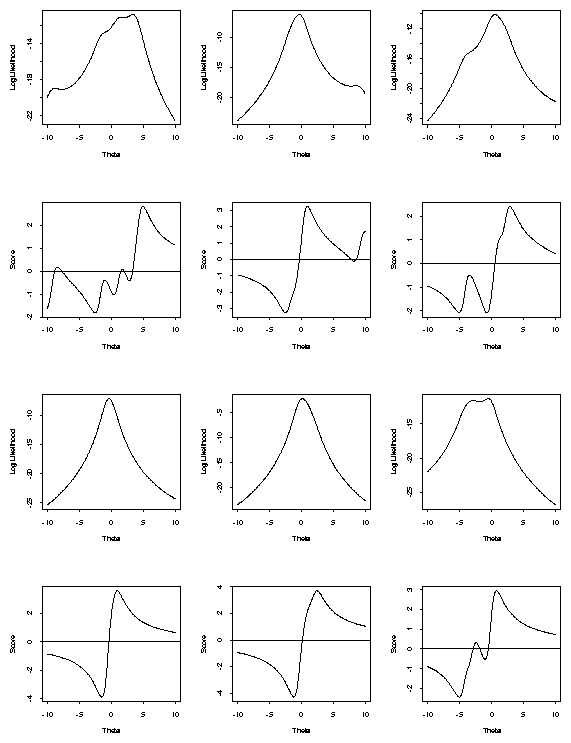
 many local maxima and minima of .
Likelihood tends to 0 as
 so max of occurs at a root of
 ,
derivative of wrt .
,
derivative of wrt .
Def'n: Score Function is gradient of

MLE
usually root of Likelihood Equations


[Examine plots of score functions.]
Notice: often multiple roots of likelihood equations.
 <\CENTER>
 <\CENTER>
Example :
<\CENTER>
Example :
 Binomial

 |
 |
|
 |
 |
|
 |
 |
is 0 at  and at
  unless
  or
or  so for
 the MLE must be found by setting
 and getting
 the log-likelihood has derivative
 so that the likelihood is an increasing
function of which is maximized at
so that the likelihood is an increasing
function of which is maximized at
 .
Similarly when the maximum is at
.
Similarly when the maximum is at
 .
.
The Normal Distribution
Now we have
iid
 . There are
two parameters
. There are
two parameters
 . We find
 |
 |
|
 |
 |
 is
is
![$\displaystyle \left[ \begin{array}{c}
\frac{\sum(X_i-\mu)}{\sigma^2}
\\
\frac{\sum(X_i-\mu)^2}{\sigma^3} -\frac{n}{\sigma}
\end{array}\right]
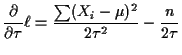
$](img65.gif) is a function with two components because has
two components.
is a function with two components because has
two components.
Setting the likelihood equal to 0 and solving gives


 of second
derivatives of is
of second
derivatives of is
![$\displaystyle \left[\begin{array}{cc}
\frac{-n}{\sigma^2} & \frac{-2\sum(X_i-\m...
...3} & \frac{-3\sum(X_i-\mu)^2}{\sigma^4}
+\frac{n}{\sigma^2}
\end{array}\right]
$](img69.gif)
![$\displaystyle H(\hat\theta) = \left[\begin{array}{cc}
\frac{-n}{\hat\sigma^2} & 0
\\
0 & \frac{-2n}{\hat\sigma^2}
\end{array}\right]
$](img70.gif) must be a local maximum.
must be a local maximum.
[Examine contour and perspective plots of .]
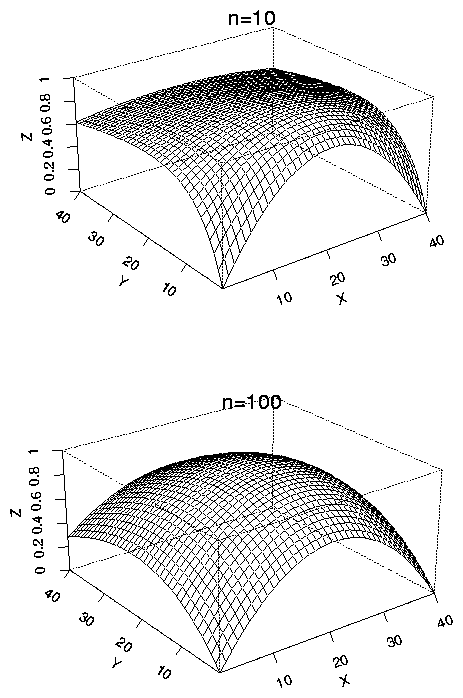 <\CENTER>
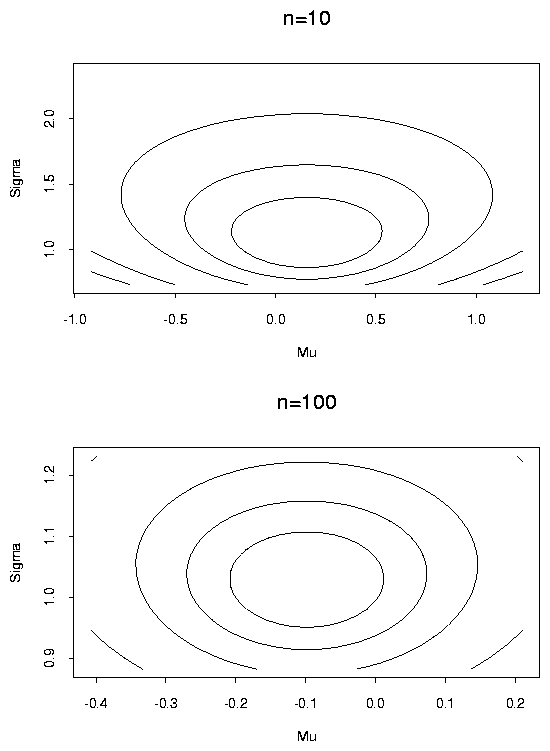 <\CENTER>
Notice that the contours are quite ellipsoidal for
the larger sample size.
<\CENTER>
Notice that the contours are quite ellipsoidal for
the larger sample size.
For
iid log likelihood is

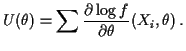 maximizes . If maximum occurs
in interior of parameter space and the log likelihood continuously
differentiable then
solves the likelihood equations
maximizes . If maximum occurs
in interior of parameter space and the log likelihood continuously
differentiable then
solves the likelihood equations

Some examples concerning existence of roots:
 : Examples
N
 )
)
Unique root of likelihood equations is a global maximum.
[Remark: Suppose we called
 the parameter.
Score function still has two components:
first component same as before but
second component is
the parameter.
Score function still has two components:
first component same as before but
second component is
 is some reparametrization of a model
(a one to one relabelling of the parameter values) then
. Does not
apply to other estimators.]
is some reparametrization of a model
(a one to one relabelling of the parameter values) then
. Does not
apply to other estimators.]
Cauchy: location
At least 1 root of likelihood equations but often several more. One root is a global maximum; others, if they exist may be local minima or maxima.
Binomial( )
)
If or : no root of likelihood equations;
likelihood is monotone. Other values of
: unique root, a global maximum. Global
maximum at
 even if or .
The 2 parameter exponential
The density is

 for
for
 and
otherwise is
and
otherwise is

 till reaches
 . Now plug in
 for ;
get so-called profile likelihood for
for ;
get so-called profile likelihood for  :
:
 derivative equal to 0 to get
 does not solve likelihood equations; we had to
look at the edge of the possible parameter space.
is called a support or
truncation parameter. ML methods behave oddly in
problems with such parameters.
does not solve likelihood equations; we had to
look at the edge of the possible parameter space.
is called a support or
truncation parameter. ML methods behave oddly in
problems with such parameters.
Three parameter Weibull
The density in question is
![$\displaystyle f(x;\alpha,\beta,\gamma)
= \frac{1}{\beta} \left(\frac{x-\alpha}{\beta}\right)^{\gamma-1}
\exp[-\{(x-\alpha)/\beta\}^\gamma]1(x>\alpha)
$](img92.gif)
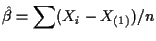
Set derivative equal to 0; get
![$\displaystyle \hat\beta(\alpha,\gamma) = \left[\sum (X_i-\alpha)^\gamma/n\right]^{1/\gamma}
$](img93.gif)
 indicates
mle of could be found by finding the mles of the
other two parameters and then plugging in to the formula above.
It is not possible to find explicitly the remaining two parameters;
numerical methods are needed.
indicates
mle of could be found by finding the mles of the
other two parameters and then plugging in to the formula above.
It is not possible to find explicitly the remaining two parameters;
numerical methods are needed.
However putting
 and letting
 will make the log likelihood go to
  .
.
MLE is not uniquely defined: any
and any will do.
If the true value of  is more than 1 then the probability that
there is a root of the likelihood equations is high; in this case there
must be two more roots: a local maximum and a saddle point! For a
true value of
is more than 1 then the probability that
there is a root of the likelihood equations is high; in this case there
must be two more roots: a local maximum and a saddle point! For a
true value of  the theory we detail below applies to the
local maximum and not to the global maximum of the likelihood equations.
the theory we detail below applies to the
local maximum and not to the global maximum of the likelihood equations.