


Large Sample Theory
Study approximate behaviour of
 by studying
the function
by studying
the function  .
.
Notice
is sum of independent random variables.
Theorem: If
 are iid with mean
  then
then

Called law of large numbers. Strong law
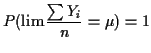
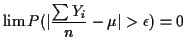
 the stronger conclusion holds; for our
heuristics ignore differences between these notions.
the stronger conclusion holds; for our
heuristics ignore differences between these notions.
Now suppose  is true value of
  . Then
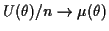
 |
![$\displaystyle E_{\theta_0}\left[ \frac{\partial\log f}{\partial\theta}(X_i,\theta)\right]$](img13.gif) |
|
 |
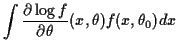 |
Example:  data:
data:

 then
then
 and
and
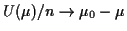
Consider
 : derivative of
 is likely to be positive so that
  increases
as increases.
increases
as increases.
For
 : derivative
is probably negative and so tends to be decreasing for
: derivative
is probably negative and so tends to be decreasing for
 .
.
Hence: is likely to be maximized close to .
Repeat ideas for more general case. Study rv
![$\displaystyle \log[f(X_i,\theta)/f(X_i,\theta_0)].$](img26.gif)
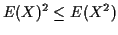
 .)
.)
Generalization: Jensen's inequality:
for  a convex function (
 roughly) then
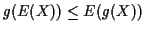
Inequality above has  . Use
. Use
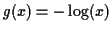 :
convex because
:
convex because
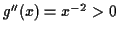 . We get
![$\displaystyle -\log(E_{\theta_0}[f(X_i,\theta)/f(X_i,\theta_0)]
\le E_{\theta_0}[-\log\{f(X_i,\theta)/f(X_i,\theta_0)\}] \, .
$](img35.gif)
![$\displaystyle E_{\theta_0}\left[\frac{f(X_i,\theta)}{f(X_i,\theta_0)}\right]$](img36.gif) |
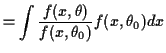 |
|
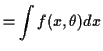 |
||
 |
![$\displaystyle E_{\theta_0}[\log\{f(X_i,\theta)/f(X_i,\theta_0)\}] \le 0
$](img40.gif) and densities are actually the same.
and densities are actually the same.
Let
 be this expected value.
Then
for each we find
![\begin{multline*}
\frac{\ell(\theta) - \ell(\theta_0)}{n}
\\
=
\frac{\sum \log[f(X_i,\theta)/f(X_i,\theta_0)] }{n}
\\
\to \mu(\theta)
\end{multline*}](img42.gif) than at any other single .
than at any other single .
Idea can often be stretched to prove that the mle is consistent.
Definition A sequence
 of estimators of
is consistent if
converges weakly
(or strongly) to .
of estimators of
is consistent if
converges weakly
(or strongly) to .
Proto theorem: In regular problems the mle
is consistent.
More precise statements of possible conclusions. Use notation

Suppose:
is global maximizer of .
 maximizes over
 .
.
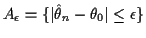
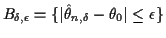

 for each
 .
.
 such that for all
we have
such that for all
we have
 .
.
there is an  so large
and an
so large
and an  so large that for all
  ,
,
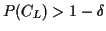 .
.
 tending to
  so
slowly that
so
slowly that
 .
.
Point: conditions get weaker as conclusions get weaker. Many possible conditions in literature. See book by Zacks for some precise conditions.
Study shape of log likelihood near the true
value of .
Assume
is a root of the likelihood equations close to .
Taylor expansion (1 dimensional parameter ):
 |
0 | |
|
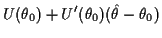 |
|
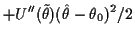 |
 between and
.
between and
.
WARNING: This form of the remainder in Taylor's theorem is not valid
for multivariate .
Derivatives of are sums of  terms.
So each derivative should be proportional
to in size.
Second derivative is multiplied by the
square of the small number
 so should be
negligible compared to the first derivative term.
so should be
negligible compared to the first derivative term.
Ignoring second derivative term get
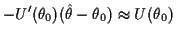 and
and  .
.
Normal case:
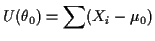 (SD
(SD  ).
).
Derivative is

Next derivative
 is 0.
is 0.
Notice: both and are
sums of iid random variables.
Let
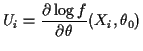
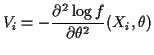
In general,
 has mean 0
and approximately a normal distribution.
has mean 0
and approximately a normal distribution.
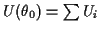
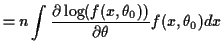
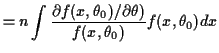
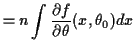
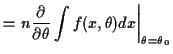
Here is how we check that:
 |
 |
|
 |
||
 |
||
 |
||
 |
||
 |
||
 |
Notice: interchanged order of differentiation and integration at one point.
This step is usually justified by applying the dominated convergence theorem to the definition of the derivative.
Differentiate identity just proved:
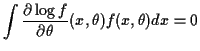 ;
pull derivative under integral sign:
;
pull derivative under integral sign:
![$\displaystyle \int \frac{\partial}{\partial\theta} \left[
\frac{\partial\log f}{\partial\theta}(x,\theta) f(x,\theta)
\right] dx =0
$](img85.gif)
![\begin{multline*}
-\int\frac{\partial^2\log(f)}{\partial\theta^2} f(x,\theta) dx...
...artial\log f}{\partial\theta}(x,\theta) \right]^2
f(x,\theta) dx
\end{multline*}](img86.gif)
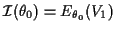
Definition: The Fisher Information is

 as
the information in 1 observation.
as
the information in 1 observation.
The idea is that  is a measure of how curved the log
likelihood tends to be at the true value of .
Big curvature means precise estimates. Our identity above
is
is a measure of how curved the log
likelihood tends to be at the true value of .
Big curvature means precise estimates. Our identity above
is

Now we return to our Taylor expansion approximation
.
We have shown that
 is a sum of iid mean 0 random variables.
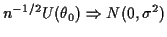
The central limit theorem thus proves that
is a sum of iid mean 0 random variables.
The central limit theorem thus proves that
 .
.
Next observe that
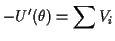

![$\displaystyle -U^\prime(\theta_0)/n \to E_{\theta_0}[ V_1] = {\cal I}(\theta_0)
$](img96.gif)
![$\displaystyle n^{1/2} (\hat\theta - \theta_0) \approx
\left[\frac{\sum V_i}{n}\right]^{-1} \frac{\sum U_i}{\sqrt{n}}
$](img97.gif)
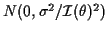 which simplifies, because of the
identities, to
which simplifies, because of the
identities, to
 .
.
Summary
In regular families: assuming
 is a consistent
root of
is a consistent
root of
 .
.
 where
where
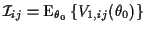
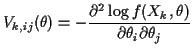
 is the matrix
![$ [V_{k,ij}]$](img106.gif) then
then
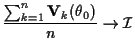
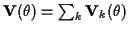 then
then

 .
.
 .
.
 in probability as
.
in probability as
.
 .
.
 |
 |
|
 |
|
|
 |
|
|
 |
|
 is the so-called observed information,
the negative second derivative of the log-likelihood.
is the so-called observed information,
the negative second derivative of the log-likelihood.
Note: If the square roots are replaced by matrix square roots we
can let be vector valued and get  as the limit law.
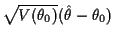
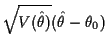
Why all these different forms? Use limit
laws to test hypotheses and compute confidence intervals.
Test
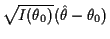
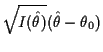
 using one of the 4 quantities as
test statistic. Find confidence intervals using quantities
as pivots. E.g.: second and fourth limits lead to
confidence intervals
using one of the 4 quantities as
test statistic. Find confidence intervals using quantities
as pivots. E.g.: second and fourth limits lead to
confidence intervals
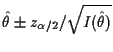
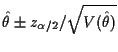
 data we have
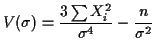

 computed by finding all those for which
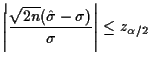
Usual summary: mle is consistent and asymptotically normal with an asymptotic variance which is the inverse of the Fisher information.
Method of Moments
Basic strategy: set sample moments equal to population moments and solve for the parameters.
Definition: The
 sample moment (about the origin)
is
sample moment (about the origin)
is
 population moment is

( Central moments are

![$\displaystyle {\rm E}\left[(X-\mu)^r\right] \, .
$](img133.gif)
If we have  parameters we can estimate the parameters
 by solving the system of
equations:
by solving the system of
equations:


 will be
formulas involving the parameters.
will be
formulas involving the parameters.
Gamma Example
The Gamma(
 ) density is
![$\displaystyle f(x;\alpha,\beta) =
\frac{1}{\beta\Gamma(\alpha)}\left(\frac{x}{\beta}\right)^{\alpha-1}
\exp\left[-\frac{x}{\beta}\right] 1(x>0)
$](img141.gif)

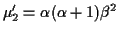
 |
 |
|
 |
 |
|
|
|
 |
 |
 is
is
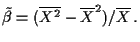

The method of moments equations are much easier to solve than the likelihood equations which involve the function
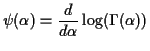
Score function has components
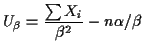
 in terms of
  to leave you
trying to find a root of the equation
to leave you
trying to find a root of the equation

 and then compute iteratively
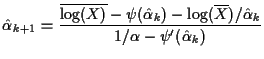
 , the
trigamma function, requires special software. Web sites like netlib
and statlib are good sources for this sort of thing.
, the
trigamma function, requires special software. Web sites like netlib
and statlib are good sources for this sort of thing.
Estimating Equations
Same large sample ideas arise whenever estimates derived by solving some equation.
Example: large sample theory for Generalized Linear Models.
Suppose is number of cancer cases in some group of people characterized by values
 of some covariates.
Think of as containing variables like age, or a dummy for sex or
average income or  .
.
Possible parametric regression model:
has a Poisson distribution with mean  where the mean
depends somehow on .
where the mean
depends somehow on .
Typically assume
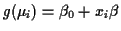 ;
is link function.
;
is link function.
Often
 and
and
 is a matrix product: row vector,
column vector.
is a matrix product: row vector,
column vector.
``Linear regression model with Poisson errors''.
Special case
 where is a scalar.
The log likelihood is simply
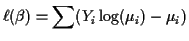 ,
,
 has
a Poisson distribution to make solving the equation
has
a Poisson distribution to make solving the equation  sensible. Suppose only that
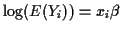 .
Then we have assumed that
.
Then we have assumed that

 has a consistent root
  .
Ignoring higher order terms
in a Taylor expansion will give
.
Ignoring higher order terms
in a Taylor expansion will give
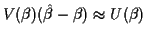
 . In the mle case we had identities relating
the expectation of
. In the mle case we had identities relating
the expectation of  to the variance of . In general here we have
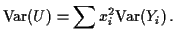 is Poisson with mean (and so
 ) this is
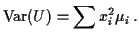

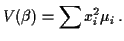
 has an approximate normal distribution with variance
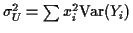 and so
 , as it is for the Poisson case,
the asymptotic variance simplifies
to
, as it is for the Poisson case,
the asymptotic variance simplifies
to
 .
.
Other estimating equations are possible, popular.
If  is any set of
deterministic weights (possibly depending on )
then could define
is any set of
deterministic weights (possibly depending on )
then could define
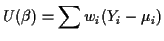 probably has a consistent root
which has an asymptotic normal distribution.
probably has a consistent root
which has an asymptotic normal distribution.
Idea widely used:
Example: Generalized Estimating Equations, Zeger and Liang.
Abbreviation: GEE.
Called by econometricians Generalized Method of Moments.
An estimating equation is unbiased if

Theorem: Suppose
is a consistent root of the
unbiased estimating equation
 . Suppose
there is a sequence of constants
. Suppose
there is a sequence of constants  such that
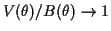
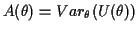

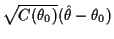 |
|
|
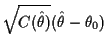 |
|
 ,
,  and
and  lead to
same conclusions. There are multivariate extensions using
matrix square roots.
lead to
same conclusions. There are multivariate extensions using
matrix square roots.