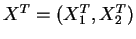
 has a
has a distribution with
  partitioned as
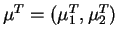 and Variance covariance
![\begin{displaymath}
\Sigma = \left[\begin{array}{rr} \Sigma_{11} & \Sigma_{12} \\
\Sigma_{21} & \Sigma_{22}\end{array}\right]
\end{displaymath}](img5.gif)
- Show that
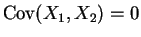 if and only if
  and
and  are independent. Use my definition of MVN; you are not allowed
to assume that
are independent. Use my definition of MVN; you are not allowed
to assume that  has a density. A mathematically careful argument may
rely on the fact that if
has a density. A mathematically careful argument may
rely on the fact that if
 are independent and
  are (measurable) functions then
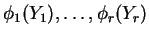 are independent.
- Show that whether or not
 is singular, each column of
 is in the column space of .
Hint: one way to do this is to use the following outline.
- Define
 and
and  to be the matrix of orthonormal eigenvectors
and the diagonal matrix of corresponding eigenvalues of
I showed in class. The columns of are a basis of
to be the matrix of orthonormal eigenvectors
and the diagonal matrix of corresponding eigenvalues of
I showed in class. The columns of are a basis of  dimensional space
if has components. You can write any vector
dimensional space
if has components. You can write any vector  as a linear
combination of the columns of , that is, in the form
as a linear
combination of the columns of , that is, in the form  .
.
- Suppose is a column of and write
 where the
  are the columns of . You are supposed to find an
  such that
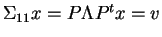 . If
. If
 then
use the orthogonality of the to derive a relationship between
then
use the orthogonality of the to derive a relationship between
 ,
,  and
and  .
.
- If
 you can solve this for while if
 then the relationship in the previous part is true anyway. This gives you
a formula for as a linear combination of the .
then the relationship in the previous part is true anyway. This gives you
a formula for as a linear combination of the .
- Define
- Show that there is a matrix
 which is
  such that
 .
.
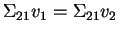
- Let
 be a column of and
  and
and  be any vectors
such that
be any vectors
such that
 for
for  . Show that
 .
.
- Show that if
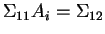 for then
 .
.
- Show that
 implies
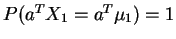 for any
  .
.
- Suppose is such that
implies
 . Show that the conditional distribution
of given
. Show that the conditional distribution
of given  is well-defined and is multivariate
normal with mean
is well-defined and is multivariate
normal with mean

and variance covariance

where is any solution of
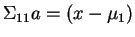 and is any solution of
 .
.
NOTE: Most facts about
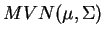 variates can be demonstrated
by writing
variates can be demonstrated
by writing 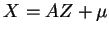 for well chosen .
. Minimize and maximize
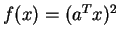 subject to
  .
.
. Minimize and maximize  subject to
 for a given symmetric positive definite matrix
  .
.
![\begin{displaymath}
A=\left[\begin{array}{rr} 1 & -1 \\ -1 & 1 \end{array}\right]
\end{displaymath}](img58.gif)
and then find a symmetric square root.
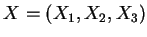 has a MVN distribution with
  and
and
![\begin{displaymath}
\Sigma = \left[\begin{array}{rrr} 2 & 1 & -1 \\ 1 & 1 & -1 \\ -1 & -1 & 1 \end{array}\right]
\end{displaymath}](img61.gif)
Find the conditional distribution of
given  and
and  . For which
values of
. For which
values of  and
and  does this make sense?