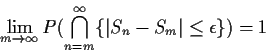
Standard approaches to probability theorems:
 or decreasing
  of events each defined from only
finitely many random variables.
of events each defined from only
finitely many random variables.


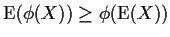 for
for  convex.
Event that Yn converges to
0 is

Not explicitly written in terms of simple events involving only a finite number of Ys.
Recall basic definition of
limit: yn converges to 0 if

 such that
 we have
 .
.
Convert the definition in A into set theory notation:
 ,
,
We get
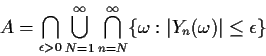
Not obvious A is event because intersection
over
 is uncountable.
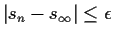
However, the intersection is countable. Let


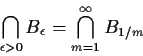
Here are some other events:
 such that
we have
such that
such that
we have
 .
Mechanically get event:
.
Mechanically get event:
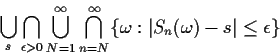
 can be made countable. Union over
s, however, is not easy to make countable. Instead use
theorem of analysis to describe existence of a limit.
A sequence sn has a limit if and only if the
sequence is Cauchy.
can be made countable. Union over
s, however, is not easy to make countable. Instead use
theorem of analysis to describe existence of a limit.
A sequence sn has a limit if and only if the
sequence is Cauchy.
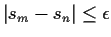
Cauchy sequence:
such that
 we have
 .
.
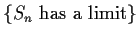 is
is
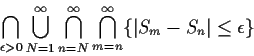 is
countable intersection over
is
countable intersection over
 for positive integers r.
 has a limit so

 such that Sn>0.
is
such that Sn>0.
is
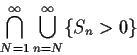
 and
and
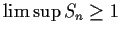 .
Former is
.
Former is
 such that
 .
Latter
is
and
.
Latter
is
and  there is an
  such that
 .
Event is
.
Event is
 where
where

 is a sequence of
independent identically distributed random variables with
is a sequence of
independent identically distributed random variables with
 .
Then
.
Then
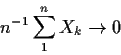
Must prove P(A)=1 where
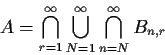

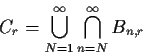
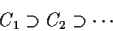

Remark: Usually ``for every
'' will be decreasing intersections
because the condition in the definition is harder to satisfy for
smaller .
Similarly unions in definitions tend to be
increasing.
Now each Cr is an increasing union. Let
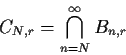
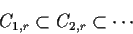
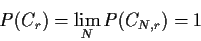
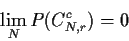
Proof with 4 moments using Borel-Cantelli Lemma.
Suppose An is a sequence of events.
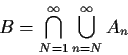
The event

 belonging to infinitely many of the An
We have seen above that
belonging to infinitely many of the An
We have seen above that
Lemma [Borel-Cantelli]:
If
 then
then
 .
.
To prove the lemma we need to prove that
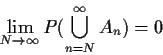
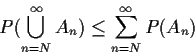
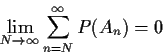
Apply lemma: notice that complement of
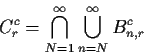 such that Bn,r happens for every
is
there is at least one
for which Bn,r does
not happen:
such that Bn,r happens for every
is
there is at least one
for which Bn,r does
not happen:

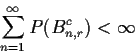
Summary: if we prove
Next ingredient: Markov's inequality
![\begin{align*}P(B_{n,r}^c) & = P(\vert X_1+\cdots+X_n\vert > n/r)
\\
& \le \frac{{\rm E}\left[(X_1+\cdots+X_n)^4\right]}{(n/r)^4}
\end{align*}](img65.gif)
Expand out, collect terms:
![\begin{multline*}{\rm E}\left[(X_1+\cdots+X_n)^4\right]
\\
= n{\rm E}(X_1^4) + n(n-1)\left[{\rm E}(X_1^2)\right]^2
\end{multline*}](img66.gif)
This produces the bound (using
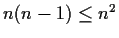 )
)
![\begin{displaymath}P(B_{n,r}^c) \le \frac{r^4{\rm E}(X_1^4)}{n^3} + \frac{r^4\left[{\rm E}(X_1^2)\right]^2}{n^2}
\end{displaymath}](img68.gif)


 proves that
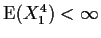 implies
 .
.
Assume
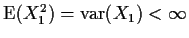 .
.
Use Kronecker's Lemma to find event inside A with probability 1.
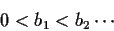

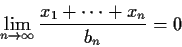
Lemma implies that

We compute
 so study
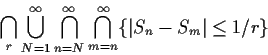
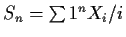 .
.
Key ingredient: lower bound on


Now Sm-Sn is a sum of m-n independent rvs. Need
bound on

Theorem [Kolmogorov]:
Suppose
 are independent random variables
with finite variances and mean 0. Put
are independent random variables
with finite variances and mean 0. Put
 .
Then
.
Then

The proof uses the idea of a stopping time. Define T to be
the least value of
 for which
 if such a k exists and T=n if no such k exists. Notice
that the event T=k is determined by the variables
if such a k exists and T=n if no such k exists. Notice
that the event T=k is determined by the variables
 ;
that is, there is a function
;
that is, there is a function
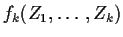 such that

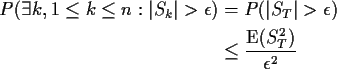
Next we compare
 to
to
 .
We have
.
We have
![\begin{align*}{\rm E}(S_n^2) & = {\rm E}\left[(S_n-S_T+S_T)^2\right]
\\
& = {\r...
...S_n-S_T)^2\right]
\\
& \qquad + 2{\rm E}\left[S_T(S_n-S_T)\right]
\end{align*}](img96.gif)
First two terms non-negative so if
![\begin{displaymath}{\rm E}\left[S_T(S_n-S_T)\right] =0
\end{displaymath}](img97.gif)
But
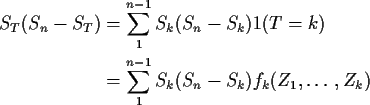
Notice that Sn-Sk and
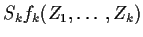 are independent so
![\begin{align*}{\rm E}\left[S_T(S_n-S_T)\right] & = \sum_1^{n-1} {\rm E}(S_n-S_k)
\\
\qquad \times{\rm E}\left[S_k1(T=k)\right]
\\
& = 0
\end{align*}](img100.gif)
Remark: In fact all I needed to prove Kolmogorov's inequality
was to know that Sn-Sk was uncorrelated with
any function of
 (or equivalently uncorrelated
with any function of
).
(or equivalently uncorrelated
with any function of
).
A sequence
 is a martingale
if, for each
is a martingale
if, for each  ,
,
![\begin{displaymath}{\rm E}[S_{k+1}\vert S_1,\ldots,S_k] = S_k
\end{displaymath}](img104.gif)
(I have yet to define conditional expectation properly but another
definition is that
![\begin{displaymath}{\rm E}[ (S_{k+1}-S_k)f_k(S_1,\ldots,S_k)] = 0
\end{displaymath}](img105.gif)
Theorem [Kolmogorov]:
Suppose
 is a martingale
with finite variances and mean 0.
Then
is a martingale
with finite variances and mean 0.
Then

Back to strong law. Fix
and integer m.
The events
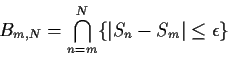
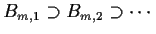 .
So
.
So
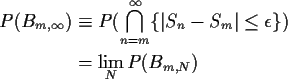
Now
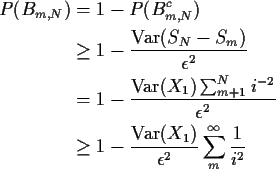
This shows

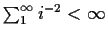 the right hand side of this inequality
goes to 0 as m goes to
the right hand side of this inequality
goes to 0 as m goes to  .
In other words
.
In other words