


Suppose
 are iid with density
 where
where
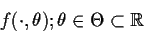
Conditions under which MLE of  is a.s.
consistent?
is a.s.
consistent?
Goal: find conditions under which
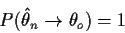
 is the mle.
General technical problems:
?
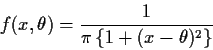
Example: Cauchy density is
 the likelihood is
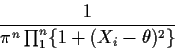 to be the value of which maximizes this function of .
This is supposed to define
 as a function of
.
as a function of
.
Underlying supposition: for each


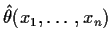 which maximizes the likelihood. If this were so we would have a
definition of a function from
which maximizes the likelihood. If this were so we would have a
definition of a function from
 to
to  .
Useful tool: log-likelihood:
.
Useful tool: log-likelihood:

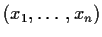 a
which
maximizes
a
which
maximizes  ?
?
unique?
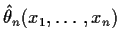 a Borel function
of
?
a Borel function
of
?
Question 1: For the Cauchy density there is always a
maximizer. Fix
.
As
 it
is easy to check that
it
is easy to check that

 implies
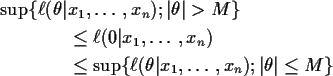
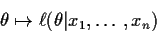 for any set of x values.
Question 2: n=2,
x1=x=-x2:


 this is 0 so
is
critical point of .
2nd derivative may
at 0 is
this is 0 so
is
critical point of .
2nd derivative may
at 0 is
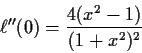 is even there must be two maxima n either side of 0. Note
that putting the two terms in
is even there must be two maxima n either side of 0. Note
that putting the two terms in
 on a common
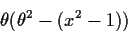
denominator will give a numerator which is a multiple of
on a common
denominator will give a numerator which is a multiple of
Summary: defining
to be the maximizer of
does not actually define a function.
Alternative strategies:
1: You might pick one of the maximizing values in an unequivocal way:
 is not empty and bounded so there
is such a
and that
is finite. By
continuity of
is not empty and bounded so there
is such a
and that
is finite. By
continuity of

2: You might try defining
to be
a suitably chosen critical point of .
3: You might try to prove that

In other words it might be true that the set of
where
achieves its maximum is almost surely a singleton when the xs are
actually a data set.
I am going to follow method 2 since this is the one which works most generally.
For
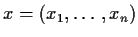 we define the order statistics
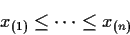
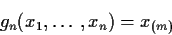

Now define
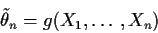
are iid from a distribution
F with the properties:

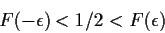
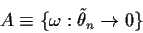
 converges almost surely to 0.
Remark: Part of the theorem is that
is a random variable.
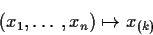



Now to prove the lemma we begin by formalizing an argument we have used several times.
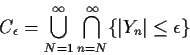
 almost surely is equivalent to
 for
each
where
for
each
where
Fix
.
For each x rvs
 defined by
 are iid
with mean 0. According to SLLN
there is a null set Nx such that for all
are iid
with mean 0. According to SLLN
there is a null set Nx such that for all
 we
have
we
have
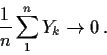
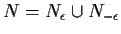 .
Then N is a null set.
If
.
Then N is a null set.
If
 then
then
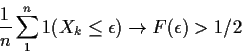
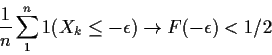
 there is an M such that for all
  the number of Xi exceeding
  is less than n/2 and
the number of Xi less than
is less than n/2 and
the number of Xi less than  is less than n/2.
Thus for such ,
and
is less than n/2.
Thus for such ,
and

 so
.
so
.
