


STAT 870 Lecture 16
Kolmogorov's Equations
The Chapman-Kolmogorov equations are

Subtract  from both sides, divide by h and let
  .
Remember that
.
Remember that  is the identity.
We find
is the identity.
We find

which gives

The Chapman-Kolmogorov equations can also be written

Now subtracting from both sides, dividing by h and letting
gives

Look at these equations in component form:
becomes

For  our calculations of instantaneous transition
rates gives
our calculations of instantaneous transition
rates gives

For i = k we have

(X(h)=i either means  which has probability
 or there have been two or more transitions in
[0,h], a possibility of probability o(h).)
Thus
or there have been two or more transitions in
[0,h], a possibility of probability o(h).)
Thus

Let  be the matrix with entries

is the infinitesimal generator of the chain.
Thus
becomes

Called Kolmogorov's backward equations.
On the other hand
becomes

These are Kolmogorov's forward equations.
Remark: When the state space is infinite the forward equations may not be justified. In deriving them we interchanged a limit with an infinite sum; the interchange is always justified for the backward equations but not for forward.
Example:  . Then

and the chain is otherwise specivied by  and
and  . The matrix
is
. The matrix
is

The backward equations become
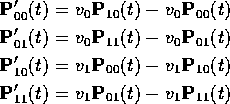
while the forward equations are

Add first and third backwward equations to get

so

Put t=0 to get  . This gives

Plug this back in to the first equation and get

Multiply by  and get

which can be integrated to get

Alternative calculation:
can be written as

where
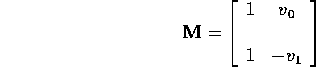
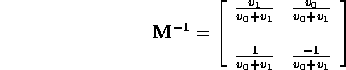
and

Then

Now

so we get

where
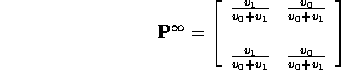
Notice: rows of  are a stationary initial distribution. If rows are
 then
then

so

Moreover

Fact:  is long run fraction of time in
state 0.
is long run fraction of time in
state 0.
Fact:

Ergodic Theorem in continuous time.
Potential Pathologies
Suppose that for each k you have a sequence

such that all  are independent exponential random variables
and has rate parameter
are independent exponential random variables
and has rate parameter  . We can use these times to
make a Markov chain with state space
. We can use these times to
make a Markov chain with state space 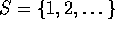 :
:
Start the chain in state 1. At time  move to 2, then at
  move
to 3 and so on. The chain progresses through the states in order 1,2,
move
to 3 and so on. The chain progresses through the states in order 1,2,  .
We have
.
We have

and

Does this define a process?
Depends on  .
.
Case 1: if  then
then

(converse to Borel Cantelli) and our construction defines a process X(t) for all t.
Case 2: if  then
for each k
then
for each k

In this case put 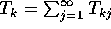 .
Our definition above defines a process X(t) for
.
Our definition above defines a process X(t) for  .
We put
.
We put  and then begin the process over with the set
of holding times
and then begin the process over with the set
of holding times  . This defines X for
 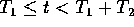 .
Again we put
.
Again we put  and continue the process.
Result: X is a Markov Chain with specified transition rates.
Problem: what if we put  and continued?
What if we used probability vector  to pick
a value for
to pick
a value for  and continued?
All yield Markov Processes with the same infinitesimal generator
.
Birth and Death Processes
Consider a population of X(t) individuals. Suppose
in next time interval (t,t+h) probability of population
increase of 1 (called a birth) is  and
probability of decrease of 1 (death) is
and
probability of decrease of 1 (death) is  .
.
Jargon: X is a birth and death process.
Special cases:
All  ; called a pure birth process.
All  (0 is absorbing): pure death process.
 and
and  is a linear
birth and death process.
is a linear
birth and death process.
 ,
,  : Poisson Process.
 and is a linear
birth and death process with immigration.
and is a linear
birth and death process with immigration.
Queuing Theory
Ingredients of Queuing Problem:
1: Queue input process.
2: Number of servers
3: Queue discipline: first come first serve? last in first out? pre-emptive priorities?
4: Service time distribution.
Example:
Imagine customers arriving at a facility at times of a Poisson
Process N with rate  . This is the input process,
denoted M (for Markov) in queuing literature.
. This is the input process,
denoted M (for Markov) in queuing literature.
Single server case:
Service distribution: exponential service times, rate  .
.
Queue discipline: first come first serve.
X(t) = number of customers in line at time t.
X is a Markov process called M/M/1 queue:


Example:  queue:
Customers arrive according to PP rate . Each
customer begins service immediately. X(t) is number
being served at time t. X is a birth and death process
with

and
