


STAT 870 Lecture 15
Continuous Time Markov Chains
Consider a population of single celled organisms in a stable environment.
Fix short time interval, length h.
Each organism has some probability of dividing to produce two organisms and some other probability of dying.
We might suppose:
 plus o(h).
 plus o(h).
Notice tacit assumption: constants of proportionality do not depend on time (that is our interpretation of ``stable environment'').
Notice too that we have taken the constants not to depend on which organism we are talking about. We are really assuming that the organisms are all similar and live in similar environments.
Y(t): total population at time t.
 : history of the
process up to time t.
: history of the
process up to time t.
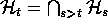
We generally take

General definition of a history (alternative jargon filtration):
any family of  -fields
indexed by t satisfying:
-fields
indexed by t satisfying:
 . measurable random variable.
 .
.
Condition on event Y(t) =n .
Then the probability of two or more divisions (either more than one division by a single organism or two or more organisms dividing) is o(h) by our assumptions.
Similarly the probability of both a division and a death or of two or more deaths is o(h).
So probability of exactly 1 division by any one of the n organisms is  .
.
Similarly probability of 1 death is  .
.
We deduce:
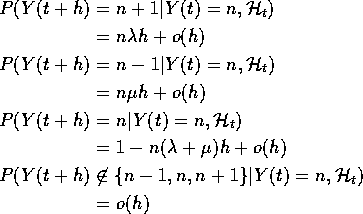
These equations lead to:
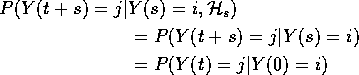
This is the Markov Property.
Definition: A process 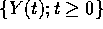 taking values in
S, a finite or countable state space is a Markov Chain
if
taking values in
S, a finite or countable state space is a Markov Chain
if

Definition: A Markov chain Y has stationary transitions if

From now on: our chains have stationary transitions.
Summary of Markov Process Results

 , until process leaves
i has exponential distribution, rate
denoted
, until process leaves
i has exponential distribution, rate
denoted  .
.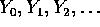 is Markov chain - transition matrix has
 . Y sometimes called skeleton.




 satisfy:


where  has entries


In this case we write  for the instantaneous
``birth'' rate:
for the instantaneous
``birth'' rate:

and  for the instantaneous
``death'' rate:
for the instantaneous
``death'' rate:

We have
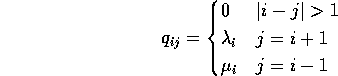
 then process is a pure birth process.
If all
then process is a pure birth process.
If all  a pure death process.
Necessary condition for existence of  is
is


In this case

provided  .
.
Detailed development
Suppose X a Markov Chain with stationary transitions. Then
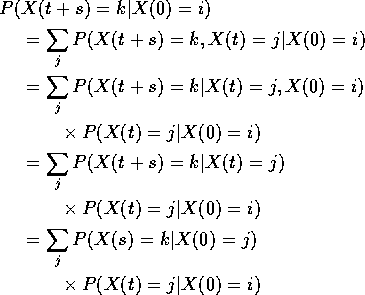
This shows

which is the Chapman-Kolmogorov equation.
Now consider the chain starting from i and let be
the first t for which  . Then is
a stopping time.
. Then is
a stopping time.
[Technically:

for each t.] Then
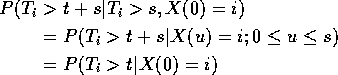
by the Markov property. Note: we actually are asserting a generalization of the Markov property: If f is some function on the set of possible paths of X then
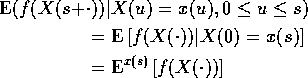
The formula requires some sophistication to appreciate. In it, f is a function which associates a sample path of X with a real number. For instance,

is such a functional. Jargon: functional is a function whose argument is itself a function and whose value is a scalar.
FACT: Strong Markov Property - for a stopping time T

with suitable fix on event  .
.
Conclusion: given X(0)=i, has memoryless porperty
so has an exponential distribution. Let be the
rate parameter.
Embedded Chain: Skeleton
Let 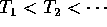 be the stopping times at which
tranisitons occur. Then
be the stopping times at which
tranisitons occur. Then
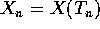 . The sequence
  is a Markov chain by the
strong Markov property. That reflects the fact
that
is a Markov chain by the
strong Markov property. That reflects the fact
that  by design.
As before we say  if
if  for some t.
It is fairly clear that for the X(t) if and only
if for the embedded chain .
for some t.
It is fairly clear that for the X(t) if and only
if for the embedded chain .
We say  if and
  .
.
Now consider

Suppose the chain has made n transitions so far so that
 . Then the event X(t+h)=j is, except
for possibilities of probability o(h) the event that
. Then the event X(t+h)=j is, except
for possibilities of probability o(h) the event that

The probability of this is
