IntroductionThroughout most of history, the human population generally lived close to the natural environment where they could depend on agriculture and hunting for survival. In recent decades, however, urban growth became extremely rapid. According to the United Nations, 3% of the world’s population lived in the urban areas in 1800. In 1950, urban population had rapidly increased to 14%. Moving on to the year 2000, the world’s population in urban areas was estimated at 47%; with 76% urban for more developed nations and 40% in less developed nations. This increase is not slowing down at all as urbanization is briskly taking place in many less developed countries. It is projected by the United Nations that the population of the world will be 60% urban by 2030, with most growth occurring in less developed countries. The rapid increase happens due to industrialization and also to people’s hope for better education and more comfortable living in the cities. Also, the automation of agricultural activities has caused workers to flock to the cities for jobs. Hence, there is an urban boom in most of the cities of the world. With rapid growth of urbanization and industrialization, one obvious response of urban areas is the extensive use mechanical devices to aid human activities. An Intergovernmental Panel on Climate Change report (IPCC 2001) confirms that “there is new and stronger evidence showing that most of the warming observed over the last 50 years is attributed to human activities.” Many of these activities require the combustion of fossil fuels for power. Fossil fuel burning in turn emits polluting gases and aerosols to the atmosphere, causing problems for human respiratory health and harm to the environment. With population and sizes of cities increasing at a rapid rate, aerosol pollution and its effects has to be looked into in order to gain insights to their role in changing climate regimes. There are two principal climatological effects regarding aerosol emission in an urban area. The first is the urban heat island effect caused by the alteration of the radiative patterns to a city due to increased aerosol concentration in the atmosphere. This has been studied into quite extensively with agreeable results from different researches showing the densest part of the city having a slightly higher (1-4oC, varies among cities) temperature compared to the surrounding rural areas. The second effect is the changes to the precipitation regime caused by increased condensation nuclei sourced from the swell of anthropogenic aerosols in an urban area. It is known that aerosols and their relationships with clouds and rainfall is one of the weakest aspects of current climate modelling (Ghan et. al. 2001, Collings, 2003). Previous studies done in this subject area are contradictory. Some studies conclude that urban areas will have a reduction in precipitation due to cloud microphysics (Rosenfeld, 2000; Rathemanthen et al. 2001), others show that an urban area will have significantly increased downwind rainfall and intensity of storms (Huff and Vogel 1978, Changnon 1978, Shepherd et. al. 2002). |
||||||||||||||||
Aerosol and Condensation NucleiAerosols are defined as microscopic solid or liquid particles of either a human or natural origin that are suspended in the atmosphere. They can be of natural or anthropogenic origins. Naturally, they occur in forms such as sea salt, dust, blown sand, etc. In urban areas, there are human activities created particles in the air that causes air pollution. Some of these particles are soot (tiny solid carbon particles), dust, smoke, and sulphur dioxide. The main sources of these anthropogenic aerosols are from mechanical processing, which involves the burning of fossil fuels, stash-and-burn agriculture, and the burning of coal. These urban aerosols act together to add to their natural counterparts to increase the grittiness of the atmosphere and also to act as additional condensation nuclei.
|
 |
|||||||||||||||
Condensation nuclei (CCM) are small
particles that provide sites for the condensation of water vapour. Within
an air parcel, a typical cubic centimetre sample of air contains anywhere
from a hundred to thousands of minute solid or liquid particles/aerosols
which provide sites for condensation to occur as the temperature in
the parcel approaches dew point. Also, note that there is an inverse
relationship between particle diameter and their concentration. In general,
larger nuclei are less common, as seen in Table 1. |
||||||||||||||||
|
||||||||||||||||
|
The relationship between aerosol and
condensation nuclei is apparent as the aerosol itself acts as a medium
for water vapour to collect. This effectively makes the aerosol the
condensation nuclei. Anthropogenic aerosols act as additional cloud
condensation nuclei to natural aerosols, spreading the cloud's liquid
water over more, smaller droplets. This essentially makes clouds more
reflective and longer lasting. The formation of cloud droplets require
two important conditions: there first has to be a presence of a seed
(condensation nuclei), and also there has to be an excess of water vapour
to supersaturate the seed. |
||||||||||||||||
Modification Caused by Urban AreasIn urban areas, human activities causes an increase in the release of aerosols, allowing more condensation nuclei to be available in the atmosphere for collecting water vapour. Hence, there is a higher concentration of nuclei tightly packed within a column of air. This affects the ability of the clouds to form rain because the higher number of nuclei spreads out the available moisture to the increased number of nuclei. Therefore, it takes more time for the nuclei in the cloud to collect enough moisture to form rain. The consequence is that areas with a high concentration of CCN (i.e. urban areas) will have a lower amount of surface precipitation compared to the rural area. |
||||||||||||||||
Smog Creation
|
||||||||||||||||
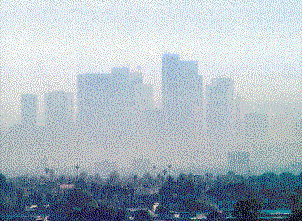 Smog
creation is related to anthopogenic release of aerosol into the atmosphere.
It has a relation to the precipitation because precipitation acts as
a "cleanser" for aerosols in the atmosphere. Areas with high
precipitation generally will flair better in air quality than the drier
areas when both areas have similar amount of aerosol release. Thus,
an if an area is dry and has a high release of aerosol, that area will
be a smog creation area. It might not be the place where the smog will
be visually evident due to wind patterns; however, it is still a generator
to pollution downstream of the location.
Smog
creation is related to anthopogenic release of aerosol into the atmosphere.
It has a relation to the precipitation because precipitation acts as
a "cleanser" for aerosols in the atmosphere. Areas with high
precipitation generally will flair better in air quality than the drier
areas when both areas have similar amount of aerosol release. Thus,
an if an area is dry and has a high release of aerosol, that area will
be a smog creation area. It might not be the place where the smog will
be visually evident due to wind patterns; however, it is still a generator
to pollution downstream of the location.