
How-to guides
Creating Appointments
 Download the PDF version of this How-to Guide
‹‹ Return to How-to guides & videos
Table of contents
QuickAdd Appointment Menu
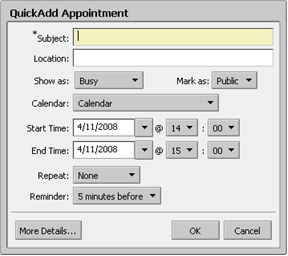
The QuickAdd Appointment menu is an abbreviated version of the more complete Appointment Details menu.
Use the QuickAdd Appointment menu to create appointments when you don't need to add attendees.
To see additional options such as viewing the availability of a person, location or resource, customizing a repeat pattern, adding attendees and adding notes to a meeting, click on the 'More Details...' button at the bottom left of the QuickAdd Appointment menu.
Tip: If you constantly need to add attendees to appointments or need to customize more appointment details, you can bypass the QuickAdd Appointment Menu by going to the Preferences tab, choosing Calendar, unchecking 'Use the QuickAdd dialogue when creating new appointments' and clicking on the 'Save' button.
-
Navigate to the Calendar tab in SFU Connect.

-
In your calendar, double click on the date in which you would like to create an appointment. Or, in the Day, Week, Work Week or Schedule views, you may also click and drag to select a time frame.
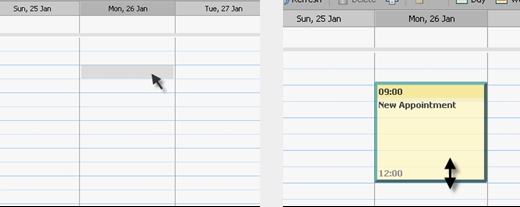
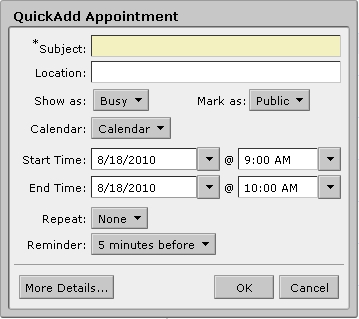
The QuickAdd Appointment Menu should pop up after you release the mouse button.
-
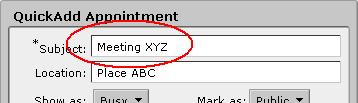
Enter the subject of your choice. If you are specifying a location but do not wish to book one that is in the system (e.g., you are meeting at a local coffee shop), simply type in the location name. Otherwise, to book a location in the system, clicking on 'More Details...' and choosing a location from 'Find Locations' in the Appointment Creation Menu is highly recommended.
-
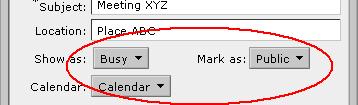
By default, appointments are set to show as 'Busy' and marked as 'Public'. You may also change the destination calendar in which you want to create this appointment, which is automatically set to your main calendar.
-
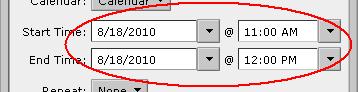
Select the dates and times for the start and end of the appointment. You can select a repeat pattern and reminder time from the drop down menu.
-
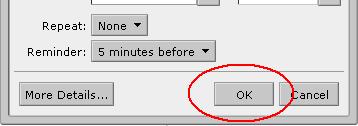
To customize the repeat pattern, click on 'More Details...', followed by clicking on the blue 'Customize' link. See the Creating & Customizing Repeat Patterns section of this guide. Otherwise, if you have finished, click 'OK' to save the appointment.
-
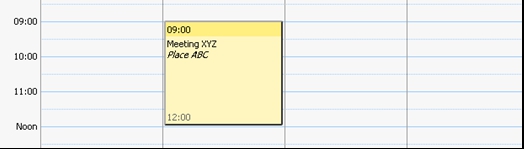
The new appointment has now been created and should appear in your calendar.
Appointment Creation Menu
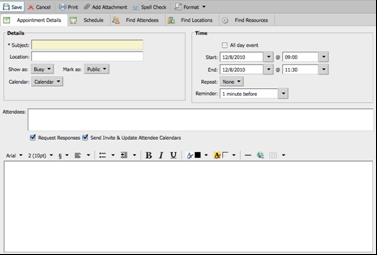
The Appointment Creation menu offers all customization options available for appointments.
Summary of additional options:
- Search/add attendees
- Search/add locations
- Search/add resources
- Add meeting notes
- Customize a repeat pattern
- Mark as an All Day Event
- Add attachments
- View free/busy times
-
Navigate to the Calendar tab in SFU Connect.
-
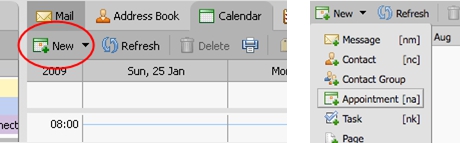
Click on the 'New' button near the top left of the screen to create a new appointment. You can also click on the triangle just to right of the 'New' button and choose 'New Appointment'.
-
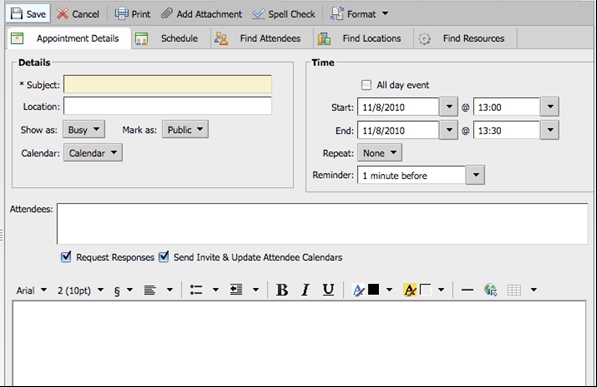
The Appointment Creation Menu should appear. There are five tabs on the Appointment Details menu: Appointment Details, Schedule, Find Attendees, Find Locations and Find Resources. Above these tabs, there are also the options to add attachments, check spelling and change the formatting (HTML or text).
-
In the Appointment Details tab, you can enter the main details of the appointment. By default, appointments are set to show as 'Busy' and marked as 'Public'.
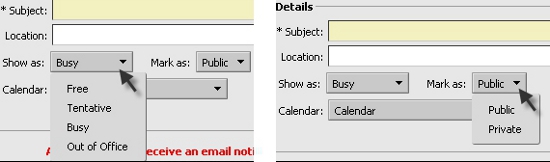
Note: By default, any SFU Connect user can only see whether you are free or busy for a meeting; they cannot see the details of your meeting unless you share your calendar with them. Marking a meeting as 'Private' will hide the meeting details from those with whom you have shared your calendar. To view more details on sharing, see the 'Sharing Calendars' How-To Guide.
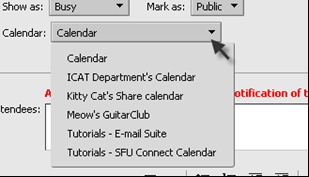
You may also change the destination calendar in which you want to create this appointment, which is automatically set to your main (default) calendar.
-
Additional notes regarding the meeting can be entered in the large field at the bottom of the page. Using the toolbar, you can customize the HTML formatting of the message. These notes will be included in the email notification to all attendees.

-
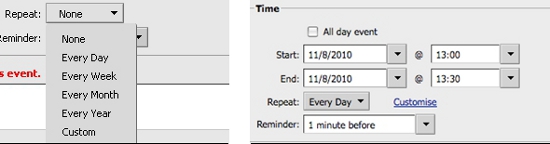
Select or type in the dates and times for the start and end of the appointment. You can select the 'All day event' check box, which makes the appointment an all day event. All day events will block off your entire day as 'busy', and will be displayed on the top of most calendar views.

A repeat pattern and reminder time can be selected from the drop down menu. To customize the repeat pattern, choose 'Custom', or click on the blue 'Customize' link, which will bring up a more options. See the Creating & Customizing Repeat Patterns section of this guide for more information.
-
Note: Before adding locations and/or resources to your appointment, please ensure that you have permission to book them. Locations/resources that have booking restrictions will have '[R]' at the end if the name. If you do not have permission to reserve a particular location or resource, you will receive an email message indicating that the booking has been declined. Contact the department's location/resource manager (seen in the Contact column of the search results) to find out more about their booking policies.
There are two methods of adding locations to an appointment:
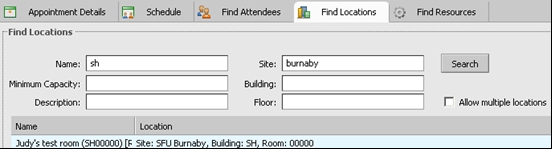
- Go to the Find Locations tab and perform a search. Double click on the location to add it.
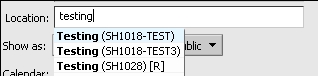
- Or, begin typing a location name in the field if you already know it. The system will attempt to find a list of matches based on your entry.
- Or, if you do not wish to request a bookable location, simply type in the name. To add resources to the meeting, go to the Find Resources tab and perform a search. Double click on the resource to add it.
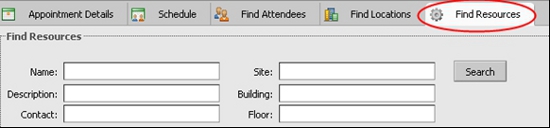
- Go to the Find Locations tab and perform a search. Double click on the location to add it.
-
There are two methods of adding attendees to an appointment:
- Begin typing an attendee's name in the field. The Global Address List (GAL) will attempt to find a match based on your entry.
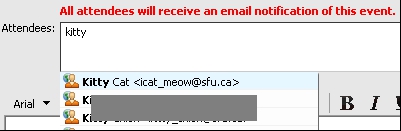
- Or, go to the Find Attendees tab and search for your attendees. Double click to add the attendee.
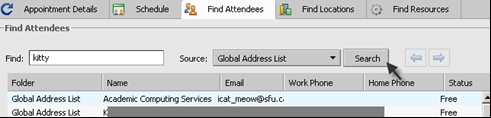
- Begin typing an attendee's name in the field. The Global Address List (GAL) will attempt to find a match based on your entry.
-
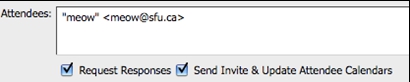
You will notice there are two checkboxes under the Attendees field: Request Responses and Send Invite & Update Attendees Calendars. These two checkboxes are activated by default.
-
To check the availability and/or time conflicts of the attendees, location or resource, click on the Schedule tab. The organizer will appear at the top of the list of All Attendees. The green line indicates the proposed start time, and the red line indicates the proposed end time.
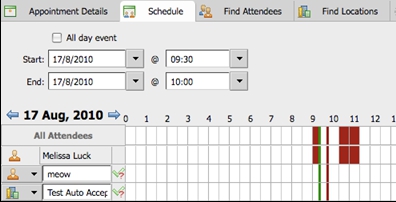
The availability of time slots is marked as follows:- White = Free.
- Dark red = Busy.
- Orange = Tentative.
- Yellow = Out of Office.
-
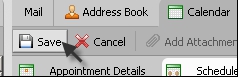
Once you have finished entering the appointment information, click 'Save'.
-
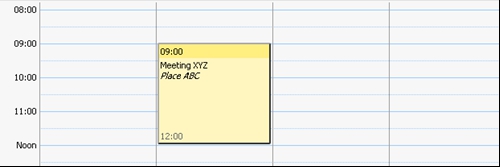
The new appointment has now been created and should appear in your calendar. An email will automatically be sent to all attendees to notify them of the new meeting.
Setting Free/Busy Status & Access Levels
Adding Locations & Resources
Adding Attendees
'Request Responses' and 'Send Invite & Update Attendee Calendars'
Request Responses
When checked, you will receive attendees' email responses (Yes, I will attend; no, I will not attend, etc.) and you will be able to see their responses on the Schedule tab of the appointment as well.
When unchecked, you will not receive attendees' email responses, nor will you be able to see their responses on the Schedule tab of the appointment.
Send Invite & Update Attendee Calendars
When checked, an email notification will be sent to attendees and their calendars will be updated with your changes.
When unchecked, no email notification will be sent to attendees. Note that the SFU Connect calendar is email-driven; email notifications must be sent by the organizer and received by attendees in order for attendees' calendars to reflect any changes you make to the appointment.
Checking Availability
Creating & Customizing Repeat Patterns
-
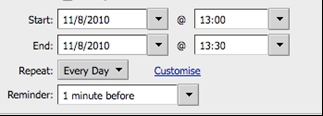
When creating a repeat pattern, begin by entering the start time/date and end time/date for the first instance (not for the entire range of the meeting pattern).
-
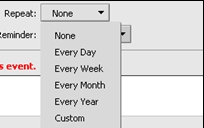
Then, either select a predefined repeat pattern from the drop down menu, or select 'Custom' to bring up more options.
-
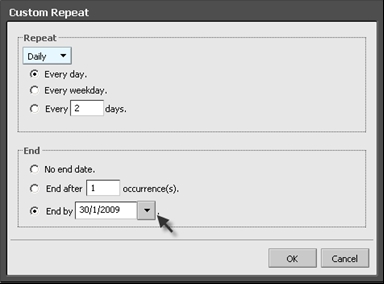
In the 'Custom Repeat' window, there is a wider range of settings available. You may also choose how the repeat pattern ends: Either after a number of occurrences, or at a specific date.
-
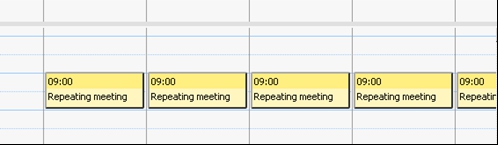
Click 'OK' to save the repeat pattern. The repeating meeting should show up in your calendar once you click 'Save' in the main Appointment Details menu.
Note: Modifying Instances and the Series of a Repeat Pattern
You can modify one or more instances of a meeting pattern. Modifications can also be made to an entire series. However, note that if you add an attendee to the series, this will cause all the meetings in the pattern to show up in the attendee's calendar, including all customized instances. This will not be apparent to the organizer of the meeting.