
Chapter Contents

Previous

Next
|
Chapter Contents |
Previous |
Next |
| The MODEL Procedure |
The RANDOM= option is used to request Monte Carlo (or stochastic)
simulation to generate confidence intervals for a forecast. The
confidence intervals are implied by the model's relationship to the
the implicit random error term  and the parameters.
The Monte Carlo simulation generates a random set of additive error values, one for each observation and each equation, and computes one set of perturbations of the parameters. These new parameters, along with the additive error terms, are then used to compute a new forecast that satisfies this new simultaneous system. Then a new set of additive error values and parameter perturbations is computed, and the process is repeated the requested number of times.
Consider the following exchange rate model for the U.S. dollar with the German mark and the Japanese yen:
   proc model data=exchange;
      endo im_jp im_wg;
      exo di_jp di_wg;
      parms a1 a2 b1 b2 c1 c2;
      label rate_jp = 'Exchange Rate of Yen/$'
            rate_wg = 'Exchange Rate of Gm/$'
            im_jp = 'Imports to US from Japan in 1984 $'
            im_wg = 'Imports to US from WG in 1984 $'
            di_jp = 'Difference in Inflation Rates US-JP'
            di_wg = 'Difference in Inflation Rates US-WG';

      rate_jp = a1 + b1*im_jp + c1*di_jp;
      rate_wg = a2 + b2*im_wg + c2*di_wg;

               /* Fit the EXCHANGE data */
      fit rate_jp rate_wg / sur outest=xch_est outcov outs=s;

               /* Solve using the WHATIF data set */
      solve rate_jp rate_wg / data=whatif estdata=xch_est sdata=s
             random=100 seed=123 out=monte forecast;
      id yr;
      range yr=1986;
   run;
Data for the EXCHANGE data set was obtained from the Department of Commerce and the yearly "Economic Report of the President."
First, the parameters are estimated using SUR selected by the SUR option on the FIT statement. The OUTEST= option is used to create the XCH_EST data set which contains the estimates of the parameters. The OUTCOV option adds the covariance matrix of the parameters to the XCH_EST data set. The OUTS= option is used to save the covariance of the equation error in the data set S.
Next, Monte Carlo simulation is requested using the RANDOM= option on the SOLVE statement. The data set WHATIF, shown below, is used to drive the forecasts. The ESTDATA= option reads in the XCH_EST data set which contains the parameter estimates and covariance matrix. Because the parameter covariance matrix is included, perturbations of the parameters are performed. The SDATA= option causes the Monte Carlo simulation to use the equation error covariance in the S data set to perturb the equation errors. The SEED= option selects the number 123 as seed value for the random number generator. The output of the Monte Carlo simulation is written to the data set MONTE selected by the OUT= option.
                    /* data for simulation */
       data whatif;
          input yr rate_jp rate_wg imn_jp imn_wg emp_us emp_jp emp_wg
             prod_us / prod_jp prod_wg cpi_us cpi_jp cpi_wg;
          label cpi_us = 'US CPI 1982-1984 = 100'
                cpi_jp = 'JP CPI 1982-1984 = 100'
                cpi_wg = 'WG CPI 1982-1984 = 100';
          im_jp = imn_jp/cpi_us;
          im_wg = imn_wg/cpi_us;
          ius = 100*(cpi_us-(lag(cpi_us)))/(lag(cpi_us));
          ijp = 100*(cpi_jp-(lag(cpi_jp)))/(lag(cpi_jp));
          iwg = 100*(cpi_wg-(lag(cpi_wg)))/(lag(cpi_wg));
          di_jp = ius - ijp;
          di_wg = ius - iwg;
       datalines;
       1980 226.63 1.8175 30714 11693 103.3 101.3 100.4 101.7
            125.4 109.8  .824  .909  .868
       1981 220.63 2.2631 35000 11000 102.8 102.2  97.9 104.6
            126.3 112.8  .909  .954  .922
       1982 249.06 2.4280 40000 12000  95.8 101.4  95.0 107.1
            146.8 113.3  .965  .980  .970
       1983 237.55 2.5539 45000 13100  94.4 103.4  91.1 111.6
            152.8 116.8  .996  .999 1.003
       1984 237.45 2.8454 50000 14300  99.0 105.8  90.4 118.5
            152.2 124.7 1.039 1.021 1.027
       1985 238.47 2.9419 55000 15600  98.1 107.6  91.3 124.2
            161.1 128.5 1.076 1.042 1.048
       1986    .      .   60000 17000  96.8 107.3  92.7 128.8
            163.8 130.7 1.096 1.049 1.047
       1987    .      .   65000 18500  97.1 106.1  92.8 132.0
            176.5 129.9 1.136 1.050 1.049
       1988    .      .   70000 20000  99.6 108.8  92.7 136.2
            190.0 135.9 1.183 1.057 1.063
       ;
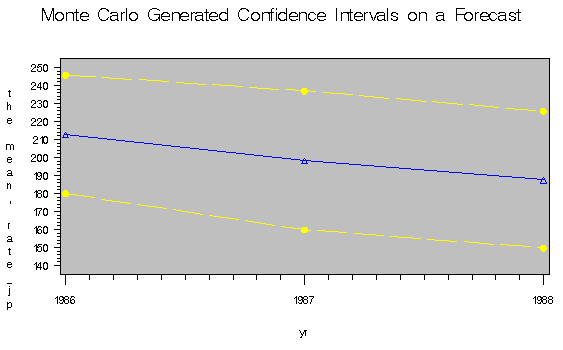
To generate a confidence interval plot for the forecast, use PROC UNIVARIATE to generate percentile bounds and use PROC GPLOT to plot the graph. The following SAS statements produce the graph in Figure 14.12.
   proc sort data=monte;
      by yr;
   run;

   proc univariate data=monte noprint;
      by yr;
      var rate_jp rate_wg;
      output out=bounds mean=mean p5=p5 p95=p95;
   run;

   title "Monte Carlo Generated Confidence Intervals on a Forecast";
   proc gplot data=bounds;
      plot mean*yr p5*yr p95*yr /overlay;
      symbol1 i=join value=triangle;
      symbol2 i=join value=square l=4;
      symbol3 i=join value=square l=4;
   run;
|
|
Chapter Contents |
Previous |
Next |
 Top |
Copyright © 1999 by SAS Institute Inc., Cary, NC, USA. All rights reserved.