
Chapter Contents

Previous

Next
|
Chapter Contents |
Previous |
Next |
| The PDLREG Procedure |
Use the MODEL statement to specify the regression model. The PDLREG procedure's MODEL statement is written like MODEL statements in other SAS regression procedures, except that a regressor can be followed by a lag distribution specification enclosed in parentheses.
For example, the following MODEL statement regresses Y on X and Z and specifies a distributed lag for X:
model y = x(4,2) z;
The notation X(4,2) specifies that the model includes X and 4 lags of X, with the coefficients of X and its lags constrained to follow a second-degree (quadratic) polynomial. Thus, the regression model specified by this MODEL statement is
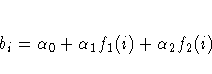
where f1(i) is a polynomial of degree 1 in i and f2(i) is a polynomial of degree 2 in i.
Lag distribution specifications are enclosed in parentheses and follow the name of the regressor variable. The general form of the lag distribution specification is
where:
If the minimum-degree option is specified, the PDLREG procedure estimates models for all degrees between minimum-degree and degree.
   data test;
      xl1 = 0; xl2 = 0; xl3 = 0;
      do t = -3 to 100;
         x = ranuni(1234);
         y = 10 + .25 * xl1 + .5 * xl2 + .25 * xl3 + .1 * rannor(1234);
         if t > 0 then output;
         xl3 = xl2; xl2 = xl1; xl1 = x;
         end;
   run;
The following statements use the PDLREG procedure to regress Y on a distributed lag of X. The length of the lag distribution is 4, and the degree of the distribution polynomial is specified as 3.
   proc pdlreg data=test;
      model y = x( 4, 3 );
   run;
The PDLREG procedure first prints a table of statistics for the residuals of the model, as shown in Figure 15.1. See Chapter 8 for an explanation of these statistics.
The PDLREG procedure next prints a table of parameter estimates, standard errors, and t-tests, as shown in Figure 15.2.
|
The preceding table shows the model intercept and the
estimated parameters of the lag distribution polynomial.
The parameter labeled X**0 is the constant term,  ,of the distribution polynomial.
X**1 is the linear coefficient,
,of the distribution polynomial.
X**1 is the linear coefficient,  ,X**2 is the quadratic coefficient,
  , and
X**3 is the cubic coefficient,
, and
X**3 is the cubic coefficient,  .
.
The parameter estimates for the distribution polynomial are not of interest in themselves. Since the PDLREG procedure does not print the orthogonal polynomial basis that it constructs to represent the distribution polynomial, these coefficient values cannot be interpreted.
However, because these estimates are for an orthogonal basis, you can use these results to test the degree of the polynomial. For example, this table shows that the X**3 estimate is not significant; the p-value for its t ratio is .4007, while the X**2 estimate is highly significant (p<.0001). This indicates that a second-degree polynomial may be more appropriate for this data set.
The PDLREG procedure next prints the lag distribution coefficients and a graphical display of these coefficients, as shown in Figure 15.3.
| |||||||||||||||||||||||||||||||||||||||||||
The lag distribution coefficients are the coefficients of the lagged values of X in the regression model. These coefficients lie on the polynomial curve defined by the parameters shown in Figure 15.2. Note that the estimated values for X(1), X(2), and X(3) are highly significant, while X(0) and X(4) are not significantly different from 0. These estimates are reasonably close to the true values used to generate the simulated data.
The graphical display of the lag distribution coefficients plots the estimated lag distribution polynomial reported in Figure 15.2. The roughly quadratic shape of this plot is another indication that a third-degree distribution curve is not needed for this data set.
|
Chapter Contents |
Previous |
Next |
 Top |
Copyright © 1999 by SAS Institute Inc., Cary, NC, USA. All rights reserved.