
Chapter Contents

Previous

Next
|
Chapter Contents |
Previous |
Next |
| The TSCSREG Procedure |
The specification for the two way model is
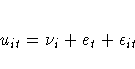
For balanced data, the two-way random effects model is estimated using the method of Fuller and Battese (1974), so in this case, the RANTWO option is equivalent to the FULLER option already existing in PROC TSCSREG.
The following method (Wansbeek and Kapteyn 1989) is used to handle unbalanced data.
Let X* and  be the independent and dependent
variables arranged by time and by cross section within each time period.
Let Mt be the number of cross sections observed in time
t and
be the independent and dependent
variables arranged by time and by cross section within each time period.
Let Mt be the number of cross sections observed in time
t and
 . Let Dt be the
Mt× N matrix obtained
from the N × N identity matrix from which rows corresponding to
cross sections not observed at time t have been omitted.
Consider
. Let Dt be the
Mt× N matrix obtained
from the N × N identity matrix from which rows corresponding to
cross sections not observed at time t have been omitted.
Consider
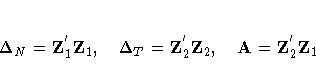
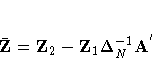
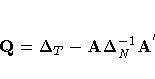
The matrix Z gives the dummy variable structure for the two-way model.
Let
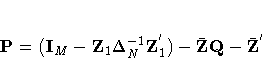
The estimator of the error variance is
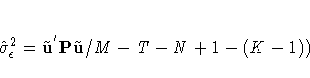
 are given by
 if there is an intercept and by
 if there is not.
The estimation of the variance
components is performed by using a
quadratic unbiased estimation (QUE) method that involves focusing
on quadratic forms of the residuals , equating
their expected values to the realized quadratic forms, and solving
for the variance components.
Let
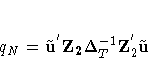
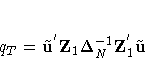
Consider the expected values


where
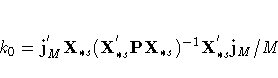
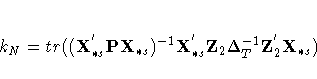
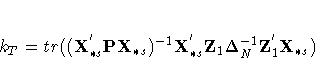
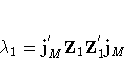
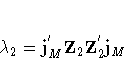
 and
and
 are obtained by equating the expected values to the quadratic forms and
solving for the two unknowns.
are obtained by equating the expected values to the quadratic forms and
solving for the two unknowns.
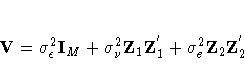
The estimated generalized least squares procedure substitute the QUE estimates into the covariance matrix of the composite error term uit, which is given by
|
Chapter Contents |
Previous |
Next |
 Top |
Copyright © 1999 by SAS Institute Inc., Cary, NC, USA. All rights reserved.