
Chapter Contents

Previous

Next
|
Chapter Contents |
Previous |
Next |
| Nonlinear Optimization Examples |
In some studies, subjects are assessed only periodically for outcomes or responses of interest. In such situations, the occurrence times of these events are not observed directly; instead they are known to have occurred within some time interval. The times of occurrence of these events are said to be interval censored. A first step in the analysis of these interval censored data is the estimation of the distribution of the event occurrence times.
In a study with n subjects, denote the raw interval
censored observations by ![\{(L_i,R_i]: 1 \leq i \leq n\}](images/i11eq168.gif) .For the ith subject, the event
occurrence time Ti lies in (Li,Ri], where Li is
the last assessment time at which there was no evidence
of the event, and Ri is the earliest time when a
positive assessment was noted (if it was observed at all).
If the event does not occur before the end of the study, Ri is
given a value larger than any assessment time recorded in the data.
.For the ith subject, the event
occurrence time Ti lies in (Li,Ri], where Li is
the last assessment time at which there was no evidence
of the event, and Ri is the earliest time when a
positive assessment was noted (if it was observed at all).
If the event does not occur before the end of the study, Ri is
given a value larger than any assessment time recorded in the data.
A set of nonoverlapping time intervals
![I_j=(q_j,p_j], \;1 \leq j \leq m](images/i11eq169.gif) is generated over which
the survival curve S(t) = Pr[T > t] is estimated.
Refer to Peto (1973) and Turnbull (1976) for details.
Assuming the independence of Ti and (Li,Ri],
and also independence across subjects, the likelihood
of the data
is generated over which
the survival curve S(t) = Pr[T > t] is estimated.
Refer to Peto (1973) and Turnbull (1976) for details.
Assuming the independence of Ti and (Li,Ri],
and also independence across subjects, the likelihood
of the data ![\{T_i \in (L_i,R_i], 1 \leq i \leq n\}](images/i11eq170.gif) can be constructed in terms of the pseudo-parameters
can be constructed in terms of the pseudo-parameters
![\theta_j = \Pr[T_i \in I_j], 1 \leq i \leq m](images/i11eq171.gif) .The conditional likelihood of
.The conditional likelihood of
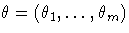 is
is
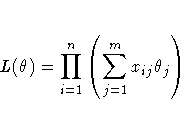
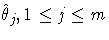 , yield an estimator
 of the survival function S(t), which is given by
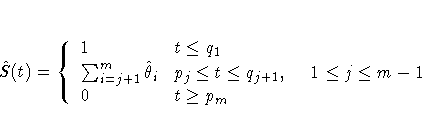
remains undefined in the intervals (qj,pj)
where the function may decrease in an arbitrary way.
The asymptotic covariance matrix of
 is obtained by inverting the
estimated matrix of second partial derivatives of the
negative log likelihood (Peto 1973, Turnbull 1976).
You can then compute the standard errors of the
survival function estimators by the delta method and
approximate the confidence intervals for survival
function by using normal distribution theory.
is obtained by inverting the
estimated matrix of second partial derivatives of the
negative log likelihood (Peto 1973, Turnbull 1976).
You can then compute the standard errors of the
survival function estimators by the delta method and
approximate the confidence intervals for survival
function by using normal distribution theory.
The following code estimates the survival curve for interval censored data. As an illustration, consider an experiment to study the onset of a special kind of palpable tumor in mice. Forty mice exposed to a carcinogen were palpated for the tumor every two weeks. The times to the onset of the tumor are interval censored data. These data are contained in the data set CARCIN. The variable L represents the last time the tumor was not yet detected, and the variable R represents the first time the tumor was palpated. Three mice died tumor free, and one mouse was tumor free by the end of the 48-week experiment. The times to tumor for these four mice were considered right censored, and they were given an R value of 50 weeks.
   data carcin;
      input id l r @@;
      datalines;
      1  20  22    11  30  32     21  22  24    31  34  36
      2  22  24    12  32  34     22  22  24    32  34  36
      3  26  28    13  32  34     23  28  30    33  36  38
      4  26  28    14  32  34     24  28  30    34  38  40
      5  26  28    15  34  36     25  32  34    35  38  40
      6  26  28    16  36  38     26  32  34    36  42  44
      7  28  30    17  42  44     27  32  34    37  42  44
      8  28  30    18  30  50     28  32  34    38  46  48
      9  30  32    19  34  50     29  32  34    39  28  50
     10  30  32    20  20  22     30  32  34    40  48  50
      ;

   proc iml;
      use carcin;
      read all var{l r};
      nobs= nrow(l);
     /*********************************************************
         construct the nonoverlapping intervals (Q,P) and
         determine the number of pseudo-parameters (NPARM)
      *********************************************************/
      pp= unique(r); npp= ncol(pp);
      qq= unique(l); nqq= ncol(qq);
      q= j(1,npp, .);
      do;
         do i= 1 to npp;
            do j= 1 to nqq;
               if ( qq[j] < pp[i] ) then q[i]= qq[j];
            end;
            if q[i] = qq[nqq] then goto lab1;
         end;
      lab1:
      end;

      if i > npp then nq= npp;
      else            nq= i;
      q= unique(q[1:nq]);
      nparm= ncol(q);
      p= j(1,nparm, .);
      do i= 1 to nparm;
         do j= npp to 1 by -1;
            if ( pp[j] > q[i] ) then p[i]= pp[j];
         end;
      end;

     /********************************************************
         generate the X-matrix for the likelihood
      ********************************************************/
      _x= j(nobs, nparm, 0);
      do j= 1 to nparm;
         _x[,j]= choose(l <= q[j]  & p[j] <= r, 1, 0);
      end;

     /********************************************************
        log-likelihood function (LL)
      ********************************************************/
      start LL(theta) global(_x,nparm);
         xlt= log(_x * theta`);
         f= xlt[+];
         return(f);
      finish LL;

     /********************************************************
        gradient vector (GRAD)
      *******************************************************/
      start GRAD(theta) global(_x,nparm);
         g= j(1,nparm,0);
         tmp= _x # (1 /  (_x * theta`) );
         g= tmp[+,];
         return(g);
      finish GRAD;

     /*************************************************************
        estimate the pseudo-parameters using quasi-newton technique
      *************************************************************/
      /* options */
      optn= {1 2};

      /* constraints */
      con= j(3, nparm + 2, .);
      con[1, 1:nparm]= 1.e-6;
      con[2:3, 1:nparm]= 1;
      con[3,nparm + 1]=0;
      con[3,nparm + 2]=1;

      /* initial estimates */
      x0= j(1, nparm, 1/nparm);

      /* call the optimization routine */
      call nlpqn(rc,rx,"LL",x0,optn,con,,,,"GRAD");

     /*************************************************************
       survival function estimate (SDF)
      ************************************************************/
      tmp1= cusum(rx[nparm:1]);
      sdf= tmp1[nparm-1:1];


     /*************************************************************
       covariance matrix of the first nparm-1 pseudo-parameters (SIGMA2)
      *************************************************************/
      mm= nparm - 1;
      _x= _x - _x[,nparm] * (j(1, mm, 1) || {0});
      h= j(mm, mm, 0);
      ixtheta= 1 / (_x * ((rx[,1:mm]) || {1})`);
      if _zfreq then
         do i= 1 to nobs;
            rowtmp= ixtheta[i] # _x[i,1:mm];
            h= h + (_freq[i] # (rowtmp` * rowtmp));
         end;
      else do i= 1 to nobs;
         rowtmp= ixtheta[i] # _x[i,1:mm];
         h= h + (rowtmp` * rowtmp);
      end;
      sigma2= inv(h);

     /*************************************************************
       standard errors of the estimated survival curve (SIGMA3)
      *************************************************************/
      sigma3= j(mm, 1, 0);
      tmp1= sigma3;
      do i= 1 to mm;
         tmp1[i]= 1;
         sigma3[i]= sqrt(tmp1` * sigma2 * tmp1);
      end;

     /*************************************************************
       95% confidence limits for the survival curve (LCL,UCL)
      *************************************************************/
     /* confidence limits */
      tmp1= probit(.975);
      *print tmp1;
      tmp1= tmp1 * sigma3;
      lcl= choose(sdf > tmp1, sdf - tmp1, 0);
      ucl= sdf + tmp1;
      ucl= choose( ucl > 1., 1., ucl);

     /*************************************************************
       print estimates of pseudo-parameters
      *************************************************************/
      reset center noname;
      q= q`;
      p= p`;
      theta= rx`;
      print ,"Parameter Estimates", ,q[colname={q}] p[colname={p}]
            theta[colname={theta} format=12.7],;

     /*************************************************************
       print survival curve estimates and confidence limits
      *************************************************************/
      left= {0} // p;
      right= q // p[nparm];
      sdf= {1} // sdf // {0};
      lcl= {.} // lcl //{.};
      ucl= {.} // ucl //{.};
      print , "Survival Curve Estimates and 95% Confidence Intervals", ,
            left[colname={left}] right[colname={right}]
            sdf[colname={estimate} format=12.4]
            lcl[colname={lower} format=12.4]
            ucl[colname={upper} format=12.4];
The iteration history produced by the
NLPQN subroutine is shown in Output 11.6.1
|
|
|
Chapter Contents |
Previous |
Next |
 Top |
Copyright © 1999 by SAS Institute Inc., Cary, NC, USA. All rights reserved.