
Chapter Contents

Previous

Next
|
Chapter Contents |
Previous |
Next |
| Details of the OPTEX Procedure |
| See OPTEX3 in the SAS/QC Sample Library |
The following example is based on an example in Mitchell (1974a). An animal scientist wants to compare wildlife densities in four different habitats over a year. However, due to the cost of experimentation, only 12 observations can be made. The following model is postulated for the density yj(t) in habitat j during month t:
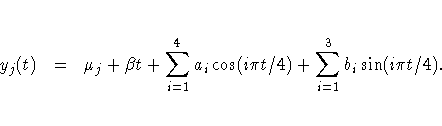
 , and cyclic
behavior in the form of a Fourier series. There is no intercept term
in the model.
, and cyclic
behavior in the form of a Fourier series. There is no intercept term
in the model.
The OPTEX procedure is used since there are no standard designs that cover this situation. The candidate set is the full factorial arrangement of four habitats by 12 months, which can be generated with a DATA step, as follows:
   data a;
      drop theta pi;
      array c{4} c1-c4;
      array s{3} s1-s3;
      pi = arcos(-1);
      do habitat=1 to 4;
         do month=1 to 12;
            theta = pi * month / 4;
            do i=1 to 4; c{i} = cos(i*theta); end;
            do i=1 to 3; s{i} = sin(i*theta); end;
            output;
         end;
      end;
   run;
Data set A contains the 48 candidate points and includes the cosine variables (C1, C2, C3, and C4) and sine variables (S1, S2, S3, S4). The following statements produce Output 24.1.1:
   proc optex seed=193030034 data=a;
      class    habitat;
      model    habitat month c1-c4 s1-s3 / noint;
      generate n=12;
   run;
Output 24.1.1: Sampling Wildlife Habitats Over Time
      output out=d1 number=1;
   run;
      output out=d6 number=6;
   run;

   proc sort data=d1;
      by  month habitat;
   proc print data=d1;
      var month habitat;
   run;

   proc sort data=d6;
      by  month habitat;
   proc print data=d6;
      var month habitat;
   run;
Output 24.1.2: The Best Design
|
|
You can try searching for the A-optimal design directly. This takes more time but (with only 48 candidate points) is not too large a problem. The following statements produce Output 24.1.4:
   proc optex seed=193030034 data=a;
      class    habitat;
      model    habitat month c1-c4 s1-s3 / noint;
      generate n=12 criterion=A;
   run;
Output 24.1.4: Searching Directly for an A-efficient Design
|
|
Chapter Contents |
Previous |
Next |
 Top |
Copyright © 1999 by SAS Institute Inc., Cary, NC, USA. All rights reserved.