
Chapter Contents

Previous

Next
|
Chapter Contents |
Previous |
Next |
| The Four Types of Estimable Functions |
For main effects models and regression models, the general form of estimable functions can be manipulated to provide tests of hypotheses involving only the parameters of the effect in question. The same result can also be obtained by entering each effect in turn as the last effect in the model and obtaining the Type I SS for that effect. These are the Type II SS. Using a modified reversible sweep operator, it is possible to obtain the Type II SS without actually rerunning the model.
Thus, the Type II SS correspond to the R notation in which each effect is adjusted for all other effects possible. For a regression model such as
| Effect | Type II SS | |
| B1 | R(B1 | B2, B3) | |
| B2 | R(B2 | B1, B3) | |
| B3 | R(B3 | B1, B2) |
For a main effects model (A, B, and C as classification variables), the Type II SS correspond to
| Effect | Type II SS | |
| A | R(A | B, C) | |
| B | R(B | A, C) | |
| C | R(C | A, B) |
As the discussion in the section "A Three-Factor Main Effects Model" indicates, for regression and main effects models the Type II SS provide an MRH for each effect that does not involve the parameters of the other effects.
For models involving interactions and nested effects, in the absence of a priori parametric restrictions, it is not possible to obtain a test of a hypothesis for a main effect free of parameters of higher-level effects with which the main effect is involved.
It is reasonable to assume, then, that any test of a hypothesis concerning an effect should involve the parameters of that effect and only those other parameters with which that effect is involved.
Given two effects F1 and F2, F1 is said to be contained in F2 provided that
Note that the interaction effect  is contained in all
pure CLASS effects, but it is not contained
in any effect involving a continuous variable.
No effect is contained by .
is contained in all
pure CLASS effects, but it is not contained
in any effect involving a continuous variable.
No effect is contained by .
Type II, Type III, and Type IV estimable functions rely on this definition, and they all have one thing in common: the estimable functions involving an effect F1 also involve the parameters of all effects that contain F1, and they do not involve the parameters of effects that do not contain F1 (other than F1).
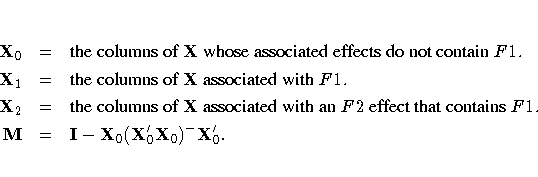
The Type II estimable functions for an effect F1 have an L (before reduction to full row rank) of the following form:
In these submatrices,
For the model Y = A B A*B, the Type II SS correspond to
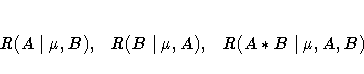

| Effect | Coefficient | |
| L1 | |
| A1 | L2 | |
| A2 | L1-L2 | |
| B1 | L4 | |
| B2 | L1-L4 | |
| AB11 | L6 | |
| AB12 | L2-L6 | |
| AB21 | L4-L6 | |
| AB22 | L1-L2-L4+L6 |
For a balanced 2 ×2 factorial with the same number of observations in every cell, the Type II estimable functions are shown in Table 12.6.
Table 12.6: Type II Estimable Functions for Balanced 2 ×2 Factorial| Coefficients for Effect | ||||||
| Effect | A | B | A*B | |||
| 0 | 0 | 0 | |||
| A1 | L2 | 0 | 0 | |||
| A2 | -L2 | 0 | 0 | |||
| B1 | 0 | L4 | 0 | |||
| B2 | 0 | -L4 | 0 | |||
| AB11 | 0.5*L2 | 0.5*L4 | L6 | |||
| AB12 | 0.5*L2 | -0.5*L4 | -L6 | |||
| AB21 | -0.5*L2 | 0.5*L4 | -L6 | |||
| AB22 | -0.5*L2 | -0.5*L4 | L6 | |||
For an unbalanced 2 ×2 factorial (with two observations in every cell except the AB22 cell, which contains only one observation), the general form of estimable functions is the same as if it were balanced since the same effects are still estimable. However, the Type II estimable functions for A and B are not the same as they were for the balanced design. The Type II estimable functions for this unbalanced 2 ×2 factorial are shown in Table 12.7.
Table 12.7: Type II Estimable Functions for Unbalanced 2 ×2 Factorial| Coefficients for Effect | ||||||
| Effect | A | B | A*B | |||
| 0 | 0 | 0 | |||
| A1 | L2 | 0 | 0 | |||
| A2 | -L2 | 0 | 0 | |||
| B1 | 0 | L4 | 0 | |||
| B2 | 0 | -L4 | 0 | |||
| AB11 | 0.6*L2 | 0.6*L4 | L6 | |||
| AB12 | 0.4*L2 | -0.6*L4 | -L6 | |||
| AB21 | -0.6*L2 | 0.4*L4 | -L6 | |||
| AB22 | -0.4*L2 | -0.4*L4 | L6 | |||
By comparing the hypothesis being tested in the balanced case to the hypothesis being tested in the unbalanced case for effects A and B, you can note that the Type II hypotheses for A and B are dependent on the cell frequencies in the design. For unbalanced designs in which the cell frequencies are not proportional to the background population, the Type II hypotheses for effects that are contained in other effects are of questionable merit.
However, if an effect is not contained in any other effect, the Type II hypothesis for that effect is an MRH that does not involve any parameters except those associated with the effect in question.
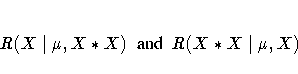
Thus, Type II SS are appropriate for
In addition to the preceding, the Type II SS is generally accepted by most statisticians for purely nested models.
|
Chapter Contents |
Previous |
Next |
 Top |
Copyright © 1999 by SAS Institute Inc., Cary, NC, USA. All rights reserved.