Example 23.2: Crude Birth and Death Rates
The following example uses the SAS data set Poverty
created in the "Getting Started" section.
The data, from Rouncefield (1995), are birth rates,
death rates, and infant death rates for 97 countries.
Six cluster analyses are performed with eight methods.
Scatter plots showing cluster membership at selected
levels are produced instead of tree diagrams.
Each cluster analysis is performed by a macro called ANALYZE.
The macro takes two arguments.
The first, &METHOD, specifies the value of the METHOD=
option to be used in the PROC CLUSTER statement.
The second, &NCL, must be specified as a list of
integers, separated by blanks, indicating the
number of clusters desired in each scatter plot.
For example, the first invocation of ANALYZE specifies the
AVERAGE method and requests plots of 3 and 8 clusters.
When two-stage density linkage is used, the K= and R=
options are specified as part of the first argument.
The ANALYZE macro first invokes the CLUSTER
procedure with METHOD=&METHOD, where &METHOD
represents the value of the first argument to ANALYZE.
This part of the macro produces the PROC CLUSTER output shown.
The %DO loop processes &NCL, the
list of numbers of clusters to plot.
The macro variable &K is a counter
that indexes the numbers within &NCL.
The %SCAN function picks out the &Kth number in &NCL,
which is then assigned to the macro variable &N.
When &K exceeds the number of numbers
in &NCL, %SCAN returns a null string.
Thus, the %DO loop executes while
&N is not equal to a null string.
In the %WHILE condition, a null string is indicated
by the absence of any nonblank characters between
the comparison operator (NE) and the right
parenthesis that terminates the condition.
Within the %DO loop, the TREE procedure creates
an output data set containing &N clusters.
The GPLOT procedure then produces a scatter plot
in which each observation is identified by the
number of the cluster to which it belongs.
The TITLE2 statement uses double quotes so that
&N and &METHOD can be used within the title.
At the end of the loop, &K is incremented by 1, and
the next number is extracted from &NCL by %SCAN.
For this example, plots are obtained only for average linkage.
To generate plots for other methods, follow
the example shown in the first macro call.
The following statements produce Output 23.2.1 through Output 23.2.7.
   title 'Cluster Analysis of Birth and Death Rates';

   %macro analyze(method,ncl);
   proc cluster data=poverty outtree=tree method=&method p=15 ccc pseudo;
      var birth death;
      title2;
   run;
   %let k=1;
   %let n=%scan(&ncl,&k);
   %do %while(&n NE);
      proc tree data=tree noprint out=out ncl=&n;
         copy birth death;
      run;
      legend1 frame cframe=ligr cborder=black
              position=center value=(justify=center);
      axis1 label=(angle=90 rotate=0) minor=none;
      axis2 minor=none;
      proc gplot;
         plot death*birth=cluster /
         frame cframe=ligr legend=legend1 vaxis=axis1 haxis=axis2;
         title2 "Plot of &n Clusters from METHOD=&METHOD";
      run;
      %let k=%eval(&k+1);
      %let n=%scan(&ncl,&k);
   %end;
   %mend;

   %analyze(average,3 8)
   %analyze(complete,3)
   %analyze(single,7 10)
   %analyze(two k=10,3)
   %analyze(two k=18,2)
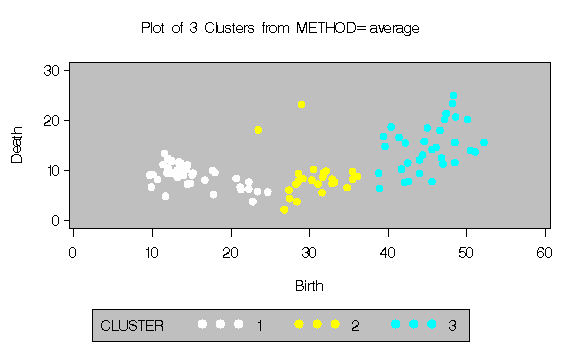
For average linkage, the CCC has peaks at 3, 8, 10, and 12
clusters, but the 3-cluster peak is lower than the 8-cluster peak.
The pseudo F statistic has peaks at 3, 8, and 12 clusters.
The pseudo t2 statistic drops sharply at 3 clusters,
continues to fall at 4 clusters, and has
a particularly low value at 12 clusters.
However, there are not enough data to
seriously consider as many as 12 clusters.
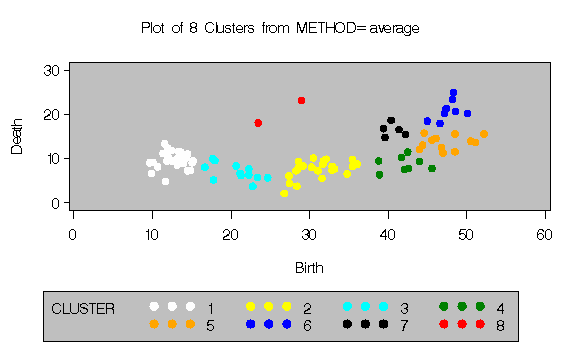
Scatter plots are given for 3 and 8 clusters.
The results are shown in Output 23.2.1 through Output 23.2.3.
In Output 23.2.3,
the eighth cluster consists of the two outlying observations, Mexico and
Korea.
Output 23.2.1: Clusters for Birth and Death Rates: METHOD=AVERAGE
|
| Cluster Analysis of Birth and Death Rates |
| The CLUSTER Procedure |
| Average Linkage Cluster Analysis |
| Eigenvalues of the Covariance Matrix |
| |
Eigenvalue |
Difference |
Proportion |
Cumulative |
| 1 |
189.106588 |
173.101020 |
0.9220 |
0.9220 |
| 2 |
16.005568 |
|
0.0780 |
1.0000 |
| Root-Mean-Square Total-Sample Standard Deviation = 10.127 |
| Root-Mean-Square Distance Between Observations = 20.25399 |
| Cluster History |
| NCL |
Clusters Joined |
FREQ |
SPRSQ |
RSQ |
ERSQ |
CCC |
PSF |
PST2 |
Norm
RMS
Dist |
T
i
e |
| 15 |
CL27 |
CL20 |
18 |
0.0035 |
.980 |
.975 |
2.61 |
292 |
18.6 |
0.2325 |
|
| 14 |
CL23 |
CL17 |
28 |
0.0034 |
.977 |
.972 |
1.97 |
271 |
17.7 |
0.2358 |
|
| 13 |
CL18 |
CL54 |
8 |
0.0015 |
.975 |
.969 |
2.35 |
279 |
7.1 |
0.2432 |
|
| 12 |
CL21 |
CL26 |
8 |
0.0015 |
.974 |
.966 |
2.85 |
290 |
6.1 |
0.2493 |
|
| 11 |
CL19 |
CL24 |
12 |
0.0033 |
.971 |
.962 |
2.78 |
285 |
14.8 |
0.2767 |
|
| 10 |
CL22 |
CL16 |
12 |
0.0036 |
.967 |
.957 |
2.84 |
284 |
17.4 |
0.2858 |
|
| 9 |
CL15 |
CL28 |
22 |
0.0061 |
.961 |
.951 |
2.45 |
271 |
17.5 |
0.3353 |
|
| 8 |
OB23 |
OB61 |
2 |
0.0014 |
.960 |
.943 |
3.59 |
302 |
. |
0.3703 |
|
| 7 |
CL25 |
CL11 |
17 |
0.0098 |
.950 |
.933 |
3.01 |
284 |
23.3 |
0.4033 |
|
| 6 |
CL7 |
CL12 |
25 |
0.0122 |
.938 |
.920 |
2.63 |
273 |
14.8 |
0.4132 |
|
| 5 |
CL10 |
CL14 |
40 |
0.0303 |
.907 |
.902 |
0.59 |
225 |
82.7 |
0.4584 |
|
| 4 |
CL13 |
CL6 |
33 |
0.0244 |
.883 |
.875 |
0.77 |
234 |
22.2 |
0.5194 |
|
| 3 |
CL9 |
CL8 |
24 |
0.0182 |
.865 |
.827 |
2.13 |
300 |
27.7 |
0.735 |
|
| 2 |
CL5 |
CL3 |
64 |
0.1836 |
.681 |
.697 |
-.55 |
203 |
148 |
0.8402 |
|
| 1 |
CL2 |
CL4 |
97 |
0.6810 |
.000 |
.000 |
0.00 |
. |
203 |
1.3348 |
|
|
Output 23.2.2: Plot of Three Clusters, METHOD=AVERAGE
Output 23.2.3: Plot of Eight Clusters, METHOD=AVERAGE
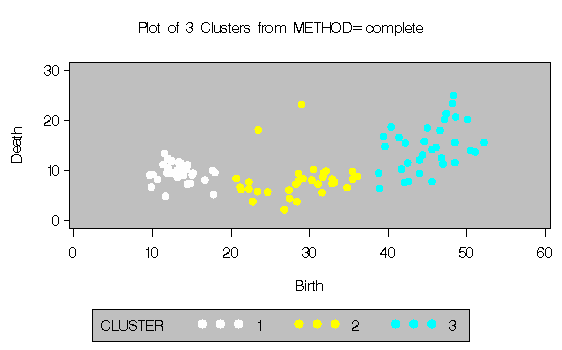
Complete linkage shows CCC peaks at 3, 8 and 12 clusters. The pseudo
F statistic peaks at 3 and 12 clusters.
The pseudo
t2 statistic indicates 3 clusters.
The scatter plot for 3 clusters is shown.
The results are shown in Output 23.2.4.
Output 23.2.4: Clusters for Birth and Death Rates: METHOD=COMPLETE
|
| Cluster Analysis of Birth and Death Rates |
| The CLUSTER Procedure |
| Complete Linkage Cluster Analysis |
| Eigenvalues of the Covariance Matrix |
| |
Eigenvalue |
Difference |
Proportion |
Cumulative |
| 1 |
189.106588 |
173.101020 |
0.9220 |
0.9220 |
| 2 |
16.005568 |
|
0.0780 |
1.0000 |
| Root-Mean-Square Total-Sample Standard Deviation = 10.127 |
| Mean Distance Between Observations = 17.13099 |
| Cluster History |
| NCL |
Clusters Joined |
FREQ |
SPRSQ |
RSQ |
ERSQ |
CCC |
PSF |
PST2 |
Norm
Max
Dist |
T
i
e |
| 15 |
CL22 |
CL33 |
8 |
0.0015 |
.983 |
.975 |
3.80 |
329 |
6.1 |
0.4092 |
|
| 14 |
CL56 |
CL18 |
8 |
0.0014 |
.981 |
.972 |
3.97 |
331 |
6.6 |
0.4255 |
|
| 13 |
CL30 |
CL44 |
8 |
0.0019 |
.979 |
.969 |
4.04 |
330 |
19.0 |
0.4332 |
|
| 12 |
OB23 |
OB61 |
2 |
0.0014 |
.978 |
.966 |
4.45 |
340 |
. |
0.4378 |
|
| 11 |
CL19 |
CL24 |
24 |
0.0034 |
.974 |
.962 |
4.17 |
327 |
24.1 |
0.4962 |
|
| 10 |
CL17 |
CL28 |
12 |
0.0033 |
.971 |
.957 |
4.18 |
325 |
14.8 |
0.5204 |
|
| 9 |
CL20 |
CL13 |
16 |
0.0067 |
.964 |
.951 |
3.38 |
297 |
25.2 |
0.5236 |
|
| 8 |
CL11 |
CL21 |
32 |
0.0054 |
.959 |
.943 |
3.44 |
297 |
19.7 |
0.6001 |
|
| 7 |
CL26 |
CL15 |
13 |
0.0096 |
.949 |
.933 |
2.93 |
282 |
28.9 |
0.7233 |
|
| 6 |
CL14 |
CL10 |
20 |
0.0128 |
.937 |
.920 |
2.46 |
269 |
27.7 |
0.8033 |
|
| 5 |
CL9 |
CL16 |
30 |
0.0237 |
.913 |
.902 |
1.29 |
241 |
47.1 |
0.8993 |
|
| 4 |
CL6 |
CL7 |
33 |
0.0240 |
.889 |
.875 |
1.38 |
248 |
21.7 |
1.2165 |
|
| 3 |
CL5 |
CL12 |
32 |
0.0178 |
.871 |
.827 |
2.56 |
317 |
13.6 |
1.2326 |
|
| 2 |
CL3 |
CL8 |
64 |
0.1900 |
.681 |
.697 |
-.55 |
203 |
167 |
1.5412 |
|
| 1 |
CL2 |
CL4 |
97 |
0.6810 |
.000 |
.000 |
0.00 |
. |
203 |
2.5233 |
|
|
The CCC and pseudo F statistics are not appropriate
for use with single linkage because of the method's
tendency to chop off tails of distributions.
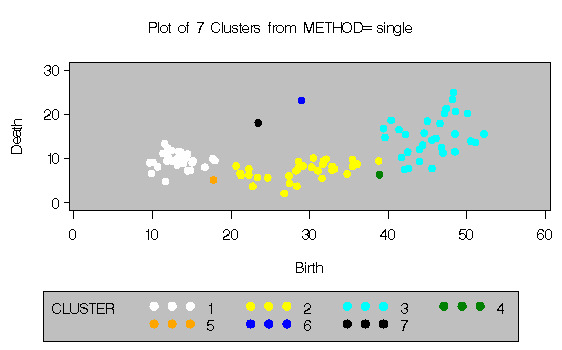
The pseudo t2 statistic can be used by looking for large
values and taking the number of clusters to be one greater than
the level at which the large pseudo t2 value is displayed.
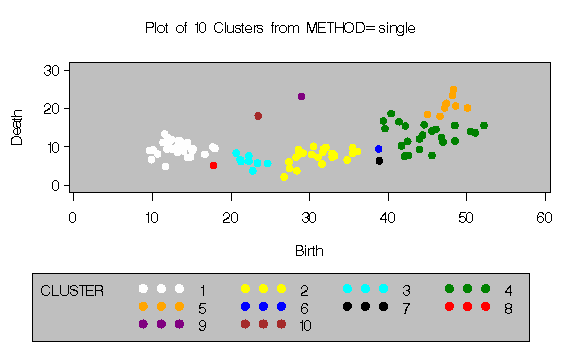
For these data, there are large values at levels
6 and 9, suggesting 7 or 10 clusters.
The scatter plots for 7 and 10 clusters are shown.
The results are shown in Output 23.2.5.
Output 23.2.5: Clusters for Birth and Death Rates: METHOD=SINGLE
|
| Cluster Analysis of Birth and Death Rates |
| The CLUSTER Procedure |
| Single Linkage Cluster Analysis |
| Eigenvalues of the Covariance Matrix |
| |
Eigenvalue |
Difference |
Proportion |
Cumulative |
| 1 |
189.106588 |
173.101020 |
0.9220 |
0.9220 |
| 2 |
16.005568 |
|
0.0780 |
1.0000 |
| Root-Mean-Square Total-Sample Standard Deviation = 10.127 |
| Mean Distance Between Observations = 17.13099 |
| Cluster History |
| NCL |
Clusters Joined |
FREQ |
SPRSQ |
RSQ |
ERSQ |
CCC |
PSF |
PST2 |
Norm
Min
Dist |
T
i
e |
| 15 |
CL37 |
CL19 |
8 |
0.0014 |
.968 |
.975 |
-2.3 |
178 |
6.6 |
0.1331 |
|
| 14 |
CL20 |
CL23 |
15 |
0.0059 |
.962 |
.972 |
-3.1 |
162 |
18.7 |
0.1412 |
|
| 13 |
CL14 |
CL16 |
19 |
0.0054 |
.957 |
.969 |
-3.4 |
155 |
8.8 |
0.1442 |
|
| 12 |
CL26 |
OB58 |
31 |
0.0014 |
.955 |
.966 |
-2.7 |
165 |
4.0 |
0.1486 |
|
| 11 |
OB86 |
CL18 |
4 |
0.0003 |
.955 |
.962 |
-1.6 |
183 |
3.8 |
0.1495 |
|
| 10 |
CL13 |
CL11 |
23 |
0.0088 |
.946 |
.957 |
-2.3 |
170 |
11.3 |
0.1518 |
|
| 9 |
CL22 |
CL17 |
30 |
0.0235 |
.923 |
.951 |
-4.7 |
131 |
45.7 |
0.1593 |
T |
| 8 |
CL15 |
CL10 |
31 |
0.0210 |
.902 |
.943 |
-5.8 |
117 |
21.8 |
0.1593 |
|
| 7 |
CL9 |
OB75 |
31 |
0.0052 |
.897 |
.933 |
-4.7 |
130 |
4.0 |
0.1628 |
|
| 6 |
CL7 |
CL12 |
62 |
0.2023 |
.694 |
.920 |
-15 |
41.3 |
223 |
0.1725 |
|
| 5 |
CL6 |
CL8 |
93 |
0.6681 |
.026 |
.902 |
-26 |
0.6 |
199 |
0.1756 |
|
| 4 |
CL5 |
OB48 |
94 |
0.0056 |
.021 |
.875 |
-24 |
0.7 |
0.5 |
0.1811 |
T |
| 3 |
CL4 |
OB67 |
95 |
0.0083 |
.012 |
.827 |
-15 |
0.6 |
0.8 |
0.1811 |
|
| 2 |
OB23 |
OB61 |
2 |
0.0014 |
.011 |
.697 |
-13 |
1.0 |
. |
0.4378 |
|
| 1 |
CL3 |
CL2 |
97 |
0.0109 |
.000 |
.000 |
0.00 |
. |
1.0 |
0.5815 |
|
|
For kth-nearest-neighbor density linkage,
the number of modes as a function of k is
as follows (not all of these analyses are shown):
|
k
|
|
modes
|
| 3 | | 13 |
| 4 | | 6 |
| 5-7 | | 4 |
| 8-15 | | 3 |
| 16-21 | | 2 |
| 22+ | | 1 |
Thus, there is strong evidence of 3 modes and an
indication of the possibility of 2 modes.
Uniform-kernel density linkage gives similar results.
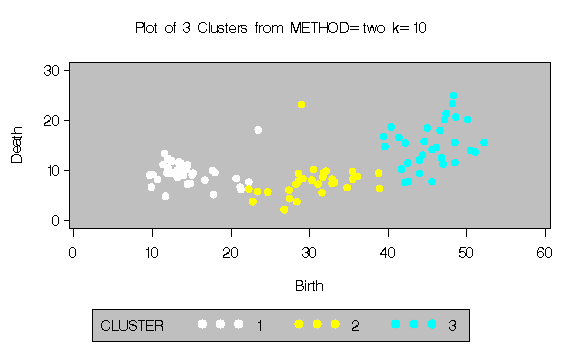
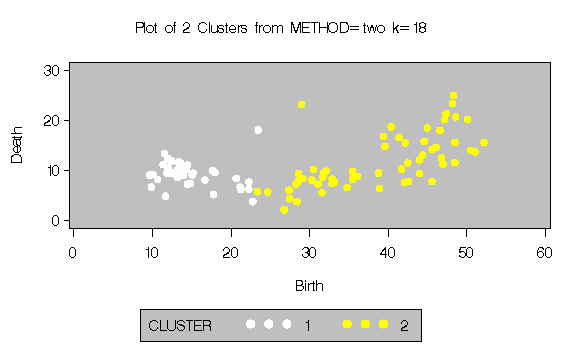
For K=10 (10th-nearest-neighbor density linkage),
the scatter plot for 3 clusters is shown; and for
K=18, the scatter plot for 2 clusters is shown.
The results are shown in Output 23.2.6.
Output 23.2.6: Clusters for Birth and Death Rates: METHOD=TWOSTAGE, K=10
|
| Cluster Analysis of Birth and Death Rates |
| The CLUSTER Procedure |
| Two-Stage Density Linkage Clustering |
| Eigenvalues of the Covariance Matrix |
| |
Eigenvalue |
Difference |
Proportion |
Cumulative |
| 1 |
189.106588 |
173.101020 |
0.9220 |
0.9220 |
| 2 |
16.005568 |
|
0.0780 |
1.0000 |
| Root-Mean-Square Total-Sample Standard Deviation = 10.127 |
| Cluster History |
| NCL |
|
FREQ |
SPRSQ |
RSQ |
ERSQ |
CCC |
PSF |
PST2 |
Normalized
Fusion Density |
Maximum Density
in Each Cluster |
T
i
e |
| Clusters Joined |
Lesser |
Greater |
| 15 |
CL16 |
OB94 |
22 |
0.0015 |
.921 |
.975 |
-11 |
68.4 |
1.4 |
9.2234 |
6.7927 |
15.3069 |
|
| 14 |
CL19 |
OB49 |
28 |
0.0021 |
.919 |
.972 |
-11 |
72.4 |
1.8 |
8.7369 |
5.9334 |
33.4385 |
|
| 13 |
CL15 |
OB52 |
23 |
0.0024 |
.917 |
.969 |
-10 |
76.9 |
2.3 |
8.5847 |
5.9651 |
15.3069 |
|
| 12 |
CL13 |
OB96 |
24 |
0.0018 |
.915 |
.966 |
-9.3 |
83.0 |
1.6 |
7.9252 |
5.4724 |
15.3069 |
|
| 11 |
CL12 |
OB93 |
25 |
0.0025 |
.912 |
.962 |
-8.5 |
89.5 |
2.2 |
7.8913 |
5.4401 |
15.3069 |
|
| 10 |
CL11 |
OB78 |
26 |
0.0031 |
.909 |
.957 |
-7.7 |
96.9 |
2.5 |
7.787 |
5.4082 |
15.3069 |
|
| 9 |
CL10 |
OB76 |
27 |
0.0026 |
.907 |
.951 |
-6.7 |
107 |
2.1 |
7.7133 |
5.4401 |
15.3069 |
|
| 8 |
CL9 |
OB77 |
28 |
0.0023 |
.904 |
.943 |
-5.5 |
120 |
1.7 |
7.4256 |
4.9017 |
15.3069 |
|
| 7 |
CL8 |
OB43 |
29 |
0.0022 |
.902 |
.933 |
-4.1 |
138 |
1.6 |
6.927 |
4.4764 |
15.3069 |
|
| 6 |
CL7 |
OB87 |
30 |
0.0043 |
.898 |
.920 |
-2.7 |
160 |
3.1 |
4.932 |
2.9977 |
15.3069 |
|
| 5 |
CL6 |
OB82 |
31 |
0.0055 |
.892 |
.902 |
-1.1 |
191 |
3.7 |
3.7331 |
2.1560 |
15.3069 |
|
| 4 |
CL22 |
OB61 |
37 |
0.0079 |
.884 |
.875 |
0.93 |
237 |
10.6 |
3.1713 |
1.6308 |
100.0 |
|
| 3 |
CL14 |
OB23 |
29 |
0.0126 |
.872 |
.827 |
2.60 |
320 |
10.4 |
2.0654 |
1.0744 |
33.4385 |
|
| 2 |
CL4 |
CL3 |
66 |
0.2129 |
.659 |
.697 |
-1.3 |
183 |
172 |
12.409 |
33.4385 |
100.0 |
|
| 1 |
CL2 |
CL5 |
97 |
0.6588 |
.000 |
.000 |
0.00 |
. |
183 |
10.071 |
15.3069 |
100.0 |
|
| 3 modal clusters have been formed. |
|
Output 23.2.7: Clusters for Birth and Death Rates: METHOD=TWOSTAGE, K=18
|
| Cluster Analysis of Birth and Death Rates |
| The CLUSTER Procedure |
| Two-Stage Density Linkage Clustering |
| Eigenvalues of the Covariance Matrix |
| |
Eigenvalue |
Difference |
Proportion |
Cumulative |
| 1 |
189.106588 |
173.101020 |
0.9220 |
0.9220 |
| 2 |
16.005568 |
|
0.0780 |
1.0000 |
| Root-Mean-Square Total-Sample Standard Deviation = 10.127 |
| Cluster History |
| NCL |
|
FREQ |
SPRSQ |
RSQ |
ERSQ |
CCC |
PSF |
PST2 |
Normalized
Fusion Density |
Maximum Density
in Each Cluster |
T
i
e |
| Clusters Joined |
Lesser |
Greater |
| 15 |
CL16 |
OB72 |
46 |
0.0107 |
.799 |
.975 |
-21 |
23.3 |
3.0 |
10.118 |
7.7445 |
23.4457 |
|
| 14 |
CL15 |
OB94 |
47 |
0.0098 |
.789 |
.972 |
-21 |
23.9 |
2.7 |
9.676 |
7.1257 |
23.4457 |
|
| 13 |
CL14 |
OB51 |
48 |
0.0037 |
.786 |
.969 |
-20 |
25.6 |
1.0 |
9.409 |
6.8398 |
23.4457 |
T |
| 12 |
CL13 |
OB96 |
49 |
0.0099 |
.776 |
.966 |
-19 |
26.7 |
2.6 |
9.409 |
6.8398 |
23.4457 |
|
| 11 |
CL12 |
OB76 |
50 |
0.0114 |
.764 |
.962 |
-19 |
27.9 |
2.9 |
8.8136 |
6.3138 |
23.4457 |
|
| 10 |
CL11 |
OB77 |
51 |
0.0021 |
.762 |
.957 |
-18 |
31.0 |
0.5 |
8.6593 |
6.0751 |
23.4457 |
|
| 9 |
CL10 |
OB78 |
52 |
0.0103 |
.752 |
.951 |
-17 |
33.3 |
2.5 |
8.6007 |
6.0976 |
23.4457 |
|
| 8 |
CL9 |
OB43 |
53 |
0.0034 |
.748 |
.943 |
-16 |
37.8 |
0.8 |
8.4964 |
5.9160 |
23.4457 |
|
| 7 |
CL8 |
OB93 |
54 |
0.0109 |
.737 |
.933 |
-15 |
42.1 |
2.6 |
8.367 |
5.7913 |
23.4457 |
|
| 6 |
CL7 |
OB88 |
55 |
0.0110 |
.726 |
.920 |
-13 |
48.3 |
2.6 |
7.916 |
5.3679 |
23.4457 |
|
| 5 |
CL6 |
OB87 |
56 |
0.0120 |
.714 |
.902 |
-12 |
57.5 |
2.7 |
6.6917 |
4.3415 |
23.4457 |
|
| 4 |
CL20 |
OB61 |
39 |
0.0077 |
.707 |
.875 |
-9.8 |
74.7 |
8.3 |
6.2578 |
3.2882 |
100.0 |
|
| 3 |
CL5 |
OB82 |
57 |
0.0138 |
.693 |
.827 |
-5.0 |
106 |
3.0 |
5.3605 |
3.2834 |
23.4457 |
|
| 2 |
CL3 |
OB23 |
58 |
0.0117 |
.681 |
.697 |
-.54 |
203 |
2.5 |
3.2687 |
1.7568 |
23.4457 |
|
| 1 |
CL2 |
CL4 |
97 |
0.6812 |
.000 |
.000 |
0.00 |
. |
203 |
13.764 |
23.4457 |
100.0 |
|
| 2 modal clusters have been formed. |
|
In summary, most of the clustering
methods indicate 3 or 8 clusters.
Most methods agree at the 3-cluster level,
but at the other levels, there is considerable
disagreement about the composition of the clusters.
The presence of numerous ties also complicates
the analysis; see Example 23.4.
Copyright © 1999 by SAS Institute Inc., Cary, NC, USA. All rights reserved.