
Chapter Contents

Previous

Next
|
Chapter Contents |
Previous |
Next |
| The LOGISTIC Procedure |
This example plots an ROC curve, estimates a customized odds ratio, produces the traditional goodness-of-fit analysis, displays the generalized R2 measures for the fitted model, and calculates the normal confidence intervals for the regression parameters. The data consist of three variables: n (number of subjects in a sample), disease (number of diseased subjects in the sample), and age (age for the sample). A linear logistic regression model is used to study the effect of age on the probability of contracting the disease.
The SAS code is as follows:
   data Data1;
      input disease n age;
      datalines;
    0 14 25
    0 20 35
    0 19 45
    7 18 55
    6 12 65
   17 17 75
   ;
   proc logistic data=Data1;
      model disease/n=age / scale=none
                            clparm=wald
                            clodds=pl
                            rsquare
                            outroc=roc1;
      units age=10;
   run;
The option SCALE=NONE is specified to produce the deviance and Pearson goodness-of-fit analysis without adjusting for overdispersion. The RSQUARE option is specified to produce generalized R2 measures of the fitted model. The CLPARM=WALD option is specified to produce the Wald confidence intervals for the regression parameters. The UNITS statement is specified to produce customized odds ratio estimates for a change of 10 years in the age variable, and the CLODDS=PL option is specified to produce profile likelihood confidence limits for the odds ratio. The OUTROC= option outputs the data for the ROC curve to the SAS data set, roc1.
Results are shown in Output 39.6.1 and Output 39.6.2.
Output 39.6.1: Deviance and Pearson Goodness-of-Fit Analysis
| ||||||||||||||||||||||||||||||||||||||||||||||||||||||||||||||||||||||||||||||||||||||||||||||||||||||||||||||||||
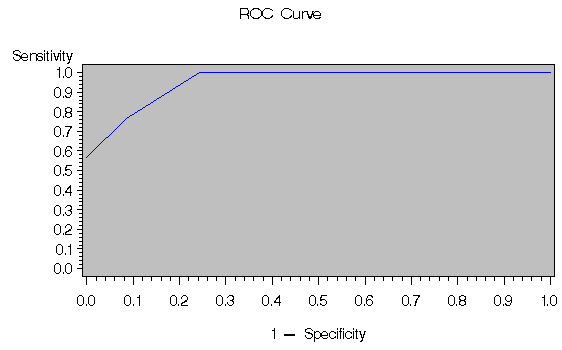
The ROC curve is plotted by the GPLOT procedure, and the plot is shown in Output 39.6.3.
   symbol1 i=join v=none c=blue;
   proc gplot data=roc1;
      title 'ROC Curve';
      plot _sensit_*_1mspec_=1 / vaxis=0 to 1 by .1 cframe=ligr;
   run;
Output 39.6.3: Receiver Operating Characteristic Curve
|
|
Chapter Contents |
Previous |
Next |
 Top |
Copyright © 1999 by SAS Institute Inc., Cary, NC, USA. All rights reserved.