
Chapter Contents

Previous

Next
|
Chapter Contents |
Previous |
Next |
| Introduction to Analysis-of-Variance Procedures |
Analysis of variance tests are constructed by comparing independent mean squares. To test a particular null hypothesis, you compute the ratio of two mean squares that have the same expected value under that hypothesis; if the ratio is much larger than 1, then that constitutes significant evidence against the null. In particular, in an analysis-of-variance model with fixed effects only, the expected value of each mean square has two components: quadratic functions of fixed parameters and random variation. For example, for a fixed effect called A, the expected value of its mean square is
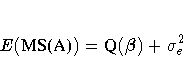
 ) of the
expected mean square is zero. This mean square is then compared to
another mean square, say MS(E), that is independent of the first
and has expected value
) of the
expected mean square is zero. This mean square is then compared to
another mean square, say MS(E), that is independent of the first
and has expected value  . The
ratio of the two mean squares
. The
ratio of the two mean squares
|
Chapter Contents |
Previous |
Next |
 Top |
Copyright © 1999 by SAS Institute Inc., Cary, NC, USA. All rights reserved.