
Chapter Contents

Previous

Next
|
Chapter Contents |
Previous |
Next |
| Introduction to Analysis-of-Variance Procedures |
An analysis-of-variance model can be written as a linear model, which is an equation that predicts the response as a linear function of parameters and design variables. In general,

 are unknown parameters to be estimated, and
xij are design variables.
Design variables for analysis of variance are indicator
variables; that is, they are always either 0 or 1.
are unknown parameters to be estimated, and
xij are design variables.
Design variables for analysis of variance are indicator
variables; that is, they are always either 0 or 1.
The simplest model is to fit a single mean to all observations.
In this case there is only one parameter,  , and one
design variable, x0i, which always has the value of 1:
, and one
design variable, x0i, which always has the value of 1:
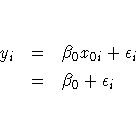 is the mean of the yi.
This simple model underlies all more complex models, and
all larger models are compared to this simple mean model.
In writing the parameterization of a linear model,
is usually referred to as the intercept.
is the mean of the yi.
This simple model underlies all more complex models, and
all larger models are compared to this simple mean model.
In writing the parameterization of a linear model,
is usually referred to as the intercept.
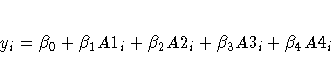
A one-way model is written by introducing an indicator variable for each level of the classification variable. Suppose that a variable A has four levels, with two observations per level. The indicator variables are created as follows:
| Intercept | A1 | A2 | A3 | A4 | ||||||
| 1 | 1 | 0 | 0 | 0 | ||||||
| 1 | 1 | 0 | 0 | 0 | ||||||
| 1 | 0 | 1 | 0 | 0 | ||||||
| 1 | 0 | 1 | 0 | 0 | ||||||
| 1 | 0 | 0 | 1 | 0 | ||||||
| 1 | 0 | 0 | 1 | 0 | ||||||
| 1 | 0 | 0 | 0 | 1 | ||||||
| 1 | 0 | 0 | 0 | 1 |
The linear model for this example is
|
Chapter Contents |
Previous |
Next |
 Top |
Copyright © 1999 by SAS Institute Inc., Cary, NC, USA. All rights reserved.