
Chapter Contents

Previous

Next
|
Chapter Contents |
Previous |
Next |
| Introduction to Categorical Data Analysis Procedures |
Suppose you take a simple random sample of 100 people and ask each person the following question: Of the three colors red, blue, and green, which is your favorite? You then tabulate the results in a frequency table as shown in Table 5.1.
Table 5.1: One-Way Frequency Table| Favorite Color | ||||
| Red | Blue | Green | Total | |
| Frequency | 52 | 31 | 17 | 100 |
| Proportion | 0.52 | 0.31 | 0.17 | 1.00 |
In the population you are sampling, you assume there is an unknown probability that a population member, selected at random, would choose any given color. In order to estimate that probability, you use the sample proportion
Because of the random variation inherent in any
random sample, the frequencies have a probability
distribution representing their relative frequency
of occurrence in a hypothetical series of samples.
For a simple random sample, the distribution of frequencies
for a frequency table with three levels is as follows.
The probability that the first frequency is n1, the second
frequency is n2, and the third is n3 = n-n1-n2
where  is the true probability of
observing the jth response level in the population.
is the true probability of
observing the jth response level in the population.
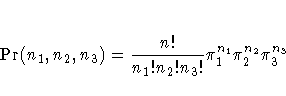
This distribution, called the multinomial distribution, can be generalized to any number of response levels. The special case of two response levels is called the binomial distribution.
Simple random sampling is the type of sampling required by PROC CATMOD when there is one population. PROC CATMOD uses the multinomial distribution to estimate a probability vector and its covariance matrix. If the sample size is sufficiently large, then the probability vector is approximately normally distributed as a result of central limit theory. PROC CATMOD uses this result to compute appropriate test statistics for the specified statistical model.
|
Chapter Contents |
Previous |
Next |
 Top |
Copyright © 1999 by SAS Institute Inc., Cary, NC, USA. All rights reserved.